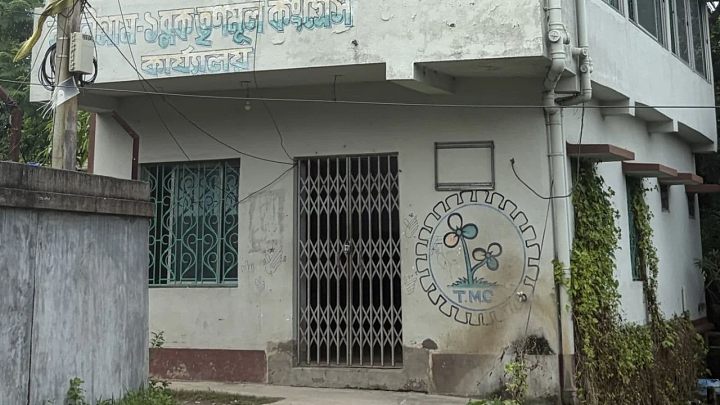
‘Mamata Started From Here, Now It Is Ending Here’: Nandigram’s Empty TMC Office Tells A Political Story
The lane that once served as one of Nandigram’s most important political corridors now lies deserted. For years, the road outside the Trinamool Congress office in Nandigram Block 1 was crowded with party workers, local l
Ni Kamalika Sengupta··47K nabasa
‘Mamata Started From Here, Now It Is Ending Here’: Nandigram’s Empty TMC Office Tells A Political Story
The lane that once served as one of Nandigram’s most important political corridors now lies deserted. For years, the road outside the Trinamool Congress office in Nandigram Block 1 was crowded with party workers, local leaders and vehicles belonging to senior politicians. The office itself, built as a high-end political headquarters with modern amenities, was once a source of pride for the TMC.
Today, the building still stands — but its doors are locked.
A large lock hanging at the entrance has become a striking symbol of the party’s changing fortunes in Bengal. The office itself remains imposing, but the scene around it is markedly different: there are no gatherings of workers, little activity and none of the political buzz that once defined the area.
Locals say the office has remained shut since the results of the Assembly election were declared. According to them, no senior leader has returned to open the party office or revive organisational activity in the area.
The lane, once filled with political movement, is now almost completely deserted.
“People do not want to talk about this party office anymore,” a local resident told News18.
A man sitting in a rickshaw near the locked building offered a blunt assessment.
“This is a cursed place,” he said. “Look at the size of this building, but there is no one here. Whatever they did for so many years, nobody wants to remain with them now.”
The silence around the office is particularly significant because of Nandigram’s place in Bengal’s political history. The constituency was central to the anti-land acquisition movement of 2007, which helped establish Mamata Banerjee and the Trinamool Congress as the principal political force in the state.
It was also the constituency where Mamata Banerjee contested the 2021 Assembly election against her former aide and now CM Suvendu Adhikari. The contest became one of the most closely watched political battles in Bengal.
Nandigram is once again at the centre of political attention, with a by-election scheduled for October 6 after Adhikari retained the Bhabanipur seat, leaving the Nandigram constituency vacant.
The Trinamool Congress, however, is not contesting the Nandigram by-election with its own candidate or symbol. The Election Commission has frozen the party’s symbol, while the candidate proposed by Mamata Banerjee withdrew from the contest after meeting CM Adhikari.
Against this backdrop, the locked TMC office appears to reflect the party’s organisational condition in the constituency.
There was almost no one outside the building when News18 visited. As the team searched for people willing to speak about the party’s decline, an elderly man approached. He introduced himself as Sukumar and said he had been part of the Nandigram movement in 2007.
“I fought in Nandigram in 2007. I was part of the Bhumi Uchhed Pratirodh Committee,” he said. “We supported Didi because she brought change. But later, new leaders began receiving more importance. My wife was a martyr in that movement, but later we were not given importance.”
Sukumar said the party had gradually distanced itself from the people who had stood with Mamata Banerjee during the movement that transformed Bengal’s political landscape.
“Definitely, something went wrong with our party,” he said. “Mamata Banerjee started from here, and now it is ending here.”
He also said that old supporters had been unable to meet the Trinamool Congress chief despite wanting to speak to her.
“We wanted to speak to Didi for just one minute, but we never got the opportunity,” he said.
The absence of party symbols is as noticeable as the absence of party workers. Nandigram, once identified with Mamata Banerjee and the Trinamool Congress, now has no visible photograph of the former chief minister and no TMC logo on the office or in the surrounding area.
The building remains, but the political presence has disappeared.
For a constituency that once became the launchpad for Mamata Banerjee’s rise to power, the locked office offers a stark image of a party that appears to have lost its organisational grip on the ground.
The empty lane, the silent office and the absence of party workers together tell a larger story — of a political movement that began in Nandigram, reached the corridors of power in Kolkata and now appears to be confronting one of its deepest crises in the very place where its journey began.