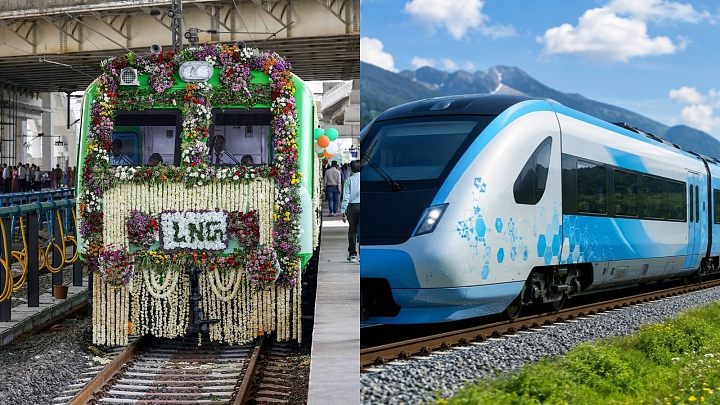
LNG Vs Hydrogen: India's Two New Trains That Could Change Rail Travel
India has added another alternative-fuel experiment to its railway network, just over two months after launching its first hydrogen-powered train. On September 27, Union Home Minister Amit Shah flagged off the country’s
Ni Pragati Ratti··156K nabasa
LNG Vs Hydrogen: India's Two New Trains That Could Change Rail Travel
India has added another alternative-fuel experiment to its railway network, just over two months after launching its first hydrogen-powered train. On September 27, Union Home Minister Amit Shah flagged off the country’s first LNG-powered train from Sabarmati in Gujarat.
At first glance, the two launches may look like parts of the same green-rail push. But technologically, they are quite different. The hydrogen train is designed as a zero-tailpipe-emission fuel-cell train, while the LNG train is a diesel train converted to run on a combination of LNG and diesel. Their intended uses and future expansion plans are also different.
LNG Vs Hydrogen Train: How Are The Two Different?
The hydrogen train does not burn hydrogen in an engine. Instead, hydrogen stored in high-pressure cylinders is fed into a fuel cell, where it reacts electrochemically with oxygen from the air. The resulting electricity powers the train’s traction system, with water vapour as the direct by-product.
India’s first hydrogen train, launched by Prime Minister Narendra Modi on July 17, has two Hydrogen Driving Power Cars and eight passenger coaches. The two power cars together provide 2,400 kW of power. The train has been designed for a maximum speed of 110 kmph, although it currently operates at up to 75 kmph on the Jind-Sonipat section.
The LNG train works in a much more conventional manner. LNG, or liquefied natural gas, is still a hydrocarbon fuel. The Sabarmati project uses two 1,400-HP Driving Power Cars that have been converted to a dual-fuel LNG-diesel system. LNG can replace nearly 40 per cent of diesel consumption in the current configuration. The train therefore continues to use an internal-combustion engine rather than generating electricity through a fuel cell.
LNG can reduce the railway’s diesel consumption and emissions, but it is not a zero-emission technology. Hydrogen fuel cells, by contrast, have no direct carbon emissions at the train’s exhaust.
All About The LNG Train
The first LNG train is an eight-coach, non-AC chair-car train. For its inaugural run, it operated between Sabarmati and Mahesana Junction, a distance of about 62 km. However, railway officials have said that its regular route has not yet been finalised.
The LNG system did not go straight from the workshop to commercial operation. The two converted power cars completed more than 2,000 km of field trials to test performance and reliability.
The railway’s estimates suggest that one converted power car could save about Rs 11.9 lakh a year, while an eight-coach rake could save roughly Rs 23.9 lakh annually. LNG use is also expected to lower carbon dioxide, nitrogen oxide and particulate emissions compared with conventional diesel operation.
Home Minister Amit Shah described the initiative as addressing “environmental concerns” while improving railway operations.
There is also a practical advantage. Because the train retains diesel capability, it does not have to depend entirely on LNG. That makes it less vulnerable to the availability of LNG refuelling infrastructure than a completely LNG-dependent system.
How Is Hydrogen Train Different?
The hydrogen train is a considerably bigger technological departure from conventional diesel traction. It has a dedicated hydrogen ecosystem at Jind, including storage, compression and dispensing infrastructure. The facility can store about 3,000 kg of hydrogen, with hydrogen stored at pressures of up to 500 bar and dispensed at 350 bar. Multiple safety systems monitor leaks, heat, flames and other risks.
The train currently operates on the 89-km Jind-Sonipat section in Haryana. It was initially planned for two round trips a day, but recent reports said that low passenger demand has resulted in it currently making one round trip daily. Railways is considering extending it towards Delhi, potentially up to Azadpur.
The train can carry around 2,600 passengers, and its current full-tank range has been reported at around 250-300 km.
Hydrogen Trains vs LNG Trains: The Future
Indian Railways has a much more clearly articulated expansion programme for hydrogen. Under its “Hydrogen for Heritage” initiative, it has envisaged 35 hydrogen trainsets for heritage and hill routes. The original plan envisaged six-car trainsets and identified eight routes:
Matheran Hill Railway
Darjeeling Himalayan Railway
Kalka-Shimla Railway
Kangra Valley Railway
Bilmora-Waghai
Patalpani-Kalakund
Nilgiri Mountain Railway
Marwar-Goram Ghat Railway
The programme was originally estimated at about Rs 80 crore per train, besides ground infrastructure costs. However, 35 is a planned programme figure, not the number of hydrogen trains currently operating. As of now, India has one operational hydrogen train, and the Railways has said expansion will depend on resources, operational feasibility and other requirements.
For LNG, the roadmap is considerably less defined at present. The September 27 launch is a demonstration and pilot of dual-fuel technology.
The immediate focus is to establish whether the LNG-diesel system delivers the expected fuel savings, reliability and emissions benefits in regular service. The inaugural Sabarmati-Mahesana route itself is not yet the confirmed permanent route.
Therefore, India’s two new alternative-fuel trains represent two different stages of the transition away from diesel. LNG is the bridge technology. It works with existing combustion-engine architecture, can substitute a substantial portion of diesel and potentially lower operating costs and emissions without requiring an entirely new propulsion ecosystem.
Hydrogen is the more fundamental technology shift. The fuel cell produces electricity onboard and eliminates direct carbon emissions, but it requires dedicated hydrogen production, storage and refuelling infrastructure and currently comes with higher costs and significant scaling challenges.