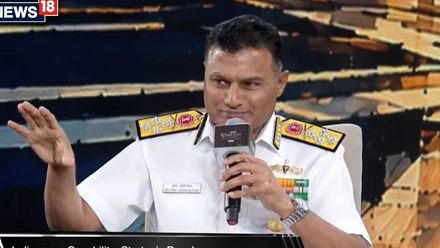
Indian Navy Targets 230-Ship Self-Reliant Fleet By 2045: Admiral Swaminathan At News18 DEFCON 2026
Chief of the Naval Staff Admiral Krishna Swaminathan on Thursday said the Indian Navy is aiming to build a self-reliant force of 230 ships by 2045 to navigate an increasingly contested maritime environment.
Ni Saurabh Verma··63K nabasa
Indian Navy Targets 230-Ship Self-Reliant Fleet By 2045: Admiral Swaminathan At News18 DEFCON 2026
Chief of the Naval Staff Admiral Krishna Swaminathan on Thursday said the Indian Navy is aiming to build a self-reliant force of 230 ships by 2045 to navigate an increasingly contested maritime environment.
Admiral Swaminathan said the Indian Navy and the Central Armed Forces have been pursuing self-reliance for several years, with the Navy having built more than 100 ships domestically.
“The Indian Navy and the Central Armed Forces have been Aatmanirbhar for many years, and our journey to self-reliance has been very, very long. With over 100 ships built in India, the Navy emphasises the need for strategic foresight in capability development,” he said.
#News18DEFCONIndia | The Indian Navy is embracing emerging technologies through innovative initiatives like the naval indigenization organization and special task forces, aiming for a self-reliant force of 230 ships by 2045 to navigate the increasingly contested maritime… pic.twitter.com/tz8p8yWUKW
— News18 (@CNNnews18) September 24, 2026
The Navy chief said the Indian Navy is also embracing emerging technologies through initiatives such as the Naval Innovation and Indigenisation Organisation and special task forces.
“The Indian Navy is embracing emerging technologies through innovative initiatives like the Naval Indigenisation Organisation and special task forces, aiming for a self-reliant force of 230 ships by 2045 to navigate the increasingly contested maritime environment,” he said.
Also Read | ‘Import Dependence Is A Vulnerability’: Defence Secy On India’s Push For Defence Indigenisation At News18 DEFCON 2026
Asked about the Indian Navy’s pace of adding an indigenous warship or submarine roughly every 40 days, Admiral Swaminathan said the achievement was the result of work carried out by generations of naval officers and not something that could be credited to the current generation alone.
He said the Navy has to plan for capability development decades in advance, given the complexity and long build time of warships.
“A warship is a very, very complex platform to build. It is not easy to build. It’s not very easy to design. You define a warship by its role and the purpose that it is meant for. You’ve got to look at the build time. You’ve got to look at future technologies,” he said.
Swaminathan said designing a warship itself involves multiple iterations, making long-term planning essential for capability development.
“Luckily, we have a culture in the Navy where we are always forward-looking. We look at 20, 30 years from now, and we see what capability gaps we may have 20, 30 years from now,” he said.
“So what we see now is the work of not just today, but is the work of many, many, many years,” he added.
Swaminathan also stressed that the pace of commissioning one ship every 40 days does not mean that all the vessels are large warships. “The Navy needs a mix of all kinds of ships. You need big battleships that are weapon-intensive, that go and fight the wars, that take the wars to the enemy shores. You’ve equally need ships like training ships. You need close-coast ships. You need coastal patrol ships. You need coastal security ships. You need survey ships. You need multipurpose ships,” he said.
“It’s a combination of all kinds of ships, big, small, that we have. It is just coincidence that we are in a sweet spot. This is the purple patch we hit,” he added.
The Navy chief said the force needs to maintain this growth momentum, with successive generations continuing to plan and build capabilities that may come into use years after they leave service.
“Left to ourselves, we like to make sure that the growth momentum of the Navy is maintained, and generation after generation of naval officers continue to build capability that may come 10 or 15 or 20 years after they have left,” he said.
#News18DEFCONIndia | Before Atmanirbhar Bharat became a national obsession, the Navy had already cracked it. One warship every 40 days—how did this magic happen?
The warships we construct are not a credit that anyone in my generation can take; they are the result of generations… pic.twitter.com/0EDTRLI0ki
— News18 (@CNNnews18) September 24, 2026
He said India’s expanding national interests and growing global footprint require the Navy to be able to deploy wherever the nation requires it.
“We deploy today like we have never deployed ever before in our history. So our national interests are spread all over the world,” Swaminathan said.
“There is an expectation that the Navy will go where the nation wants it to go. And India’s footprint is all over the world,” he added.
Swaminathan said future generations of naval officers would need to continue planning ahead to ensure that the Navy has the capabilities required to meet the country’s security needs.
“And what we now are enjoying the benefits of are actually the work of generation of people much before me,” he said.