‘India’s Voice Must Remain One’: Amit Shah Stresses Unity Of Indian Languages At Hindi Diwas Event
Union Home Minister and Minister of Cooperation Amit Shah on Monday addressed Hindi Diwas 2026 and the 6th All India Official Language Conference in Mumbai, stressing the importance of India’s linguistic diversity while
Ni Pragya Bahuguna··197K nabasa
‘India’s Voice Must Remain One’: Amit Shah Stresses Unity Of Indian Languages At Hindi Diwas Event
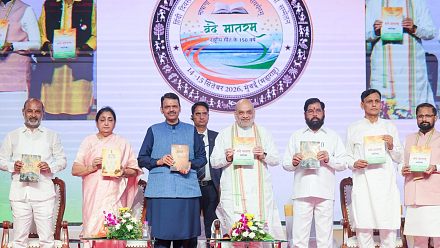
Union Home Minister and Minister of Cooperation Amit Shah on Monday addressed Hindi Diwas 2026 and the 6th All India Official Language Conference in Mumbai, stressing the importance of India’s linguistic diversity while calling for greater interconnectivity among the country’s languages.
Speaking at the event, Shah said Hindi should not be viewed as competing with other Indian languages, but as a language that can help connect them. He also highlighted several initiatives undertaken by the Department of Official Language under the Narendra Modi government, including the expansion of the Hindi Shabd-Sindhu dictionary and the use of artificial intelligence in language-related work.
Amit Shah Says Hindi Can Connect India’s Languages
Shah said India’s languages have interacted with one another for centuries and that the Official Language has developed a connection with languages spoken across the country.
Referring to his own experience as a Gujarati speaker, Shah said he had never faced difficulty working at the national level because he understood and spoke Hindi. He cited Acharya Vinoba Bhave’s use of Hindi to communicate the message of Bhoodan and Gramdan across different parts of the country as an example of the language’s wider reach.
He also appealed against attempts to create disputes between Indian languages, saying, “There may be many dialects, but India’s voice must remain one.”
‘Hindi Shabd-Sindhu’ Expands To 8 Lakh Words
Shah highlighted the growth of the Hindi Shabd-Sindhu dictionary, saying it has expanded from 51,000 words to around 8 lakh words.
According to Shah, more than 50,000 words from local Indian languages have been incorporated into the dictionary to make Hindi more flexible and inclusive. He said words from languages including Tamil, Telugu, Marathi, Gujarati, Bengali and Odia have been added.
Shah expressed confidence that Hindi Shabd-Sindhu would become the world’s largest dictionary by 2029.
Focus On Mother Tongue And Another Indian Language
Shah also stressed the importance of learning in one’s mother tongue. He said children develop their ability to think, analyse and make decisions more effectively when they are able to do so in their mother tongue.
He said learning another Indian language alongside one’s mother tongue would strengthen the idea of Ek Bharat, Shreshtha Bharat and help children connect more closely with India’s diverse linguistic and cultural identity.
“Children can truly understand India only through their mother tongue,” Shah said, while urging people to focus on promoting Indian languages beyond political differences.
AI And Technology Being Used For Indian Languages
The Home Minister also highlighted the government’s efforts to use technology for language development. He said the AI-based Kanthasth 2.0 platform, which has a database of more than five crore sentences, has been opened to foreign users.
He also mentioned initiatives including LILA Rajbhasha, LILA Pravah and Bharti – Bahubhashi Anuvad Sarathi, aimed at supporting the learning and translation of Indian languages.
Shah said more than five lakh Government of India employees have been trained in the Official Language, while Hindi is also being taught at universities in several countries.
Hindi, Indian Languages To Expand In Governance And Science
Shah said the government aims to make Indian languages more prominent in governance, science and literature while strengthening links between them.
He said examinations such as JEE, NEET and undergraduate entrance tests are now conducted in 13 languages, describing this as part of efforts to expand the use of Indian languages.
He also said the Department of Official Language is working to build a larger collective linguistic resource by connecting India’s different languages.
Shah Highlights Savarkar’s Contribution To Hindi
Shah said the Department of Official Language has incorporated words coined or revised by Veer Savarkar into Hindi Shabd-Sindhu.
He described Savarkar as a linguist who contributed words that were subsequently accepted in Marathi, Hindi and other Indian languages.
Four Official Language Committee Reports Submitted Since 2019
Shah said that, under the Modi government, four volumes of the Official Language Committee’s reports have been submitted to the President since 2019, while the fifth volume is ready.
He also recalled the decision taken in 2019 to hold the All India Official Language Conference outside Delhi on a rotational basis. The Mumbai event marks the sixth edition of the conference.
Vande Mataram Publications Released
During the event, Shah presented the Rajbhasha Kirti and Rajbhasha Gaurav Awards and congratulated the recipients.
Special commemorative editions of Rajbhasha Bharati were also released, including publications centred on Shiv Anadi Hain, Anant Hain, Bharatiya Gyan Tantra: Srot Aur Swaroop, Andheron Se Ujalon Tak and Vande Mataram. The publication 150 Chapters of Vande Mataram was also released.
Shah described Vande Mataram as an important part of India’s freedom movement and cultural nationalism, and highlighted Prime Minister Narendra Modi’s initiative to have the song sung in its complete form at official functions.
Maharashtra’s Multilingual Heritage Highlighted
Speaking in Mumbai, Shah also highlighted Maharashtra’s multilingual character and its cultural and linguistic traditions.
He recalled the contribution of Chhatrapati Shivaji Maharaj, saying Marathi was given prominence in administration during his era. He also noted the contributions of Maharashtra’s Bhakti movement to Indian cultural traditions.
Shah said Maharashtra represents India’s multilingual character, with languages including Marathi, Konkani, Gujarati, Sindhi, Hindi, Kannada and Warli receiving recognition and respect.
Concluding his remarks, Shah said India’s languages may have different “notes”, but the country’s cultural and patriotic song remains one.