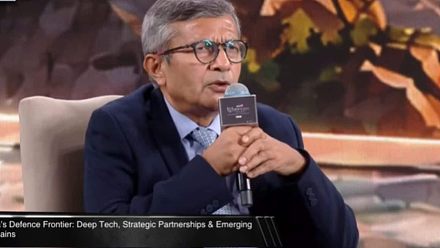
‘Import Dependence Is A Vulnerability’: Defence Secy On India’s Push For Defence Indigenisation At News18 DEFCON 2026
Defence Secretary Rajesh Kumar Singh on Thursday said dependence on imports for defence equipment is a vulnerability, while calling for the development of a stronger domestic defence ecosystem.
Ni Saurabh Verma··170K nabasa
‘Import Dependence Is A Vulnerability’: Defence Secy On India’s Push For Defence Indigenisation At News18 DEFCON 2026
Defence Secretary Rajesh Kumar Singh on Thursday said dependence on imports for defence equipment is a vulnerability, while calling for the development of a stronger domestic defence ecosystem.
Singh said dependence on foreign supply chains can create vulnerabilities, particularly when a partner country is unpredictable or disruptions affect critical supplies.
“It’s a vulnerability, I would say, in the sense that import dependence creates vulnerability. It may not be so much of a vulnerability if the supply chain partner is with your ally, or with a friendly foreign country,” Singh said, while speaking at News18’s DEFCON 2026.
“It could be a problem if that ally is not predictable, or if he creates conditions or problems in the supply chain that lead to sometimes only delays, but in other cases even more drastic kinds of dependencies and vulnerabilities,” he added.
Also Read | ‘One Ukraine Firm Makes 100 Missiles A Month, India Can’t Make Just 200-300 A Year’: Defence Secy At News18 DEFCON 2026
Singh said India, therefore, needs to develop the entire defence ecosystem within the country and establish a cycle of mutual interdependence with friendly foreign partners.
“That’s why you have to develop that entire ecosystem within the country and develop sort of a cycle of mutual interdependence, where you are a supply chain partner for them and vice versa, so that our ability to at least cooperate with our friendly foreign countries is increased,” he said.
‘Emergency Procurements After Operation Sindoor’
Singh said India undertook fairly extensive emergency procurements following Operation Sindoor, particularly in areas where additional capability was considered necessary.
“Certainly, the learnings not only from Operation Sindoor, but from the geopolitical conflicts around the world are to be absorbed and taken into account when it comes to your shopping list, so to speak, to put it in a simplistic way,” he said.
“Right after Operation Sindoor, we did do a round of emergency procurements, fairly extensive, focusing on areas like drones and counter-drone systems, various types of tactical radars, electronic warfare equipment. Those were obviously areas where we felt that some strengthening was required,” Singh added.
‘Comprehensive National Air Defence Network’
Singh said India would work towards developing a comprehensive national air defence and offence network, which would provide a protective shield over critical infrastructure and key population centres.
“In the future, the Prime Minister has already mentioned that we will be working on a comprehensive national air defence and offence network, which will involve providing a protective shield over the whole of the country’s infrastructure and key settlements, key concentrations of population,” he said.
He said an initial report prepared by a committee chaired by the DRDO chairman has already been submitted, following which gaps would be identified, particularly in areas such as air defence.
“The initial report of that, which was, the committee was chaired by the Chairman DRDO, that report has already come, and again there will be gaps identified, particularly in areas like air defence and in some of the other areas that I mentioned just now, which we will work on in the future,” Singh said.
‘Future Procurement To Broadly Follow 10-Year Capability Plan’
Singh also said India’s future defence procurement would broadly align with the Integrated Capability Development Plan (ICDP) prepared by the three services for a 10-year period.
“The Integrated Capability Development Plan of the three services, held by Headquarters IDS for a 10-year period, has just reached us, and in future our procurement will sort of broadly conform to this 10-year ICDP, which has just been prepared by the services,” he said.