The political storm over the Election Commission’s Special Intensive Revision (SIR) of electoral rolls has intensified, with fresh questions being raised over the process of adding and deleting voters, the functioning of
The political storm over the Election Commission’s Special Intensive Revision (SIR) of electoral rolls has intensified, with fresh questions being raised over the process of adding and deleting voters, the functioning of the poll panel’s digital systems and the handling of objections by election officials.
The latest flashpoint is Goa, where, according to a report in The Indian Express, the state Chief Electoral Officer wrote to the Election Commission eight times in seven days seeking a mechanism to restore the names of 97 voters who had been found eligible for inclusion in the electoral roll. The names, however, did not appear in the final roll published in February.
Read More: CEC, ECs And The Power To Decide: What Are The Rules When The Election Commissioners Cannot Agree?
The issue gained wider political significance following an investigative report by The Indian Express, which also reported that Election Commissioners Sukhbir Singh Sandhu and Vivek Joshi had recorded objections on several occasions over matters linked to electoral rolls and the implementation of SIR.
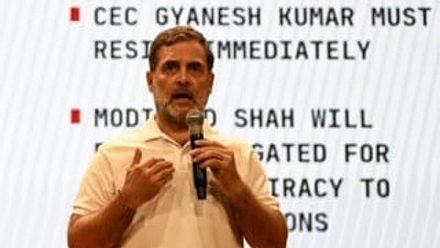
The findings have given Congress leader Rahul Gandhi fresh ammunition in his sustained attack on the Election Commission. Gandhi has accused the poll body of enabling what he calls “vote chori”, demanded the resignation of Chief Election Commissioner Gyanesh Kumar and argued that manipulation of votes could ultimately undermine India’s constitutional institutions.
The Election Commission has rejected such allegations, maintaining that its decisions on SIR were unanimous and legally sound. The BJP has also hit back at Gandhi, accusing the Congress of attempting to discredit the electoral process.
What Fuelled The Latest Political Storm?
The latest escalation followed the Indian Express report published on September 23 that examined internal records of the Election Commission. The report said Election Commissioners Sukhbir Singh Sandhu and Vivek Joshi had recorded formal objections on at least 14 occasions over a 10-month period on matters relating to electoral rolls and the implementation of SIR.
The issues reportedly included the addition and deletion of voters, Form 6 applications, appeals against electoral-roll decisions and the functioning of ECINet, the Election Commission’s centralised digital platform.
The report also highlighted concerns over how electoral officials could implement corrective decisions when the software system did not always provide a mechanism to reverse an earlier action.
It was this report that provided a fresh trigger for Rahul Gandhi’s latest offensive against the Election Commission.
Goa’s Missing Voters: Here’s What Happened
The Goa episode has emerged as one of the most concrete examples in the controversy. According to the report, some voters in Goa were flagged during the electoral-roll revision process because of what officials termed “logical discrepancies”.
The affected voters were given an opportunity to submit documents and raise objections. After the cases were examined, 97 electors were found eligible for inclusion in the electoral roll.
However, officials encountered a problem while trying to put that decision into effect. The ECINet system did not have a functioning mechanism to “roll back” the earlier action and restore the names of the voters who had subsequently been found eligible.
The Goa Chief Electoral Officer’s office consequently wrote to the Election Commission eight times between February 11 and February 17 seeking a solution.
One communication reportedly said the “rollback option is urgently required”, while another sought intervention to ensure that the 97 electors could be included in the final electoral roll.
Yet when the final roll was published on February 21, the 97 names were not included, as per the report and claims by the Congress party.
Goa CEO Says Many Names Added
The Goa CEO’s office has since clarified that the 97 cases were separately processed through house-to-house verification by Booth Level Officers for completion of Form 6.
The office said “many have since been enrolled”, while the remaining cases were being processed. It also reiterated, “No eligible elector will be left behind.”
That sequence has nevertheless become politically important because of the larger controversy surrounding SIR.
‘Vote Chori’ An Attack On Constitution: Rahul Gandhi
Gandhi has been using the phrase “vote chori” for months to describe what he alleges are irregularities in electoral rolls and the wider election process.
Reacting to the the latest reports, Gandhi said, “Vote chori is a crime against the Indian people and a direct attack on our Constitution.” He alleged that the BJP, RSS and Election Commission had committed “an act of treason”, adding, “Justice will be served.”
The Congress leader has argued that the issue is not limited to individual voter names.
Gandhi sharpened that argument at his September 24 press conference, where he directly targeted Chief Election Commissioner Gyanesh Kumar. “From vote chori comes kanoon chori, and from that comes sanstha chori,” Gandhi said.
He demanded Kumar’s resignation and questioned how the Election Commission could function credibly when other Election Commissioners had raised objections to aspects of the electoral-roll process. “Two Election Commissioners have raised questions against Gyanesh Kumar. I have done the same,” Gandhi said.
He also called upon the CEC to “turn approver”, asking him to explain what had happened within the poll panel.
Gandhi simultaneously questioned the BJP’s repeated electoral victories, arguing that such sustained success was inconsistent with the anti-incumbency traditionally seen in Indian politics. He cited former Prime Minister Indira Gandhi’s experience following the 1971 election and Bangladesh war.
Cockroach Janta Party Steps In Too
The controversy has also drawn a sharp response from the Cockroach Janta Party (CJP), which on Thursday demanded the resignation of Chief Election Commissioner Gyanesh Kumar within 48 hours and threatened a nationwide agitation if he does not step down. CJP national convenor Abhijeet Dipke said, “If Gyanesh Kumar does not resign within 48 hours, we will start a nationwide protest before coming for a protest in Delhi,” adding that “Jantar Mantar 2.0 will definitely happen” if the demand is not met.
The group also announced an “Election Commission Thik Karo” campaign and sought an independent inquiry into decisions taken during the SIR exercise, a halt to SIR-related exclusions and the securing of the January 2025 electoral rolls pending verification.
What The Election Commission Says
The Election Commission has rejected the interpretation that the reported internal objections indicate a crisis or division within the institution.
The poll panel’s position is that internal notes, objections and scrutiny of legal and technical questions are part of institutional decision-making. It has also maintained that decisions concerning SIR were taken unanimously.
The ECI has defended the SIR exercise as a legally backed process intended to verify electoral rolls and ensure that eligible voters are included while ineligible or duplicate entries are removed.
BJP Rejects Gandhi’s Charge
The BJP hit back at Gandhi by defending the Election Commission’s SIR process and questioning the basis of the Indian Express report. BJP spokesperson Sudhanshu Trivedi said the report did not carry “even an off-record response from the Election Commissioners” and asked, “Does the news report have any quote from the Election Commission? Yes or no?”
He also said there was “not a single report stating that decisions were not unanimous”, arguing that the three-member Commission takes decisions by majority. Defending the legal basis of SIR, Trivedi cited Section 21(3) of the Representation of the People Act, 1950, and said the Supreme Court had upheld the ECI’s powers in relation to the exercise.
On Gandhi’s argument about the absence of anti-incumbency against the BJP, Trivedi countered that anti-incumbency had instead been “very consistent and strong against the Congress”, particularly after Sonia Gandhi and Rahul Gandhi entered politics.
CEC Appointment Case In Supreme Court
The appointment of the Chief Election Commissioner is itself under challenge before the Supreme Court. On September 23, a two-judge bench of Justices Dipankar Datta and Satish Chandra Sharma delivered a split verdict on whether petitions challenging the 2023 law governing the appointment of the CEC and Election Commissioners should be heard by a larger Constitution Bench. The law replaced the Chief Justice of India with a Union Cabinet minister nominated by the Prime Minister on the three-member selection panel, which now comprises the Prime Minister, the Leader of Opposition and the nominated Union minister.
Justice Datta held that a larger-bench reference was not necessary, while Justice Sharma held that the challenge raised a substantial constitutional question requiring a five-judge bench. Because of the split, the papers have been placed before Chief Justice of India Surya Kant to consider constituting a Constitution Bench. The Supreme Court has not yet ruled on the constitutional validity of the 2023 law, that substantive question remains open.