'Global Trend Of India Becoming A Superpower Can't Be Changed': Russian Envoy Alipov At News18 DEFCON Event
Russian Ambassador to India Denis Alipov said on Thursday that the growing global influence of India and China was part of a trend that could not be reversed, while highlighting the long-standing India-Russia relationshi
Ni Vani Mehrotra··155K nabasa
'Global Trend Of India Becoming A Superpower Can't Be Changed': Russian Envoy Alipov At News18 DEFCON Event
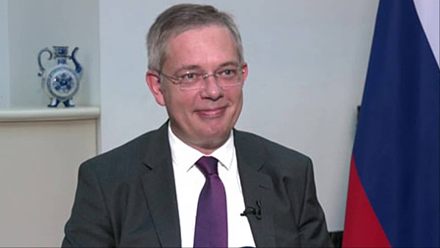
Russian Ambassador to India Denis Alipov said on Thursday that the growing global influence of India and China was part of a trend that could not be reversed, while highlighting the long-standing India-Russia relationship and calling for greater diversification in trade and financial transactions.
Speaking at News18 DEFCON 2026, Alipov said, “The global trend of India becoming a superpower and China acquiring more influence cannot be changed,” according to CNN-News18.
Alipov was speaking at the inaugural edition of News18 DEFCON, organised by News18 in association with The Chanakya Dialogues.
The summit brings together policymakers, military leaders, diplomats, defence manufacturers, technology experts and strategic affairs specialists to discuss India’s defence manufacturing ambitions, strategic capabilities and national security.
The summit is being held under the theme ‘India as the World’s Defence Manufacturing Partner: From Self-Reliance to Global Leadership’.
Its discussions are focused on India’s Atmanirbhar Bharat ambitions in defence manufacturing, expanding aerospace capabilities, strategic partnerships, cyber security and unconventional warfare.
Alipov On Dollar Dependence, BRICS Alternatives
Alipov also said the growth of India and BRICS countries could not remain entirely dependent on the US dollar, arguing that alternative mechanisms were needed for trade and financial cooperation.
“The growth of India and BRICS countries cannot be totally dependent on the US dollar. We need to have alternatives,” the Russian envoy said.
He clarified that discussions within BRICS were not necessarily aimed at replacing the dollar but at creating alternatives for transactions, trade, cooperation and finance.
“We discussed within BRICS the alternatives not to substitute the dollar but for transactions, trade, cooperation and finance,” Alipov said.
He added that India and Russia already have bilateral mechanisms using national currencies and claimed that almost 96 per cent of bilateral transactions between the two countries are conducted using national currencies.
“Bilaterally, we utilise national currencies for almost 96 per cent of our transactions,” he said.
‘One More, One Less’ Sanction Does Not Change Russia’s Objective
Responding to the Lindsey O Graham Sanctioning Russia and Iran Act of 2026, Alipov said additional sanctions would not alter Russia’s objectives.
“Russia has been under 30,000+ sanctions, so one more, one less doesn’t make sense, and the US knows that. These sanctions will not in any way change our objective, and the US knows that,” he said.
The Russian envoy said, however, that such pressure would have implications for India and predicted that further sanctions and new measures would continue.
“For India it makes a difference. I’m sure that this kind of pressure and new Acts/sanctions will continue,” Alipov said.
Russia Wants More Indian Goods
Alipov also said Moscow wanted to see greater diversification in Indian exports to Russia, particularly as the two countries work to address what he described as a significant trade imbalance.
“We are looking at increasing exports of mangoes, textiles, industrial equipment, various kinds of goods from India,” he said.
“We’ve to increase India exports to Russia since we have huge imbalance of trade, and we are addressing this. We’re putting more diversified India exports in our economic dialogue now,” the ambassador added.
Alipov described India-Russia ties as a sustained relationship spanning almost eight decades and covering several sectors.
“We have had a very diverse and very much sustained relationship between us for almost 80 years,” he said, listing defence, trade, industrial cooperation, industrial projects, cultural ties, educational exchanges, migration and labour among the areas of engagement.
“We are very optimistic about our future. We have a comprehensive economic partnership in place till 2030. Russia remains a major defence partner of India,” Alipov said.