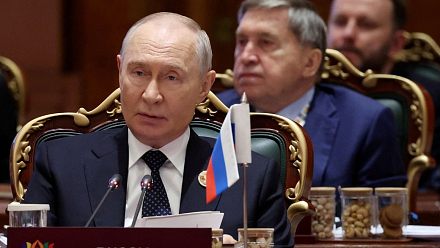
'Dividing World Between Beautiful Garden, Savage Jungle': Putin Slams West's 'Colonial Mindset' At BRICS
Russian President Vladimir Putin used the BRICS summit in New Delhi on Saturday to launch a sharp attack on what he described as the “colonial mindset” of Western powers, accusing them of trying to prevent the emergence
Ni News Desk··139K nabasa
'Dividing World Between Beautiful Garden, Savage Jungle': Putin Slams West's 'Colonial Mindset' At BRICS
Russian President Vladimir Putin used the BRICS summit in New Delhi on Saturday to launch a sharp attack on what he described as the “colonial mindset” of Western powers, accusing them of trying to prevent the emergence of a more multipolar world.
“Those used to the colonial mindset are resisting the emergence of a multipolar world,” Putin said at the summit, arguing that some countries were unwilling to accept the rise of new centres of global influence.
He also criticised what he described as attempts to divide the world into a “beautiful garden” and a “savage jungle”.
ALSO READ | After PM Modi’s Call, Putin Backs India’s UNSC Bid: ‘Unipolar World Order Fading Into History’
According to Putin, emerging competitors are being targeted through “tariff wars, illegitimate sanctions” and “blackmail”. His remarks come as BRICS seeks to position itself as a stronger voice for the Global South and push for reforms to international institutions that its members say no longer reflect the balance of global power.
The grouping now represents more than 40 per cent of the world’s population and around a quarter of the global economy, giving its calls for a more multipolar international order considerably greater weight than when BRICS was first formed.
Addressing BRICS leaders at the summit in New Delhi, Putin had also said the unipolar world order that catered to a select few nations is “fading into history”.
Ukraine War, NATO In The Background
Putin’s comments also come against the backdrop of Russia’s ongoing war in Ukraine and its increasingly strained relationship with the US and Europe.
Ahead of the BRICS summit, Putin had warned that any deployment of Western troops to Ukraine would amount to direct war between Russia and the West. He has also repeatedly blamed NATO expansion and Western pressure on Moscow for the conflict, while rejecting the Western argument that Russia poses a wider threat to Europe.
“I think that everything happening in Europe right now is basically the result of system errors by the so-called West,” Putin said, referring to what he called Western globalists in politics, security and economics. “It is the Western globalist elites that are to blame for this, though they keep shifting the blame onto us all the time,” he added.
The remarks have particular significance as European countries continue to debate security guarantees for Ukraine and what role European forces could play in any future peace arrangement.
For Moscow, the Ukraine conflict has become part of a much larger confrontation with the US and its allies over the shape of the international system. Western sanctions on Russia, restrictions on Russian trade and finance, and efforts to isolate Moscow economically have simultaneously strengthened Russia’s push for closer ties with non-Western powers, particularly China, India and other BRICS members.
US, Tariffs And The BRICS Message
Putin’s criticism of tariff wars and sanctions also comes at a time when Washington’s relationship with BRICS has become increasingly contentious. The US has opposed moves by the grouping towards de-dollarisation and has warned countries against creating alternatives to the dollar-led financial system.
For Russia and China, BRICS offers a platform to challenge what they see as Western dominance in global finance, trade and international decision-making. But India has consistently sought to ensure that the grouping does not become an explicitly anti-Western bloc.
That balancing act is particularly important at the Delhi summit, where India is simultaneously deepening strategic ties with the US while maintaining long-standing relations with Russia and engaging China.
Prime Minister Narendra Modi has stressed that BRICS is meant to amplify the voice of emerging and developing economies rather than work as an alliance against any particular country. At the same time, India has backed reforms of institutions such as the UN Security Council to give greater representation to emerging powers.
‘Multipolar’ World At The Heart Of BRICS
Putin’s remarks underline one of the biggest debates surrounding BRICS: whether the grouping is primarily an economic platform for developing countries or an emerging counterweight to the US-led global order.
Russia and China have increasingly presented BRICS as part of a transition towards a multipolar world, while India has pushed for a more inclusive and practical grouping that can work with both the West and the Global South.
The challenge for New Delhi is to keep those competing visions together.
The fact that BRICS managed to agree on a joint declaration despite deep differences among members over the Iran conflict and other geopolitical issues was itself seen as a test of the grouping’s ability to maintain unity. The declaration called for restraint and diplomacy over the Middle East conflict while avoiding directly naming individual countries.