ChatGPT 80s Trend: As Netas Go Retro, Is Nostalgia The New Gen Z Outreach?
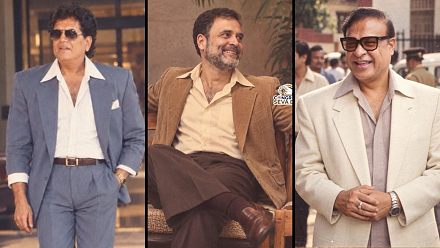
Piyush Goyal went back to the 1980s. So did Kiren Rijiju. Shashi Tharoor joined in too, though rather than create an AI version of himself, he pulled out an actual photograph from the decade. Other political figures, inc
Ni Apoorva Misra··173K nabasa
ChatGPT 80s Trend: As Netas Go Retro, Is Nostalgia The New Gen Z Outreach?
Piyush Goyal went back to the 1980s. So did Kiren Rijiju. Shashi Tharoor joined in too, though rather than create an AI version of himself, he pulled out an actual photograph from the decade. Other political figures, including Rahul Gandhi and Himanta Biswa Sarma, have also featured in the latest retro-photo wave sweeping social media.
On the surface, it is just another internet trend: upload a photograph, ask AI to give it an unmistakable 1980s makeover and post the result. But when politicians start joining a trend whose currency is not policy, ideology or political messaging but “vibe”, it raises a larger question—are India’s politicians learning to communicate with a generation that consumes politics as part of internet culture?
The answer is not necessarily that an AI-generated photograph will make a politician more popular with Gen Z. But politicians increasingly have to compete for attention in spaces where traditional political communication such as speeches, press conferences, carefully produced campaign videos do not automatically work.
ALSO READ | What Is Instagram’s Viral ChatGPT ’80s Photo Trend? Here’s How To Create Yours
In that environment, sometimes the first objective is simply to be part of the conversation.
Why The 80s, And Why Now?
The current trend uses AI to turn contemporary photographs into retro 1980s portraits, often complete with period fashion, hairstyles, cars, film-like grain and old-school studio aesthetics. The trend has spread rapidly on Instagram and other social platforms, with Indian politicians now joining ordinary users.
There is something particularly interesting about Gen Z’s relationship with this period.
Most Gen Z users are too young to remember the 1980s. Yet that has not stopped the decade from becoming a recurring cultural reference point in fashion, music, films, gaming and social-media aesthetics.
This is where the idea of “anemoia”—nostalgia for a time one never personally experienced—becomes useful.
The phenomenon has been increasingly discussed in relation to Gen Z’s attraction to retro culture. The Financial Times recently described young people’s renewed interest in older technologies and analogue aesthetics as a response to a digital world that can feel overly polished, transient and artificial.
That does not mean every Gen Z user wants to live in the 1980s. It means the past can become a cultural aesthetic even for people who never experienced it.
And that gives politicians an unusual opportunity. They don’t have to convince young users to care about a policy. They can first enter a conversation they already care about.
The Power Of Nostalgia
There is substantial psychological research behind the appeal of nostalgia.
Researchers Constantine Sedikides, Tim Wildschut and colleagues have spent years studying nostalgia, not simply as a longing for the past but as a psychological resource.
A 2022 paper by Hepper, Wildschut and Sedikides, published in Current Directions in Psychological Science, describes nostalgia as a resource that can support psychological wellbeing and social connectedness. Earlier research by Abeyta, Routledge and Juhl similarly found nostalgia could serve relationship-related goals and help people feel connected.
A 2022 study by Zhou, Sedikides, Mo, Li, Hong and Wildschut examined nostalgia during the Covid-19 pandemic and found evidence that nostalgia could help counter loneliness by increasing happiness.
The relevance for political communication is not that politicians can manufacture these psychological effects simply by wearing an 80s jacket. It is that nostalgia is inherently social. It gives people something to recognise, remix and share.
That makes it particularly well suited to social platforms, where a successful post often needs to be more than informational. It needs to invite participation.
Where Politics Meets Attention Economy
A political speech asks the audience to listen while a viral trend asks the audience to participate.
A 2026 study by K Akash and KS Mochish, published in Political Studies Review, examines how Instagram Reels are changing political communication in India. The researchers argue that political communication is increasingly shaped by the platform’s attention-driven logic, with parties adopting visual styles and formats associated with influencer culture. Their analysis of highly viewed political Reels found that political communication increasingly mirrors platformisation and influencer culture.
In other words, politicians are not simply putting politics on Instagram; they are adapting political communication to the grammar of Instagram. That grammar includes humour, personality, short-form video, trends, music, memes, visual references and increasingly, AI.
The 80s trend fits neatly into that ecosystem because it requires almost no political explanation. A politician can participate without asking the audience to first understand a policy position.
When The Politician Becomes The Content
For decades, political publicity was largely about the politician’s message: What does the leader say? What does the party promise? What does the campaign stand for?
Social media has added another question: What does the politician look like when there is no obvious political message?
That is why seemingly trivial posts matter. A minister talking about a policy is performing a political role. A minister joining a meme or AI trend is performing something closer to a social-media personality. This also shows that political communication increasingly happens through networks that do not look overtly political.
The India Example
The youth vote is becoming an increasingly important political constituency, while the way young Indians encounter political information is changing.
Prime Minister Narendra Modi and the BJP have been increasing their focus on Instagram and other youth-oriented digital platforms following Gen Z-led protests. News18 had earlier reported how the party leaders had been asked to make efforts to show the political content as less polished and more casual.
However, the biggest risk for politicians jumping on internet trends is that participation can easily look manufactured.
Gen Z has grown up surrounded by branded content, influencer marketing and algorithmically optimised posts. It is therefore not particularly difficult for younger users to recognise when something feels like a campaign team trying to manufacture relatability.
A politician can joke about their hairstyle, fashion or imagined retro persona without making a serious political claim. But the same strategy can fail if every trend becomes an obvious attempt to court young voters.
Social Media Translates To Votes?
This is where the hype around political social media needs to be restrained.
There is evidence that social media can change political communication and lower the cost of reaching voters. But that does not mean a viral post automatically translates into votes.
A voter may first encounter a politician through a meme, then see a Reel about their personal life, then encounter a policy video, then hear them discussed by an influencer, and only later form a political opinion. The viral post may therefore be less like a campaign speech and more like an introduction.
And that may be the real value of the 80s trend.
From Rallies To Reels To “Vibes”
Political outreach has travelled a long way. There were rallies and newspaper advertisements. Then came television. Then websites and blogs. Then Twitter. Then Facebook and Instagram. Now politicians increasingly have to understand memes, creators, Reels, trends and AI-generated visual culture.
The University of Michigan’s Joyojeet Pal, who studies Indian politicians’ use of YouTube and Instagram, has described a shift away from traditional news intermediaries towards creator-driven spaces. His research has examined how politicians use seemingly casual, entertainment-oriented content, from eating street food to interacting with social-media personalities, to project a more relatable image.
That is the larger story behind a politician posting an 80s photograph.
The photograph itself is almost irrelevant. What matters is the willingness to step outside the formal political script and enter a cultural conversation already happening online.