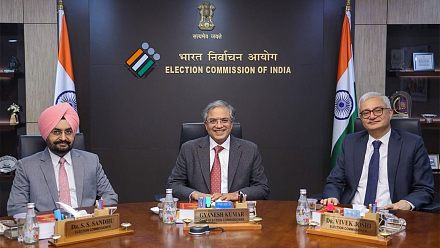
CEC, ECs And The Power To Decide: What Are The Rules When The Election Commissioners Cannot Agree?
The Election Commission of India is a three-member constitutional body—and the law does not make the Chief Election Commissioner the sole decision-maker. When its members disagree, the statute provides a clear route: the
Ni Pathikrit Sen Gupta··55K nabasa
CEC, ECs And The Power To Decide: What Are The Rules When The Election Commissioners Cannot Agree?
The Election Commission of India is a three-member constitutional body—and the law does not make the Chief Election Commissioner the sole decision-maker. When its members disagree, the statute provides a clear route: the majority view prevails.
That provision has come sharply into focus after an Indian Express investigation reported that Election Commissioners Sukhbir Singh Sandhu and Vivek Joshi recorded at least 14 objections over 10 months to decisions taken during the Special Intensive Revision (SIR) of electoral rolls.
The report has triggered fresh questions about how India’s top poll body is supposed to function when its members are not on the same page.
The answer lies in a combination of Article 324 of the Constitution and the Chief Election Commissioner and Other Election Commissioners Act, 2023.
Is the CEC more powerful than the other Election Commissioners?
Not when it comes to voting on decisions of the Commission.
Article 324 vests the superintendence, direction and control of elections in the Election Commission. It provides for a Chief Election Commissioner and such number of other Election Commissioners as the President may fix.
The ECI has functioned as a three-member body since October 1993, with one CEC and two ECs.
The important point is that all three have an equal say in the Commission’s decision-making. The CEC is the head of the institution, but the law does not give the CEC a casting vote or unilateral authority to overrule the other two Commissioners.
The CEC does, however, have an important institutional role, including coordinating the Commission’s functioning and allocating responsibilities within the framework prescribed by law.
So what happens when Commissioners disagree?
This is where Section 18 of the 2023 Act becomes crucial.
It says that the Commission may, by unanimous decision, regulate the procedure for conducting its business and allocate work among the CEC and the other Commissioners.
The law also says that the Commission’s business should, as far as possible, be conducted unanimously.
But unanimity is not an absolute legal requirement.
If the CEC and ECs differ on a matter, the majority opinion decides it.
In a three-member Commission, that means two Commissioners can constitute the majority.
The Supreme Court has previously recognised that Parliament can provide for majority decision-making within a multi-member Election Commission.
Does an objection mean the final decision is invalid?
Not necessarily.
A Commissioner can raise an objection, record a dissent or disagree during the decision-making process. That does not automatically prevent the Commission from taking a final decision.
The critical question is whether the matter was ultimately decided in accordance with the statutory procedure.
That distinction matters in the present SIR controversy.
The Indian Express report describes repeated written objections by Sandhu and Joshi concerning issues including voter registration, electoral-roll changes and access to voter databases. The reported objections, therefore, raise questions about how decisions were processed and recorded, rather than establishing by themselves that every disputed decision was legally invalid.
The ECI has maintained that its decisions, including those relating to SIR, were taken by the Commission.
What counts as the Commission’s decision?
This is the key institutional question.
The Commission conducts business through meetings and circulation of papers, and can delegate certain executive functions to its officers. But a communication issued in the name of the ECI is not automatically equivalent to a fresh decision of the three-member Commission.
The latest controversy has brought precisely this distinction into focus, with the two ECs reportedly questioning whether certain communications and administrative steps had received the requisite approval.
That makes the paper trail important: what was proposed, who considered it, what was approved, and whether the required decision-making procedure was followed.
Why this matters beyond the current SIR row
The significance of the controversy is therefore larger than a disagreement between three office-holders.
India’s election machinery is deliberately structured as a multi-member Commission. Differences of opinion are not, by themselves, a constitutional breakdown. The law anticipates disagreement and provides a mechanism for resolving it.
The real issue is whether the statutory process — including consultation, allocation of work, approval and, where necessary, majority decision-making — was followed in each disputed matter.
That is ultimately the test against which the latest claims and counterclaims surrounding the ECI’s handling of SIR have to be examined.