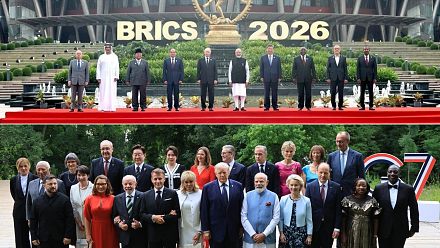
BRICS Vs G7: Who Has More People, Oil, Land, GDP And Trade?
The high-stakes BRICS Summit 2026 kicked off in New Delhi on Saturday, bringing together leaders from major emerging economies, including Russian President Vladimir Putin and Chinese President Xi Jinping.
Ni Saurabh Verma··54K nabasa
BRICS Vs G7: Who Has More People, Oil, Land, GDP And Trade?
The high-stakes BRICS Summit 2026 kicked off in New Delhi on Saturday, bringing together leaders from major emerging economies, including Russian President Vladimir Putin and Chinese President Xi Jinping.
Other leaders attending the summit include Iranian President Masoud Pezeshkian, South African President Cyril Ramaphosa, Malaysian Prime Minister Anwar Ibrahim, Indonesian President Prabowo Subianto, Abu Dhabi Crown Prince Mohamed bin Zayed Al Nahyan, Ethiopian Prime Minister Abiy Ahmed Ali, Egyptian President Abdel Fattah El-Sisi and Vietnamese Prime Minister Le Minh Hung.
The expanded BRICS grouping and the Group of Seven (G7) represent two very different centres of global economic and geopolitical power.
While the G7 continues to enjoy a significant advantage in nominal economic output, financial markets and high-value services, BRICS has a much larger population, greater geographic reach and considerable weight in areas such as energy, commodities and purchasing power parity (PPP).
So, how do the two blocs compare on some of the key indicators?
BRICS Vs G7: Demographics And Geography
One of BRICS’ biggest advantages is its sheer demographic and geographic scale.
The expanded BRICS grouping, comprising 11 member countries, represents more than 3.7 billion people — nearly half of the world’s population. Its members also cover a vast geographic area and have access to a wide range of natural resources and markets.
By comparison, the G7 — comprising the United States, Canada, the United Kingdom, France, Germany, Italy and Japan — accounts for around 10% of the global population.
This gives BRICS a much larger potential consumer base and labour pool, while its geographic spread provides access to diverse markets, resources and production centres.
BRICS Vs G7: Energy And Natural Resources
BRICS also carries significant weight in global energy markets.
The grouping includes several major oil and gas producers and exporters, including Russia, Saudi Arabia, the United Arab Emirates and Iran. Brazil is also a major oil producer.
The G7, meanwhile, includes major energy producers such as the United States and Canada.
However, BRICS’ concentration of major energy-producing and exporting economies gives the grouping considerable influence in global oil and commodity markets.
BRICS Vs G7: Economic Output — PPP Vs Nominal GDP
The economic comparison between BRICS and the G7 depends largely on how GDP is measured.
On a purchasing power parity (PPP) basis, BRICS accounts for a much larger share of the global economy. PPP takes into account differences in the prices of goods and services between countries, giving greater weight to large emerging economies such as China and India.
However, the picture changes when GDP is measured at market exchange rates, or nominal GDP.
The G7 remains significantly ahead on this measure, reflecting the higher per-capita incomes and large, developed economies of countries such as the US, Germany, Japan and the UK.
The G7 also retains major advantages in global financial markets, advanced technology, capital markets and high-value services.
BRICS Vs G7: Global Trade And Commerce
BRICS has also emerged as a major force in global trade.
China’s position as the world’s largest manufacturing powerhouse gives the grouping enormous weight in global goods trade. Other BRICS members add to its influence through exports of energy, agricultural commodities, minerals and other raw materials.
The G7, meanwhile, remains a major force in both global trade and services. Its members have strong positions in finance, technology, advanced manufacturing, pharmaceuticals and other high-value sectors.
The comparison therefore highlights the different strengths of the two blocs.
BRICS has greater demographic, geographic and resource weight, while the G7 retains significant advantages in nominal economic output, financial influence, technology and high-value services.
As the global economic order becomes increasingly fragmented and multipolar, the relative strengths of BRICS and the G7 are likely to play an important role in shaping global trade, investment and geopolitics.