From Brazilian clay art to Belarusian willow weaving and Iranian Balochi embroidery, a heritage bazaar in Delhi is bringing traditional crafts from BRICS member and partner countries to the Indian capital.
From Brazilian clay art to Belarusian willow weaving and Iranian Balochi embroidery, a heritage bazaar in Delhi is bringing traditional crafts from BRICS member and partner countries to the Indian capital.
The BRICS Bazaar has been set up at the National Crafts Museum & Hastkala Academy, next to Bharat Mandapam, where the two-day BRICS Summit began on Saturday. India is hosting the 18th BRICS Summit after taking over the chairship on January 1. The year 2026 also marks 20 years since the grouping was established.
According to the official BRICS 2026 website, the bazaar brings together artisans, designers and creative enterprises from member and partner countries, displaying crafts, handlooms, textiles and artworks.
From Belarusian willow to Brazilian clay
The bazaar, themed ‘Crafting Culture, Connecting People’, was mounted on September 10 and will remain open until September 15.
Among those featured is Lana Slastsion, a celebrated willow weaver from Molodechno, Belarus, who leads the Verbachka folk crafts collective. The BRICS website describes her as a People’s Master of the Republic of Belarus.
“Willow weaving in Belarus is a traditional folk craft that creates useful and beautiful objects from flexible willow branches,” a note on the website says. It adds that the craft predates weaving and the potter’s wheel, with artisans making baskets, furniture, decorative pieces and household utensils from willow.
Brazilian ceramic artisan and sculptor Cleziania Ribeiro de Lima Paiva from Goias is also featured at the bazaar.
“Brazilian clay art is one of the Americas’ oldest living traditions,” the artist’s note says. Indigenous communities used riverbank clay to make pots and vessels, while Portuguese and African techniques later blended with these traditions.
The clay itself varies by region, with deep reds found in Pernambuco and warm browns in Goias and Minas Gerais. The process involves collecting clay by hand, kneading and modelling it without moulds or wheels, drying it, firing it in open bonfires and finishing it with natural or industrial pigments.
Kazakh jewellery, Iranian embroidery
Kazakhstani artist-jeweller Serik Rysbekov is another artisan listed on the BRICS website. His silver jewellery combines hot enamel and natural stones with traditional Kazakh influences and contemporary design.
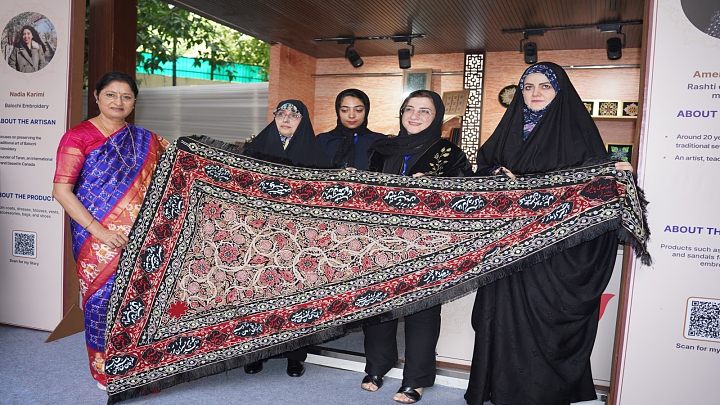
Iranian artist Nadia Karimi is represented for her work preserving and developing Balochi embroidery.
The craft is closely linked to the identity and heritage of Balochi women, according to the note accompanying her work. It is passed from mothers to daughters, with patterns and motifs hand-stitched using silk thread without machines.
The note describes the process as requiring hours of devotion, patience and cultural memory.
The website does not specify how many artists are participating in the stalls.
New Delhi: Zahra Pezeshkian, daughter of Iranian President Masoud Pezeshkian, and her husband, Hassan Majidi, visited the BRICS Bazaar, accompanied by Union Minister Annapurna Devi
(Source: DD) pic.twitter.com/eTaKojkj38
— IANS (@ians_india) September 12, 2026
Culture alongside BRICS diplomacy
A tight security cover was put in place at the bazaar and surrounding areas as the summit got underway. While there was no official confirmation, spouses of some delegates were expected to visit the bazaar before noon.
The National Crafts Museum is one of Delhi’s cultural addresses and offers visitors a view of Indian art and textile heritage through its permanent exhibits and artworks.
Russian President Vladimir Putin, Chinese President Xi Jinping, Iranian President Masoud Pezeshkian, South African President Cyril Ramaphosa and other leaders are attending the BRICS Summit on September 12 and 13.
BRICS originally comprised Brazil, Russia, India, China and South Africa. It expanded in 2024 to include Egypt, Ethiopia, Iran, the UAE and Saudi Arabia, while Indonesia joined in 2025. Belarus, Bolivia, Kazakhstan, Cuba, Malaysia, Nigeria, Thailand, Uganda, Uzbekistan and Vietnam became partner countries last year.
The grouping now covers political and security cooperation, economy and finance, and cultural and people-to-people exchanges.
BRICS brings together 11 major emerging economies, representing around 49.5 per cent of the world’s population, around 40 per cent of global GDP and 26 per cent of global trade.
Minister of State for External Affairs and Textiles Pabitra Margherita said on X on Friday that the bazaar brings together “our rich textile and craft traditions and our spirit of global engagement”.
He described it as “a celebration of heritage, craftsmanship and international cooperation, with India’s timeless traditions finding a global platform”.