BJP Knows How To Win. Nitin Nabin Now Wants It To Listen | Saffron Scoop
For a party that has spent more than a decade perfecting the art of winning elections, the Bharatiya Janata Party is suddenly talking a lot about something that cannot be measured in seats: connect.
Ni Anindya Banerjee··165K nabasa
BJP Knows How To Win. Nitin Nabin Now Wants It To Listen | Saffron Scoop
For a party that has spent more than a decade perfecting the art of winning elections, the Bharatiya Janata Party is suddenly talking a lot about something that cannot be measured in seats: connect.
The message coming from the BJP’s new organisational leadership is strikingly consistent. Spend less time in Delhi. Spend more time in your state. Go down to the booth. Meet workers. Talk to people who don’t necessarily vote for you. Reach out to women and young people. Take feedback from the ground. And, importantly, come back and explain what you did with it.
It tells us something about where the BJP believes its next challenge lies.
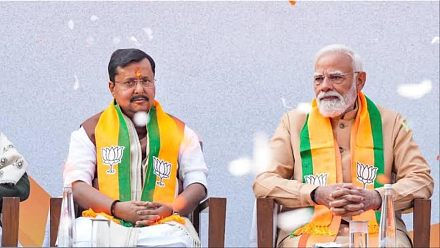
Nitin Nabin, who took over as BJP president early this year, has made this emphasis particularly clear. At the September 29 meeting of the party’s state in-charges and co-in-charges in Delhi, the new functionaries were told to spend more time in their assigned states and avoid unnecessary trips to Delhi, sources have told News18.
They were asked to strengthen the organisation down to the booth level, maintain regular contact with workers and ensure that organisational meetings have clear agendas, followed by reviews of whether targets were actually achieved.
There was another important instruction: reach out to people irrespective of their background or political affiliation.
The BJP’s organisational strength has traditionally been built around a formidable combination of cadre, ideology, booth management and an increasingly sophisticated election machine. But elections are not fought only on polling day.
Between elections, political parties have to listen, absorb local grievances, identify social shifts and detect changes in voter behaviour before they become visible in an election result.
The BJP appears to be trying to institutionalise precisely that process.
For instance, look at Punjab. On October 1, the party began a two-day strategy meeting with district presidents, in-charges and co-in-charges after its 13-day ‘Nasha Mukt Punjab Yatra’ travelled roughly 4,000 km through all 117 Assembly constituencies. The exercise is not simply about reviewing a campaign. The party is seeking ground feedback on its organisational depth, particularly in rural areas where it has traditionally been weaker.
Nabin has also said that decisions on alliances will depend on ground feedback, surveys and voters’ aspirations.
A rally tells a party how many people came. A booth worker can tell it why people did not. A social-media campaign tells a party what is trending. A local worker can tell it what is actually bothering people. A survey can identify a voter preference. A sustained organisational presence can sometimes explain why that preference is changing.
Nabin is seeking to bridge this gap as the BJP gets ready for a slew of state elections in 2027 and Modi’s fourth-term bid in 2029, in an attempt to close the distance between the party’s central decision-making apparatus and the political reality in the states.
The BJP has, after all, become exceptionally good at centralised political communication. The Modi-era party has built an election machine capable of coordinating national messaging with extraordinary speed. But centralisation has an inherent risk: information can travel upwards through layers of organisation and become increasingly sanitised on the way.
People close to the 46-year-old BJP president say Nabin thinks the best political organisations are those that hear uncomfortable things early.
There are signs that the BJP understands this.
In August, Prime Minister Narendra Modi met the party’s 65 newly appointed national office-bearers and urged them to strengthen the organisation at the grassroots, develop fresh ideas and deepen the party’s connect with people. Youth and new demographic groups were specifically highlighted.
The BJP has created a dedicated outreach effort aimed at younger voters, with Nabin, Smriti Irani and Vinod Tawde among the leaders associated with the initiative.
After the student stir at Jantar Mantar that forced the resignation of former Union Education Minister Dharmendra Pradhan, the party was forced to adapt to new grammars of communication. A generation that consumes politics largely through Instagram, YouTube, short videos, memes and creators is not automatically going to respond to the communication grammar that worked for earlier generations, the BJP realised.
With social media audits of Cabinet ministers and instructions to make vertical videos for Instagram, the BJP was quick to reconnect the lost signal with a generation that will be the single largest voting bloc in the 2029 Lok Sabha election.
The BJP may have been good at broadcasting, but that is not the same thing as being good at listening. That may be the more difficult transition for the saffron party.
The political events of this year have offered a reminder that younger Indians can organise and communicate outside conventional political structures. The BJP’s subsequent effort to recalibrate its youth and digital outreach suggests the party has taken notice. On PM Narendra Modi’s 76th birthday, the BJP youth wing kicked off two bike rallies, with 500 youths travelling each way between Varanasi in Uttar Pradesh and Vadnagar in Gujarat.
“The rally will cover around 40,000 km, passing through 193 districts and approximately 1,159 villages across ten states. Around 1,000 youths will participate in the two-way journey,” said VD Sharma, the national in-charge of the Vadnagar-Varanasi bike rally.
However, Vinod Tawde says that while resting at night, the bikers will speak to locals and listen to their feedback about the Modi government and its policies — both positive and negative — and bring those comprehensive inputs to the BJP headquarters, where they will serve as a survey.
These moves point towards an organisation trying to make itself more accountable, more structured and, at least in stated intent, more connected to the ground.
That does not mean the BJP is suddenly facing an existential political problem. Nor does every organisational instruction imply voter dissatisfaction.
In fact, the opposite may be closer to the point.
Political organisations often begin changing when they are strong enough to think beyond the next election.
The BJP’s current challenge is therefore not simply how to win the next contest. It is how to ensure that electoral success does not create an organisational echo chamber.
That distinction becomes particularly important as the party moves towards a demanding electoral calendar. Uttar Pradesh, Uttarakhand, Punjab, Goa and Manipur are among the states heading towards Assembly elections in 2027, and the BJP has already appointed experienced leaders to manage several of these politically consequential states.
Vinod Tawde has been given Uttar Pradesh, Satish Poonia Punjab, Ram Madhav Uttarakhand and Tamil Nadu, while Smriti Irani has been assigned Haryana and Chhattisgarh.
The real test of those appointments will not be the number of meetings at 6A Deen Dayal Upadhyay Marg that go on for hours without breaks. It will be whether they can tell the central leadership what is happening in Lucknow, Chandigarh, Dehradun or Imphal — including things the leadership may not want to hear.
That is ultimately the “connect” Nitin Nabin is seeking through his team.
Not just reaching voters with a message, but allowing voters to alter the message. Not just mobilising supporters, but understanding why some supporters are becoming less enthusiastic. Not just asking workers to execute a strategy, but using workers to understand whether the strategy makes sense on the ground. And not just talking to people who already agree with you.
The BJP’s great organisational achievement over the past decade has been to convert political popularity into an election-winning machine. Its next organisational challenge may be to make sure that machine remains sensitive to the society it is trying to represent.
For a party that has made winning an organisational habit, staying connected may be the harder skill to institutionalise.