BJP Door Not Closed, But Sanjay Nishad Keeps Exit Option Open? Decoding His Meeting With SP For 2027 UP Polls
Is Sanjay Nishad preparing for a political shift ahead of the 2027 Uttar Pradesh Assembly election, or is he using the possibility of an exit to strengthen his bargaining position with the Bharatiya Janata Party (BJP)?
Ni Oliver Fredrick··51K nabasa
BJP Door Not Closed, But Sanjay Nishad Keeps Exit Option Open? Decoding His Meeting With SP For 2027 UP Polls
Is Sanjay Nishad preparing for a political shift ahead of the 2027 Uttar Pradesh Assembly election, or is he using the possibility of an exit to strengthen his bargaining position with the Bharatiya Janata Party (BJP)?
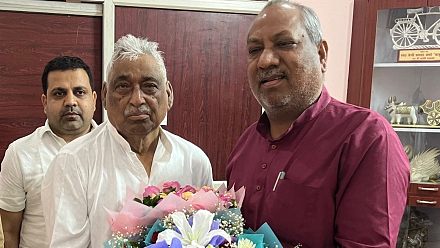
The question has gained importance after Uttar Pradesh minister and Nishad Party chief Sanjay Nishad met Samajwadi Party (SP) leader and Leader of Opposition Mata Prasad Pandey in Lucknow. Nishad described the meeting as a courtesy call to enquire about Pandey’s health, but his subsequent remarks have added a clear political dimension to the episode.
Nishad has said that when the Samajwadi Party had closed its doors to him, he joined the BJP, and if the BJP now closes its doors, his party would have to consider other options. He also said the Nishad Party would stand with whoever stands with the Nishad community and addresses its outstanding demands.
For political analyst Dr Shashikant Pandey, Head of the Department of Political Science, Dr Bhimrao Ambedkar University, Lucknow, the statement is significant less as an announcement of a switch and more as a bargaining signal.
“Sanjay Nishad is keeping his options open. At this stage, the meeting with Mata Prasad Pandey should not automatically be interpreted as a decision to leave the BJP. It is also a way of reminding the BJP that the Nishad vote cannot be taken for granted and that the Nishad Party expects political space, representation and a larger role in the 2027 election,” Dr Pandey said.
लखनऊ में नेता प्रतिपक्ष एवं वरिष्ठ समाजवादी पार्टी नेता मा० श्री माता प्रसाद पाण्डेय जी से उनके निजी आवास पर शिष्टाचार भेंट कर विभिन्न समसामयिक विषयों पर चर्चा की। pic.twitter.com/D2jrA02eMN
— Dr. Sanjay Kumar Nishad (@drsanjayknishad) September 14, 2026
WHY THE NISHAD VOTE MATTERS
The political importance of the Nishad community comes from both its numerical strength and its geographical concentration.
There is no recent official caste census that provides a definitive statewide population figure for Nishads. Different political and media estimates put the community at roughly 5–9% of Uttar Pradesh’s population, while some estimates of the electoral share put Nishad voters at around 4.5% of the state’s electorate. The broader Nishad social grouping can include communities identified locally as Mallah, Kevat, Bind, Kashyap and others, although not all such groups necessarily identify politically as one bloc.
What makes the community important is its concentration in several politically crucial belts, particularly eastern Uttar Pradesh and the wider Purvanchal region.
Political estimates cited in recent analyses suggest that Nishad voters can be decisive in around 80 of Uttar Pradesh’s 403 Assembly constituencies, while having an electoral influence in more than 160 seats. The community has also been identified as influential in around 23 Lok Sabha constituencies, although the exact strength varies considerably from seat to seat.
In some constituencies, Nishad voters are estimated to number in the hundreds of thousands. This means that even when the community does not constitute a majority, it can become important in closely fought contests.
Dr Pandey said the significance of the Nishad vote should therefore be understood geographically rather than merely through its statewide percentage.
“The Nishad vote is important because it is concentrated in constituencies where even a few percentage points can alter the electoral contest. Their influence is particularly visible in eastern UP, but the community is not confined to one region. For political parties, the challenge is to convert community-level support into a wider electoral coalition,” he said.
FROM SP ALLY TO BJP ALLY
Sanjay Nishad’s own political journey illustrates this fluidity.
The Nishad Party had aligned with the Samajwadi Party-led alliance in the 2017 Assembly election. It subsequently moved towards the BJP-led NDA before the 2019 Lok Sabha election. Sanjay Nishad’s son Praveen Nishad won Sant Kabir Nagar on a BJP ticket in 2019, and the alliance continued into the 2022 Assembly election. Sanjay Nishad later became a minister in the Yogi Adityanath government.
The relationship, however, has periodically been marked by disagreements, particularly over the community’s demand for reservation-related benefits and political representation.
The Nishad Party has sought the inclusion of several Nishad sub-groups currently classified as OBCs in the Scheduled Caste category. The demand remains a major political issue for the party.
माता प्रसाद पांडेय से मुलाकात पर बोले संजय निषाद- ‘SP ने दरवाजा बंद किया था तो BJP में गए’, ‘दो नेता मिलते हैं तो चर्चा होती है’क#SanjayNishad #MataPrasadPandey #UPPolitics pic.twitter.com/CMdtIxwnhA
— News18 Uttar Pradesh (@News18UP) September 15, 2026
GONDA EPISODE ADDS ANOTHER LAYER
The latest political speculation also comes after Nishad publicly confronted his own government over the killing of Nishad community trader Vinod Sahani in Gonda.
Nishad staged a protest demanding stringent action against those accused in the case. SP leaders also joined the protest, creating an unusual situation in which an NDA ally was protesting while opposition representatives stood alongside him.
Against that backdrop, the meeting with Mata Prasad Pandey assumes greater political significance.
However, the BJP has rejected speculation of an imminent split. BJP spokesperson Dinesh Pratap Singh has said Nishad remains an NDA ally and is free to meet political leaders.
WHAT HAPPENS NEXT?
The immediate issue is likely to be seat-sharing and political representation.
The Nishad Party contested 16 Assembly seats in 2022 and is now seeking a larger role in 2027, particularly in constituencies where the BJP suffered defeats.
For the BJP, retaining Nishad Party support is part of maintaining its broader non-Yadav OBC coalition. For the SP, any erosion in the BJP’s relationship with Nishad voters creates an opportunity to expand beyond its traditional social base.
Dr Pandey said the coming months will show whether the present tension develops into an actual realignment.
“The key question is not simply whether Sanjay Nishad changes sides. It is whether the Nishad community feels adequately represented by the existing alliance. If that perception changes, the political implications can extend well beyond the Nishad Party and affect contests across a sizeable number of constituencies,” he said.
Though Sanjay Nishad has not announced a break with the BJP, his message has put the alliance on notice: the Nishad vote is being treated as a negotiating asset ahead of 2027, and both the BJP and the opposition will be watching its direction closely.