Barapullah Jam | Promised 15 Mins, Got 2 Hours: Drone Survey Says It's Not Just New Road's Fault
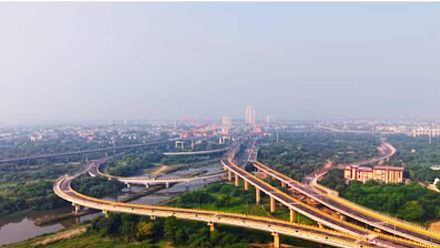
Twelve years after work began and just two days after the Barapullah Phase III corridor opened, Delhi Traffic Police are back at the drawing board. A drone survey and a joint meeting with PWD now closely scrutinise lane
Ni News Desk··178K nabasa
Barapullah Jam | Promised 15 Mins, Got 2 Hours: Drone Survey Says It's Not Just New Road's Fault
Twelve years after work began and just two days after the Barapullah Phase III corridor opened, Delhi Traffic Police are back at the drawing board. A drone survey and a joint meeting with PWD now closely scrutinise lane configuration, merging points and traffic flow along the entire Barapullah corridor.
The trouble surfaced on Wednesday morning, when thousands of motorists took the new route expecting the promised 15-minute drive between Mayur Vihar and INA. Many instead crawled for two hours or more. Congestion persisted on Thursday: some who had braved the route a day earlier stayed away, while those who tried again met another jam. Frustration quickly spilled onto social media.
The new road, however, is not the only culprit, police have found, The Times of India reported. The Phase III corridor has three lanes but feeds into the existing two-lane Barapullah stretch, a sudden squeeze that bites hardest when traffic surges.
Several streams also converge on the older Barapullah flyover, which has comparatively less capacity, so at key points more vehicles are being funnelled into a road that can carry fewer.
Where Is The Jam Building Up?
The biggest bottleneck so far is near Sarai Kale Khan, close to the loop around Sundial Park, where traffic from the loop joins the new elevated stretch. Instead of blending gradually, the two streams meet abruptly because of the sharp geometry of the merge, officials were quoted by TOI.
A second trouble spot lies in the older section, where traffic from the Guru Harkrishan Medical Institute side merges with Barapullah. Police also flagged driver behaviour, including last-minute lane changes known as scissor cuts and wrong-side driving.
Online, the anger was sharp. One commuter claimed the flyover was “a total mess” with a five-km jam for the second day running, and called it a “public hazard” that should be closed immediately, TOI reported. The commuter also warned that in an emergency, nobody could even take a detour.
Barapullah corridor: what the drone survey found, and the suggested fixes
#
Problem spot
Suggested fix
1
Phase III corridor narrows from three lanes to the existing two-lane stretch; traffic from the Sundial Park loop meets the new corridor abruptly, creating a bottleneck
Cones/barricades for better, tapered traffic alignment
2
Traffic from the Guru Harkrishan Medical Institute side merges into the existing Barapullah section
Traffic police to regulate movement at crucial times
3
New road appeared open and smooth on Google Maps, so more motorists were routed through Barapullah
Traffic police have raised a ticket with Google
4
Commuter behaviour: scissor cuts (last-minute lane changes) and wrong-side driving
Not specified
Is Google Maps Adding To The Problem?
Possibly. The new corridor appeared smooth on Google Maps, making it look like a shorter, faster option and steering motorists towards it. Traffic police have raised the issue with Google, TOI quoted its sources.
The company reportedly said its real-time system needs a few days of actual traffic data after a new road opens before it can reflect conditions accurately. In other words, the app was sending Delhi’s traffic onto a road still learning to handle it.
What Is Being Done Now?
For now, officials are leaning on measures decidedly less glamorous than the Rs 1,000-crore-plus infrastructure around them.
Personnel have been asked to stay deployed at crucial times to regulate vehicles and keep traffic moving in stop-and-go fashion.
Officials are also examining whether traffic can be diverted towards NH-24 wherever feasible, easing pressure on the corridor. The exercise, they said, has helped pinpoint spots where flow can be improved without waiting for another major construction project.
Stopgap measures planned for the Barapullah corridor
#
Measure
What it involves
1
Physical channelisation
Barricades or cones to create a tapered, smoother merge of vehicle streams
2
Manual regulation
Traffic personnel to manage movement and ensure stop-and-go flow
3
Possible diversion
Traffic diverted towards NH-24 where feasible, to reduce pressure on the corridor
4
Navigation-app corrections
Corrections to routing on Google Maps
The irony is hard to miss: a 12-year-old project meant to smooth commutes had officials studying where the road itself needs help within 48 hours, the publication noted.