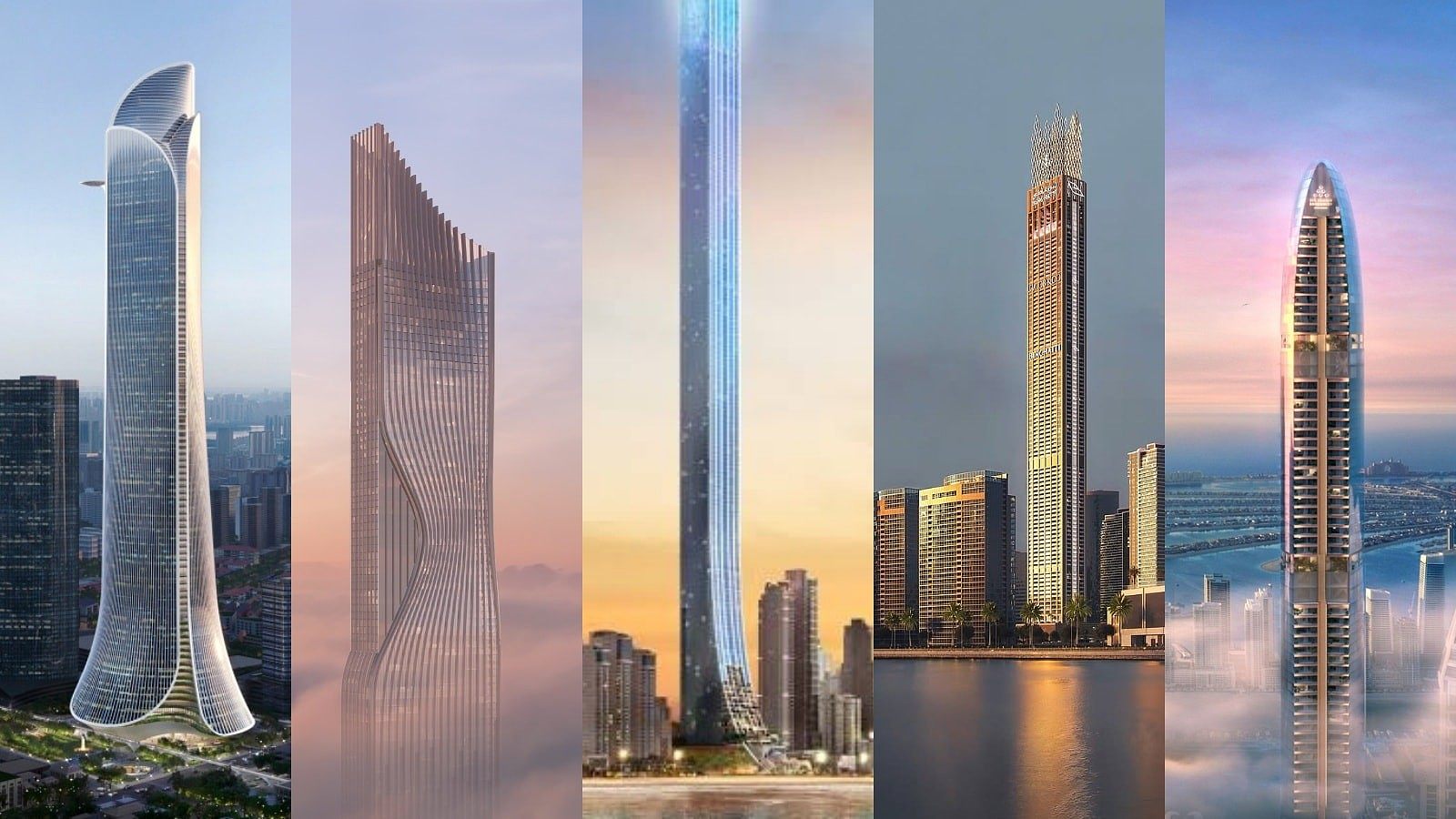
World Skyscraper Day 2026: 5 Supertall Towers Set To Redefine Skylines By 2030
World Skyscraper Day is observed annually on September 3, celebrating the engineering, architecture and ambition behind the world’s tallest buildings. The date is associated with birth anniversary of architect Louis H. S
Ni Nibandh Vinod··32K nabasa
World Skyscraper Day 2026: 5 Supertall Towers Set To Redefine Skylines By 2030
World Skyscraper Day is observed annually on September 3, celebrating the engineering, architecture and ambition behind the world’s tallest buildings. The date is associated with birth anniversary of architect Louis H. Sullivan, widely regarded as a pioneer of modern skyscraper design.
From Chicago’s early vertical landmarks to today’s supertall towers, skyscrapers have transformed how cities use limited land while creating new symbols of economic and architectural ambition.
In 2026, the celebration comes as a new generation of towers takes shape across major global cities. Several projects rising above 300 metres are expected to reshape skylines before 2030, pushing residential, hospitality, office and mixed-use design to extraordinary new heights.
World Skyscraper Day 2026: The next 5 supertall towers to watch
Skyscrapers are no longer limited to traditional business districts. The next wave of supertall construction is increasingly residential, hospitality-led and mixed-use, with developers competing to create towers that function as vertical cities rather than simply high-rise office blocks.
The Council on Tall Buildings and Urban Habitat’s current criteria classify buildings measuring at least 300 metres (984 feet) as supertalls. Against that benchmark, these five projects stand out for their scale and potential skyline impact by 2030.
Burj Binghatti Jacob & Co Residences, Dubai
Burj Binghatti Jacob & Co Residences is listed at about 557 metres (1,827 feet) and 105 floors. (Image: binghatti/Instagram)
Dubai is set to add another dramatic vertical landmark with the Burj Binghatti Jacob & Co Residences. The project is listed at about 557 metres (1,827 feet) and 105 floors, with completion currently listed for 2027*.
The tower is planned as a luxury residential development, continuing Dubai’s push to combine extreme height with branded hospitality and high-end living.
Its significance goes beyond its height. Dubai has turned the skyscraper into a major part of its global identity, and projects such as this reinforce the city’s reputation as a laboratory for ultra-luxury vertical development.
Six Senses Residences Dubai Marina, Dubai
Six Senses Residences Dubai Marina, planned at approximately 517 metres (1,695 feet).
Another major addition to Dubai’s skyline is Six Senses Residences Dubai Marina, planned at approximately 517 metres (1,695 feet). Current tall-building data lists completion in 2028*.
The tower is expected to bring a wellness-oriented luxury residential concept into one of Dubai’s most recognisable urban districts.
At more than half a kilometre high, the project demonstrates how Dubai’s next generation of supertalls is increasingly focused on residential experiences rather than conventional corporate towers. Its height, location and hospitality positioning could make it one of the city’s most recognisable new landmarks.
Tiger Sky Tower, Dubai
Tiger Sky Tower is roughly 532 metres (1,725 feet).
The Tiger Sky Tower is another ambitious Dubai project expected to make its mark before the end of the decade. Current listings place it at roughly 532 metres (1,725 feet) with an expected completion around 2029*.
Its scale puts it firmly in supertall territory and illustrates the continuing appetite for high-density luxury development in Dubai.
The project also reflects a broader trend in global skyscraper design: developers are using height as part of an experience-led proposition, combining residences and amenities rather than relying solely on conventional office space.
North Bund Tower, Shanghai
he North Bund Tower is listed at 480 metres (1,575 feet) and 97 floors
Shanghai’s skyline is also preparing for a major addition. The North Bund Tower is listed at 480 metres (1,575 feet) and 97 floors, with completion targeted for 2030*.
The tower forms part of the broader North Bund development on Shanghai’s waterfront. CTBUH/CVU data lists a mix of observation, serviced-apartment, hotel and office functions, highlighting the project’s mixed-use character.
Its arrival would strengthen the North Bund as a major high-rise district and add another defining vertical element to Shanghai’s already iconic skyline.
Senna Tower, Balneário Camboriú, Brazil
The Senna Tower is currently listed at around 550 metres (1,804 feet) and 154 floors.
Brazil’s Balneário Camboriú is emerging as one of the world’s most striking residential skyscraper markets. The Senna Tower is currently listed at around 550 metres (1,804 feet) and 154 floors, with a target completion around 2030*.
If delivered at its planned height, the tower would become an extraordinary addition to the city’s dense coastal skyline and one of the world’s tallest residential buildings.
The project is particularly notable because it shows that the supertall race is no longer confined to established global megacities such as Dubai, Shanghai or New York. Smaller but rapidly developing urban markets are increasingly using landmark towers to establish an international architectural identity.
Why these towers matter
The next generation of skyscrapers is about more than breaking height records. These buildings point toward a changing model of urban development.
First, residential supertalls are gaining ground. Several of the projects on the list are residential or hospitality-led, showing that the economics of extreme-height construction are increasingly being tied to luxury living, branded residences and tourism.
Second, mixed-use towers are becoming more important. A modern supertall can combine homes, hotels, offices, observation decks, restaurants and entertainment within one vertical structure. That creates a building capable of remaining active throughout much of the day.
Third, skyline competition remains a powerful force. Cities increasingly use landmark architecture as a tool for tourism, investment and global branding. The concentration of projects in Dubai is perhaps the clearest example, but Shanghai and Balneário Camboriú show how the trend is spreading.
Finally, engineering remains central to the skyscraper story.
As towers approach and exceed 500 metres, structural systems, wind engineering, elevators, foundations, fire safety and vertical transportation become increasingly complex. Every additional metre brings another set of engineering challenges.
The skyline race toward 2030
The global skyscraper race is entering a new phase. Rather than simply asking which city will have the tallest building, developers are increasingly competing over design, lifestyle, amenities, sustainability, location and the overall experience offered by a vertical development.
By 2030, today’s construction sites could become some of the world’s most recognisable landmarks. Dubai is expected to remain a major centre for supertall residential development, Shanghai continues to expand its waterfront skyline, and Balneário Camboriú is demonstrating that spectacular vertical architecture can emerge in unexpected markets.
World Skyscraper Day 2026 therefore offers more than a chance to look back at the history of tall buildings. It is also an opportunity to look ahead, toward a skyline where 500-metre-plus towers may increasingly become part of the world’s urban vocabulary.
* Note: Project completion dates and planned heights can change during construction, so these figures should be treated as current project targets rather than guaranteed delivery dates.