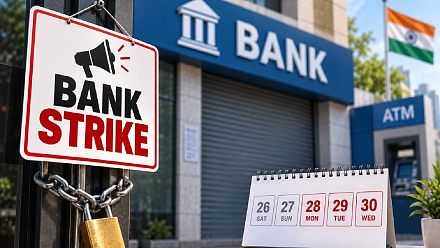
September Bank Strike: Which Banks Will Be Open Or Closed For 5 Days (Sept 26-30)?
September Bank Strike 2026: Bank customers across India could face disruption in branch banking services for five consecutive days from September 26 to September 30, 2026, as a three-day nationwide bank strike has been c
Ni Mohammad Haris··45K nabasa
September Bank Strike: Which Banks Will Be Open Or Closed For 5 Days (Sept 26-30)?
September Bank Strike 2026: Bank customers across India could face disruption in branch banking services for five consecutive days from September 26 to September 30, 2026, as a three-day nationwide bank strike has been called for September 28-30, immediately after the regular weekend closure.
The United Forum of Bank Unions (UFBU) has called the three-day strike to press for the implementation of a five-day banking week. The proposed strike covers public sector banks and is supported by unions/associations representing bank employees. However, the finance ministry, in its statement on September 21, has urged employees to call off the strike and resolve the remaining issue through dialogue.
The five-day closure is not technically a five-day strike. September 26 is the fourth Saturday? Actually, September 26, 2026 is the fourth Saturday, which is a regular bank holiday, while September 27 is Sunday. The strike is scheduled for September 28, 29 and 30. Together, these dates could leave many bank branches unavailable for five consecutive days.
Bank Strike September 2026: Full 5-Day Schedule
Date
Day
Bank Status
September 26
Saturday
Closed – Fourth Saturday
September 27
Sunday
Closed – Weekly holiday
September 28
Monday
Strike (branch services may be affected)
September 29
Tuesday
Strike (branch services may be affected)
September 30
Wednesday
Strike + half-yearly closing
It is important to note that the September 28-30 closure is due to the proposed strike, while September 26-27 are regular holidays. The finance ministry has specifically pointed out that the strike coincides with the half-yearly closing of banks on September 30, making the timing particularly significant for banking, reconciliation, treasury and other financial operations.
Which Banks Will Be Closed From September 28 to 30?
The strike has been called by bank unions in the public sector banking system, with Regional Rural Banks (RRBs) also supported by the unions. Therefore, customers of major public sector banks could face disruption in branch operations.
These include banks such as State Bank of India (SBI), Punjab National Bank (PNB), Bank of Baroda, Canara Bank, Union Bank of India, Bank of India, Indian Bank, Bank of Maharashtra, Central Bank of India, Indian Overseas Bank, UCO Bank, and Punjab & Sind Bank.
The actual impact, however, can vary depending on employee participation and arrangements made by individual banks. SBI, for example, has advised customers to complete important branch-related transactions before the strike and use digital channels and ATMs during the period.
What About Private Banks?
The September 28-30 strike is primarily directed at the public sector banking workforce and associated unions, rather than being a blanket strike covering every bank in India. Therefore, customers of private-sector banks such as HDFC Bank, ICICI Bank, Axis Bank and Kotak Mahindra Bank should not automatically assume that their branches will be shut because of the strike.
However, customers should check their individual bank’s communication, particularly for services dependent on inter-bank processing, cheque clearing or other back-end operations.
Will ATM, UPI and Net Banking Work During the Bank Strike?
Digital banking services are expected to remain available, although customers could face delays in certain physical or branch-dependent services.
SBI has specifically advised customers to use ATMs and automated deposit and withdrawal machines (ADWMs), customer service points (CSPs), internet banking, mobile banking, UPI, and YONO, for services that can be completed digitally.
This means a five-day disruption in physical branch access does not mean that all banking services will stop for five days.
Customers can generally continue making UPI payments, transferring money through digital banking channels and withdrawing cash from ATMs, subject to normal service availability and cash levels.
Which Banking Services Could Be Affected?
Customers who need to visit a branch should ideally complete their work before September 26. Services that could face disruption or delays include:
Cash deposits and withdrawals requiring branch assistance
Cheque-related work
Account opening and closure
Submission or verification of physical documents
Demand drafts and pay orders
KYC-related branch work
Loan-related documentation
Other services requiring bank employees’ physical assistance
SBI has also warned customers to complete important transactions in advance because branch operations could be affected during the strike.
Why Are Bank Employees Going On Strike?
The principal unresolved demand is the implementation of a five-day banking week. The finance ministry said the unions had initially raised two major demands — implementation of five-day banking and withdrawal of the Performance Linked Incentive (PLI) scheme.
According to the ministry, the government has already decided to keep the PLI scheme in abeyance, thereby addressing one of the two principal demands. The government said the remaining demand for a five-day workweek continues to be examined through discussions with stakeholders.
The unions, however, have continued with their strike programme.
A one-day nationwide strike was held on September 11, followed by the proposed three-day strike from September 28 to 30. The finance ministry release also says an indefinite strike has been proposed from October 26, 2026, if the issue remains unresolved.
Why Is September 30 Important For Banks?
September 30 marks the half-yearly closing of banks. This makes the proposed three-day strike particularly important for the banking system. The finance ministry has said that the strike, combined with the preceding weekend, could effectively result in a five-day disruption at a time when banks are dealing with half-yearly closing, reconciliation, provisioning, treasury and market-related operations.
“The proposed 3-day strike period, from 28th to 30th Sept 2026, also coincides with the half-yearly closing of banks on 30th September, a date of particular significance for reconciliation, provisioning, and treasury and market operations. A disruption of this nature, combined with the preceding weekend, would result in an effective five-day closure of banking services at a particularly sensitive point in the financial calendar — causing considerable inconvenience to customers, businesses, Government transactions, and international banking operations,” the ministry stated.
Finance Ministry Appeals Against Bank Strike
In its September 21 statement, the finance ministry appealed to employees of public sector banks and Regional Rural Banks to ensure uninterrupted banking services.
The government said it had undertaken several measures relating to employee welfare, recruitment, promotions, pensions, medical insurance and working conditions. It also highlighted that PSBs recruited around 4.82 lakh employees between FY2014-15 and FY2025-26.
The ministry urged bank employees to resolve the remaining issue through dialogue rather than disrupting banking services.
“Given that most concerns of the Unions have been substantially addressed, that the remaining demand continues to be examined, and that the Government continues to proactively introduce welfare measures for the banking workforce, bank employees are urged to refrain from resorting to strikes, work towards resolving issues through dialogue, and ensure that banking services remain uninterrupted,” the ministry said.
What Should Bank Customers Do?
If you have any branch-dependent banking work, it would be prudent to complete it before September 26. Customers who need cash should also plan their withdrawals in advance. For routine payments and transfers, digital channels such as UPI, mobile banking and internet banking can continue to be used.
For SBI customers in particular, the bank has advised completing important transactions before the strike and using ATMs, CSPs, internet banking, YONO, mobile banking and UPI during the period.