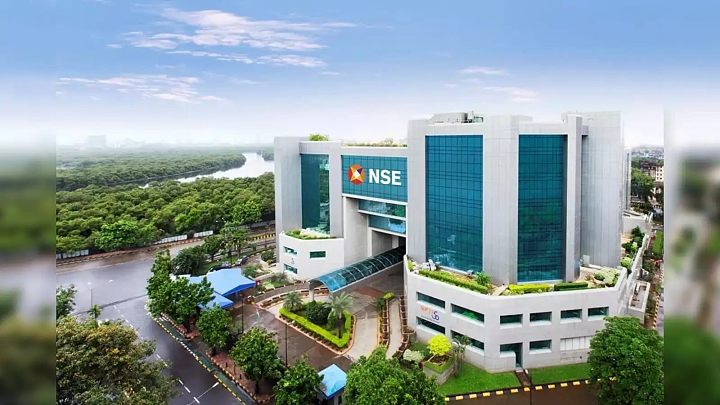
NSE To More Than Double Co-Location Capacity As Algo Trading Surges; Here's What Exchange Says
The National Stock Exchange (NSE) is set to more than double its co-location capacity over the next two to three years as high-frequency trading (HFT) and algorithmic trading gain a larger share of market activity.
Ni Business Desk··43K nabasa
NSE To More Than Double Co-Location Capacity As Algo Trading Surges; Here's What Exchange Says
The National Stock Exchange (NSE) is set to more than double its co-location capacity over the next two to three years as high-frequency trading (HFT) and algorithmic trading gain a larger share of market activity.
NSE currently has around 2,200 racks for co-location servers and plans to take the capacity beyond 4,500 racks, NSE Managing Director and CEO Ashishkumar Chauhan told Moneycontrol in an interview.
“We have prepared for very large racks. We should be able to do about 4,500 plus racks over next two, three years easily,” Chauhan said.
The planned expansion will require additional physical infrastructure, including more space, electricity and cooling capacity. This is because newer and more powerful servers consume greater amounts of electricity and generate more heat.
According to Chauhan, NSE has already vacated some space at its existing headquarters to facilitate the expansion of its data-centre infrastructure. The exchange has also received additional space near its existing building from the Maharashtra government, he told Moneycontrol.
Why NSE Is Expanding Co-Location Capacity
The infrastructure expansion comes against the backdrop of a sharp rise in algorithmic and high-frequency trading, both in India and globally. Algorithmic trading accounted for 55% of NSE’s equity cash-market turnover in FY26, its highest-ever share, while co-location accounted for 39.4%, also a record, according to the exchange.
The role of algorithms is even more prominent in the derivatives segment. Algorithmic trading accounted for 70% of equity derivatives’ notional turnover in FY26, compared with just 12% in 2010.
Trading infrastructure has also become significantly faster. NSE now disseminates its index around 10 to 20 times a second, compared with once every second earlier. Orders can be processed at response times measured in nanoseconds.
Chauhan explained that faster index dissemination is necessary because algorithmic traders can otherwise calculate an estimated index between official updates and trade on the basis of that estimate.
“If I give you the index once a second, they will calculate in between estimated index and then trade on that,” he said.
NSE Says It Can Detect Market Manipulation
The expansion of trading infrastructure comes at a time when scrutiny of algorithmic and high-frequency trading has increased, particularly following SEBI’s action against US-based trading firm Jane Street.
NSE Chairman Srinivas Injeti told Moneycontrol that the exchange’s surveillance systems are capable of identifying suspicious trading patterns and reporting them to the regulator in real time.
“We are more than equipped,” Injeti said when asked whether exchanges could flag potentially manipulative activity in real time.
He said NSE’s surveillance framework analyses a wide range of trading activity, including different permutations and combinations, to identify possible instances of market manipulation.
The exchange also uses surveillance mechanisms such as the Additional Surveillance Measure (ASM) and Graded Surveillance Measure (GSM).
“There is no downside and there is no problem with regard to detection and reporting,” Injeti said, adding that surveillance had also been undertaken in the Jane Street matter.
Detection And Enforcement Are Different
Chauhan, however, drew a distinction between detecting and reporting suspicious activity and taking enforcement action. While exchanges have extensive surveillance capabilities, their enforcement powers depend on the type of market participant and the nature of the suspected violation.
In the case of brokers, exchanges have a wider regulatory mandate. In other cases, the exchange’s role can involve identifying suspicious activity, carrying out an investigation and reporting its findings to Sebi, which can then take regulatory or enforcement action.
NSE officials also pointed to the exchange’s regulatory oversight committee, which receives surveillance outcomes and incident reports at close intervals.
Regulatory Role Takes Priority Over Business, NSE Says
NSE also emphasised that its regulatory responsibilities take precedence over its commercial interests. “The board is very clear that when there is a sort of a dichotomy between the regulatory role vis-a-vis the business role, regulatory role wins,” Chauhan said.
Another NSE official reiterated the position, saying that where commercial interests and regulatory responsibilities come into conflict, the latter would take precedence.
“If there is a clash between business interest and a regulatory duty, the regulatory duty will gain primacy,” the official said.
The planned co-location expansion highlights how rapidly trading infrastructure is evolving as algorithmic and high-frequency strategies account for an increasing proportion of activity in Indian markets. At the same time, NSE’s comments underline the growing importance of surveillance systems as trading speeds and the use of automated strategies increase.