Diwali Cash Gifts: How Much Money Can You Receive Tax-Free From Family And Friends?
Diwali is a time for exchanging gifts, with cash being one of the most common ways to share festive cheer with family members, friends, colleagues and neighbours. However, while receiving money as a Diwali gift may be a
Ni Mohammad Haris··41K nabasa
Diwali Cash Gifts: How Much Money Can You Receive Tax-Free From Family And Friends?
Diwali is a time for exchanging gifts, with cash being one of the most common ways to share festive cheer with family members, friends, colleagues and neighbours. However, while receiving money as a Diwali gift may be a long-standing tradition, such gifts can have income-tax implications depending on the amount received and the relationship between the giver and the recipient.
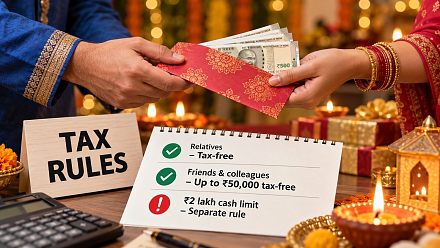
Under the Income-tax Act, 2025, which corresponds to the earlier Income-tax Act, 1961, cash gifts received from specified relatives are generally exempt from tax, irrespective of the amount. However, gifts received from friends, colleagues, neighbours and other non-relatives may attract tax if their aggregate value exceeds Rs 50,000 during a tax year.
CA Suresh Surana explained that the tax treatment of gifts depends on both the value of the gifts and the relationship between the donor and the recipient.
“While exchanging cash gifts during Diwali is a common tradition, recipients should be mindful of the tax implications. Under Section 92(2)(m) of the Income-tax Act (ITA), 2025 (corresponding to Section 56(2)(x) of the ITA 1961), an individual can receive cash gifts from friends, colleagues, neighbours or other non-relatives up to an aggregate value of Rs. 50,000 in a tax year without attracting tax. However, if the total value of such gifts exceeds Rs. 50,000, the entire amount received becomes taxable, and not merely the excess over Rs. 50,000,” Surana said.
How Much Cash Can You Receive As A Diwali Gift Without Paying Tax?
The tax implications of a cash gift depend on whether the person giving the money qualifies as a specified relative under the income-tax law.
If an individual receives cash gifts from non-relatives worth up to Rs 50,000 in aggregate during a tax year, the amount is generally exempt from tax. However, if the aggregate value exceeds this threshold, the entire amount becomes taxable under the head ‘Income from Other Sources’.
For instance, if you receive Rs 20,000 from a friend, Rs 15,000 from a colleague and Rs 20,000 from a neighbour during the tax year, the total comes to Rs 55,000. Since the aggregate value exceeds Rs 50,000, the entire Rs 55,000 becomes taxable, rather than just the excess of Rs 5,000.
It is important to note that the Rs 50,000 threshold applies to the aggregate value of gifts covered by the provision during the tax year, rather than to each individual gift separately.
Are Diwali Cash Gifts From Family Members Taxable?
Cash gifts received from specified relatives are generally exempt from income tax, irrespective of their value, under the gift-tax provisions.
The definition of specified relatives includes a spouse, siblings, siblings of the spouse or either parent, lineal ascendants and descendants of the individual or spouse, and the spouses of the aforementioned relatives.
Therefore, cash gifts received from eligible family members during Diwali are generally not taxable merely because their value exceeds Rs 50,000.
However, the exemption from income tax does not mean that every amount can be received in physical cash without restrictions. A separate provision governs high-value cash receipts, including gifts received from relatives.
Is There A Limit On Receiving Diwali Gifts In Cash?
Apart from the Rs 50,000 threshold applicable to gifts from non-relatives, the income-tax law places a separate restriction on receiving Rs 2 lakh or more in physical cash in specified circumstances.
Under Section 186 of the Income-tax Act, 2025, corresponding to Section 269ST of the Income-tax Act, 1961, a person cannot receive Rs 2 lakh or more in cash from another person in the following circumstances:
In aggregate from one person in a single day.
In respect of a single transaction.
In respect of transactions relating to one event or occasion from a person.
This restriction can apply even when the gift is otherwise exempt from income tax because it was received from a specified relative.
Explaining the provision, Surana said, “However, it is pertinent to note that a separate restriction applies to physical cash receipts of Rs. 2 lakh or more under section 186 of the 2025 Act (corresponding to section 269ST of the 1961 Act). It covers receipts from one person in a day, a single transaction, or transactions relating to one event or occasion from a person i.e. tax would be applicable in such case even where the gift is otherwise exempt because it comes from a relative. Violation of this provision may attract a penalty equal to the amount received under section 451 of ITA 2025 (corresponding section 271DA of ITA 1961). Therefore, high-value gifts should preferably be made through banking channels such as account transfers, cheques or other digital modes.”
The restriction concerns the mode of receiving money, rather than simply whether the gift is taxable. A breach may attract a penalty equivalent to the amount received in violation of the provision. Consequently, individuals planning to give or receive high-value Diwali gifts should consider using banking channels, such as account transfers or cheques, instead of physical cash.
How Are Diwali Gifts From Friends And Colleagues Taxed?
Unlike gifts from specified relatives, cash gifts received from friends, colleagues, neighbours and other non-relatives are subject to the Rs 50,000 aggregate threshold.
If the total value of such gifts during the tax year exceeds Rs 50,000, the entire amount becomes taxable under the head ‘Income from Other Sources’. The taxable amount is added to the recipient’s total income and taxed at the applicable income-tax slab rate.
Surana said, “As mentioned above, gifts received from specified relatives (as aforementioned) are fully exempt from tax irrespective of their value. However, where gifts are received from friends, colleagues, neighbours or other non-relatives and the aggregate value exceeds Rs. 50,000 during a tax year, the entire value of such gifts becomes taxable under the head ‘Income from Other Sources’. The taxable amount is added to the recipient’s total income and taxed at the applicable income-tax slab rate.”
For example, if you receive Diwali cash gifts worth Rs 60,000 in total from friends and colleagues during the tax year, the entire Rs 60,000 may be taxable, not just the Rs 10,000 exceeding the threshold. The actual tax payable will depend on your total taxable income and the applicable tax regime and slab rates.
What Should You Keep In Mind Before Accepting A Cash Gift This Diwali?
Before accepting a cash gift, it is important to consider both the relationship with the donor and the total value of gifts received during the tax year.
Cash gifts from specified relatives are generally exempt from income tax, while gifts from non-relatives exceeding Rs 50,000 in aggregate may make the entire amount taxable. Separately, receiving Rs 2 lakh or more in physical cash from a person in the circumstances specified under the law can attract a penalty, even if the gift itself qualifies for an income-tax exemption.
For high-value gifts, using banking channels is advisable. Recipients should also retain relevant records of the gift, including the donor’s identity, the amount received and the relationship with the donor, wherever appropriate, to help explain the transaction if required.