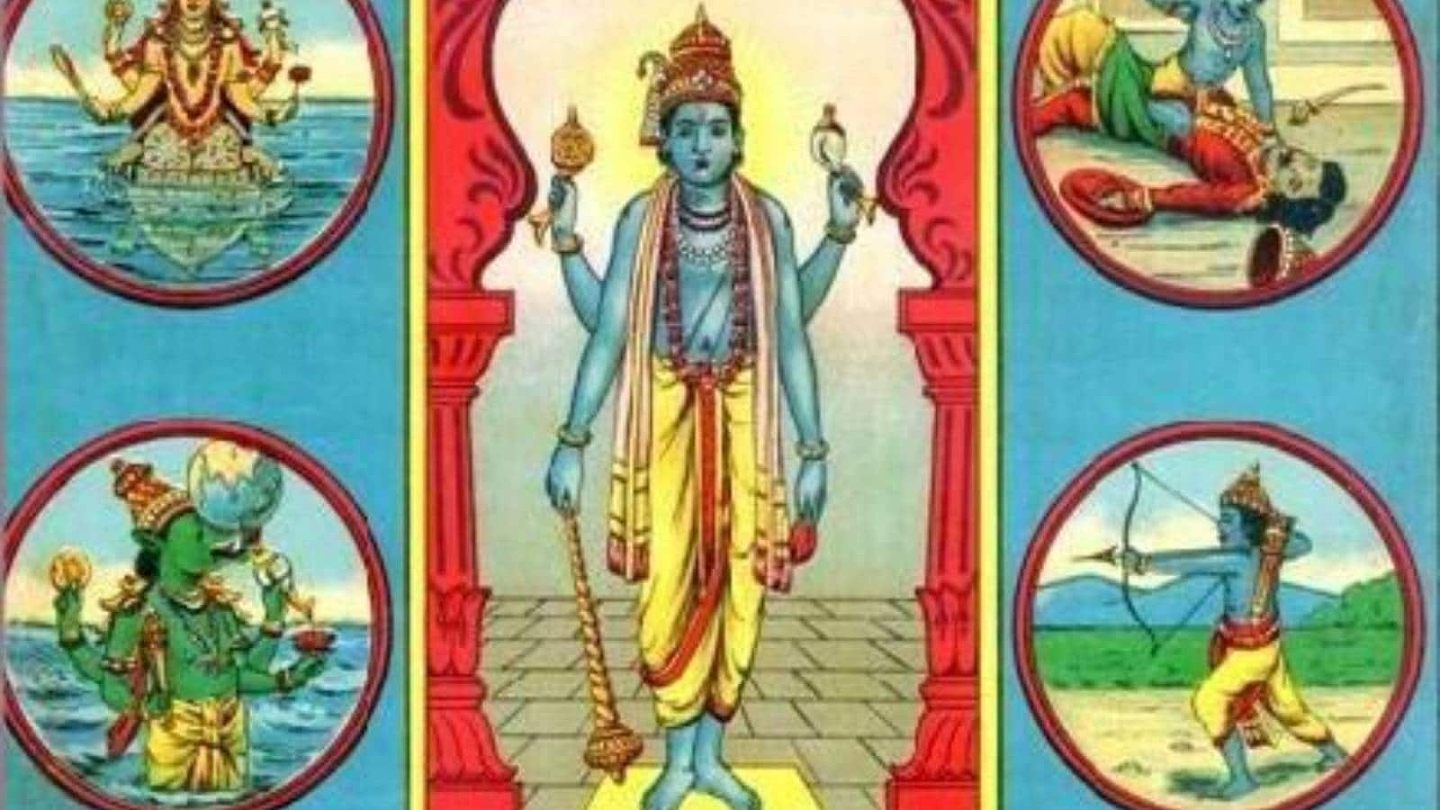
Who Are The 10 Avatars Of Lord Vishnu? Know The Stories Behind Each Incarnation
With the buzz around Ramayana bringing Indian mythology back into the spotlight, interest in the stories of Hindu gods and their different incarnations has also grown. Among these, the Dashavatara, or the ten avatars of
Ni Priyanka Das··24K nabasa
Who Are The 10 Avatars Of Lord Vishnu? Know The Stories Behind Each Incarnation
With the buzz around Ramayana bringing Indian mythology back into the spotlight, interest in the stories of Hindu gods and their different incarnations has also grown. Among these, the Dashavatara, or the ten avatars of Lord Vishnu, holds a special place. According to Hindu belief, Lord Vishnu takes different forms whenever the world faces a crisis and the balance between good and evil is disturbed. Each incarnation has a specific purpose, whether it is protecting the universe, defeating evil forces or restoring dharma (righteousness). (Image: Saileshpat/Wikimedia Commons)
MatsyaMatsya, the first avatar of Lord Vishnu, appeared in the form of a giant fish. According to Hindu mythology, a great flood threatened to destroy the world and wipe out life. Lord Vishnu took the form of Matsya and warned King Manu about the approaching catastrophe. He instructed Manu to build a boat and preserve seeds, living beings and the seven sages. During the flood, Matsya guided the boat through the waters, ensuring that life could begin again after the destruction. (Image: Anant Shivaji Desai, Ravi Varma Press/Wikimedia Commons)
KurmaIn his second incarnation, Lord Vishnu appeared as Kurma, a giant tortoise. This avatar is closely associated with the Samudra Manthan. According to the legend, the gods and demons joined forces to churn the ocean to obtain amrit, the nectar of immortality. They used Mount Mandara as the churning rod and Vasuki, the serpent king, as the rope. However, the mountain began sinking into the ocean. To prevent this, Lord Vishnu took the form of a giant tortoise and supported the mountain on his back. This allowed the churning to continue, eventually leading to the emergence of several divine treasures, including amrit. (Image: Raja Ravi Varma – The Ganesh Shivaswamy Foundation via the Google Arts & Culture/Wikimedia Commons)
VarahaThe third avatar of Lord Vishnu was Varaha, a powerful boar. According to Hindu mythology, the demon Hiranyaksha had dragged the Earth into the cosmic ocean, threatening the balance of the universe. To rescue the planet, Lord Vishnu appeared as Varaha and entered the ocean. He fought Hiranyaksha in a fierce battle and eventually defeated him. Varaha then lifted the Earth on his tusks and restored it to its rightful place. (Image: The Ravi Udaya Vijaya Press Ghatkoper, Raja Ravi Varma – Google Arts & Culture/Wikimedia Commons)
NarasimhaOne of the most fascinating incarnations of Lord Vishnu is Narasimha, who appeared as a combination of a human and a lion. The story revolves around the demon king Hiranyakashipu; he could not be killed by a human or an animal, during the day or night, indoors or outdoors, or by a weapon. Hiranyakashipu’s son, Prahlada, was a devoted follower of Lord Vishnu. Angered by his son’s devotion, the demon king tried several times to punish him. To protect Prahlada and defeat Hiranyakashipu, Vishnu appeared as Narasimha. He killed the demon at dusk, on a palace threshold, using his claws. In doing so, he fulfilled the conditions of the boon while restoring dharma. (Image: Raja Ravi Varma – The Ganesh Shivaswamy Foundation/Wikimedia Commons)
VamanaThe fifth avatar of Lord Vishnu was Vamana, who appeared as a dwarf Brahmin. His story is associated with King Mahabali, a powerful and generous ruler who had gained control over the three worlds. To restore the balance of the universe, Lord Vishnu approached Mahabali during a ritual and asked for just three paces of land. The king agreed. However, Vamana then revealed his enormous cosmic form. With his first step, he covered the Earth, and with his second, he covered the heavens. When he asked where to place his third step, Mahabali offered his own head. Vamana placed his foot on the king’s head and sent him to the netherworld. However, impressed by Mahabali’s generosity and devotion, Vishnu granted him a special place in his devotees’ hearts. (Image: Raja Ravi Varma/Wikimedia Commons)
ParashuramaParashurama was the sixth avatar of Lord Vishnu and is depicted as a warrior sage carrying an axe. He was born to sage Jamadagni and Renuka. According to Hindu mythology, Parashurama took up arms against arrogant and oppressive Kshatriya rulers who had abandoned their duties and misused their power. His battles were intended to restore justice and punish those who abused their authority. Interestingly, Parashurama is also associated with the Ramayana. He appears in the epic after Lord Rama breaks Lord Shiva’s bow during Sita’s swayamvar. (Image: Raja Ravi Varma/Wikimedia Commons)
RamaLord Rama, the seventh avatar of Vishnu, is one of the most widely worshipped deities in Hinduism. He is also known as Maryada Purushottam, meaning the ideal man who upholds righteousness and moral values. His story is narrated in the Ramayana. Rama, the prince of Ayodhya, was sent into exile for 14 years along with his wife Sita and brother Lakshmana. During their stay in the forest, Ravana abducted Sita and took her to Lanka. With the help of Hanuman and the vanar sena, Rama fought Ravana and rescued Sita. His victory symbolises the triumph of good over evil, while his life is remembered for his commitment to duty, truth and righteousness. (Image: Gita Press Gorakhpur/Wikimedia Commons)
KrishnaLord Krishna is considered the eighth avatar of Vishnu in the commonly followed Dashavatara list that includes Buddha. His life is filled with stories of childhood miracles, divine love, wisdom and the defeat of evil. Born in Mathura to Devaki and Vasudeva, Krishna was raised in Gokul and Vrindavan. He eventually defeated his uncle Kansa, who had tried to kill him as an infant. Krishna also played a crucial role in the Mahabharata. Before the Kurukshetra war, he became Arjuna’s charioteer and delivered the teachings of the Bhagavad Gita. His message focused on duty, selflessness, devotion and the importance of following dharma. (Image: By Miskin/Wikimedia Commons)
BuddhaIn several popular Hindu traditions, Gautama Buddha is considered the ninth avatar of Lord Vishnu. His inclusion is associated with teachings of compassion, non-violence and detachment from material desires. Born as Prince Siddhartha Gautama, he left his royal life after witnessing suffering, old age, illness and death. He later attained enlightenment and became known as Buddha, meaning the awakened one. His teachings encouraged people to follow the path of wisdom, compassion and freedom from suffering. It is worth noting that some Hindu traditions include Balarama, the elder brother of Krishna, as the ninth avatar instead of Buddha. (Images: By by Garde B M; Unknown author/Wikimedia Commons)
KalkiKalki is believed to be the tenth and final avatar of Lord Vishnu, who is yet to appear. According to Hindu scriptures, he will arrive towards the end of Kali Yuga, the current age in the traditional cycle of time. Kalki is generally depicted as a warrior riding a white horse and carrying a sword. His arrival is associated with the destruction of evil, the end of corruption and the restoration of righteousness. According to the traditional belief, Kalki’s appearance will mark the end of Kali Yuga and the beginning of a new Satya Yuga, restoring balance to the world. (Image: Raja Ravi Varma/Wikimedia Commons)