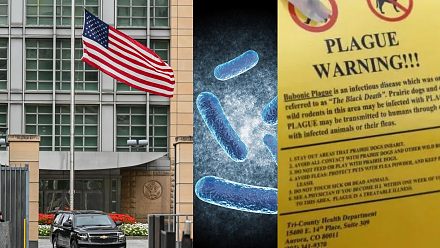
US Embassy Issues Health Alert, Warns Americans To 'Have A Plan To Depart' Amid Plague Scare In Russia
The U.S. Embassy in Moscow has issued a health alert following reports of a suspected pneumonic plague case in Russia’s Irkutsk region. The alert references the death of a laboratory worker at a plague research institute
Ni Tanya Dutt··8K nabasa
US Embassy Issues Health Alert, Warns Americans To 'Have A Plan To Depart' Amid Plague Scare In Russia
The U.S. Embassy in Moscow has issued a health alert following reports of a suspected pneumonic plague case in Russia’s Irkutsk region. The alert references the death of a laboratory worker at a plague research institute and associated quarantine measures at local hospitals.
Russian authorities have not confirmed that the death was caused by plague, while the World Health Organization has said there is currently no indication of a wider outbreak.
The incident has nevertheless prompted heightened monitoring, quarantine measures and renewed warnings for Americans in Russia. The U.S. Embassy advised citizens in the affected area to follow local health guidance, avoid affected medical facilities and seek medical attention if they develop symptoms.
US Embassy’s Health Alert
On 6 October 2026, the U.S. Embassy stated it was aware of press reports from Irkutsk concerning a suspected case of pneumonic plague that resulted in one death, along with quarantine measures and hospital closures in the area. The individual involved has been identified in Russian media as Darya Shipilova, a 28-year-old technician at an anti-plague research institute. Reports suggested possible workplace exposure, though Russian authorities have described the cause of death as pneumonia of unknown or undetermined etiology and have not officially confirmed plague.
Dozens to nearly 200 contacts were placed under medical observation. Quarantine measures were applied at the institute and several hospitals. Russian officials later reported that no dangerous pathogens linked to the woman’s professional work had been detected among tested contacts and described the overall sanitary situation as stable.
What Does The Advisory Warns Americans Of?
The suspected case reportedly involved a 28-year-old laboratory worker at an anti-plague research institute in Irkutsk. Russian media reports said she may have been exposed to Yersinia pestis, the bacterium that causes plague, after accidentally breaking a test tube at work.
Dozens of Shipilova’s colleagues and other contacts have been placed under strict quarantine.
She subsequently developed severe pneumonia and died last week. Around 200 people who had contact with her have reportedly been placed under medical observation, while quarantine measures were introduced at the research institute and several hospitals in the region.
However, Russian health authorities have not confirmed plague as the cause of death, describing it as “pneumonia of unknown aetiology”. That distinction is important because the current reports concern a suspected pneumonic plague infection, not a confirmed outbreak.
The embassy urged U.S. citizens in the affected area to:
Follow guidance issued by local health authorities.
Avoid medical facilities or other locations under quarantine.
Seek prompt medical care if they develop fever or respiratory symptoms.
Monitor their health for 14 days after potential exposure.
Review CDC information on plague and Russia-specific travel health guidance.
Check whether their travel insurance covers medical evacuation, if required.
The embassy has also reiterated the U.S. State Department’s existing Level 4 “Do Not Travel” advisory for Russia. This warning predates the Irkutsk reports and is not solely related to the suspected plague case.
Under the existing advisory, U.S. citizens currently in Russia are urged to depart immediately. The embassy also warned that the U.S. government has limited ability to provide assistance to American citizens in Russia, particularly outside Moscow.
Image Credits: Copyright Иркутский научно-исследовательский противочумный институт Сибири и Дальнего Востока /AP
What is Pneumonic Plague and How Does it Spread?
Pneumonic plague is a severe form of plague that affects the lungs and is caused by the bacterium Yersinia pestis. Unlike bubonic plague, which primarily affects the lymph nodes, pneumonic plague can involve the respiratory system and can be transmitted between people through respiratory droplets.
Symptoms can include fever, chills and acute respiratory symptoms. Because pneumonic plague can become serious quickly, prompt medical assessment and treatment are important when there is a genuine exposure risk.
The disease is rare, but it is treatable with antibiotics when appropriate treatment is started promptly.
The World Health Organization has said there is no sign of a wider outbreak. A WHO spokesperson reported that identified contacts were being monitored and that none had shown symptoms of illness as of early October.
U.S. Secretary of State Marco Rubio has urged Russia to share more information while cautioning against speculation given limited details. President Donald Trump said he had a call scheduled with Russian President Vladimir Putin on the matter and indicated willingness to offer assistance.
The situation remains under investigation, and health authorities are continuing to monitor people who may have been exposed. Until the cause of the laboratory worker’s death is established, it is important to distinguish between a suspected pneumonic plague case and a confirmed outbreak.