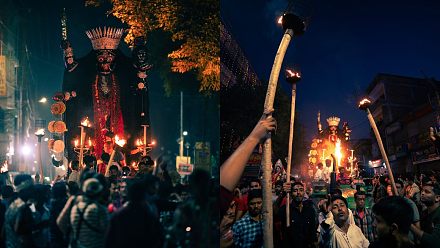
Shantipur's Famous Bama Kali Dance Is Moving After 56 Years: The Story Behind Bengal's Extraordinary Ritual
For 56 years, Barabazar More in Shantipur, West Bengal, has been the place to witness a religious spectacle unlike any other. A towering idol of Goddess Kali, carried on a bamboo framework, sways and dances to the beat o
Ni Lifestyle Desk··10K nabasa
Shantipur's Famous Bama Kali Dance Is Moving After 56 Years: The Story Behind Bengal's Extraordinary Ritual
For 56 years, Barabazar More in Shantipur, West Bengal, has been the place to witness a religious spectacle unlike any other. A towering idol of Goddess Kali, carried on a bamboo framework, sways and dances to the beat of dhaak as trained performers move in synchrony before thousands of devotees.
But this year, the famous Bama Kali dance is getting a new address. For the first time in more than five decades, the procession will move from its traditional venue to Bejpara ground, around 200 metres from the temple.
The decision follows crowd-management concerns during the 2025 celebrations, when the gathering reportedly came close to a stampede-like situation. After discussions between the organisers and the police, a larger venue was chosen to accommodate the crowds. The shift marks a change for one of Shantipur’s most recognisable religious traditions, which has drawn growing attention from devotees, visitors and social media creators alike.
But the real story lies in what happens when the procession begins. This is no ordinary idol immersion, nor is it a choreographed performance staged for an audience. The Bama Kali dance is a striking blend of devotion, physical endurance and ritual, with a history that goes back to the early days of the puja itself.
What Makes Shantipur’s Bama Kali Dance So Extraordinary?
View this post on Instagram
A post shared by Sammya Brata Mullick (@deckle_edge)
Imagine a massive idol of Goddess Kali being lifted onto a specially constructed bamboo structure. As the drums begin to beat, a team of trained performers moves the structure rhythmically, making the goddess appear to dance. The movements require strength, balance and remarkable coordination, particularly when the idol must be carried and manoeuvred through a large gathering.
According to reports, around 50 trained performers take part in the dance, supported by another 50 members of the organising club. Their synchronised movements, accompanied by traditional percussion, create a dramatic spectacle that draws thousands of spectators.
The idol itself adds to the visual impact, with the goddess depicted in her traditional form, her hair flowing freely and her iconography reflecting her fierce, protective presence. For the crowds gathered to witness the procession, the combination of music, movement and devotion makes the experience unlike a conventional religious gathering.
The dance takes place before the goddess’s immersion during the Kali Puja celebrations. It is this distinctive ritual that has helped Shantipur’s Bama Kali Puja become one of the region’s most talked-about festive events.
The Story Behind Shantipur’s Bama Kali Puja
The origins of the Bama Kali Puja in Shantipur date back to 1969, when worship reportedly began with a sacred pot, known as a ghat, rather than a full idol. The following year, in 1970, the worship of the goddess in idol form began, setting the stage for the tradition that would gradually develop over the decades.
The puja is organised by Netaji Subhas Sangha and is formally known as Shri Shri Charjijira Bama Kali Mata Puja. According to local accounts, its beginnings are associated with Yamuna Chowdhury, who is said to have received a divine instruction in a dream. The goddess was initially known as Yamuna Kali before becoming popularly identified as Bama Kali.
Over time, the annual worship developed its own distinctive procession, with the dance becoming a central attraction. What began as a local religious observance gradually drew devotees from surrounding areas and visitors keen to witness the unusual sight of the goddess being carried in a rhythmic, dance-like procession.
Today, videos of the Bama Kali dance circulate widely on social media, bringing the tradition to audiences far beyond Shantipur. The scale of the idol, the physical skill involved and the charged atmosphere of the gathering have all contributed to its growing popularity.
Why Is The Goddess Kali Worshipped With Such Fervour?
Kali occupies a powerful place in Bengal’s religious and cultural imagination. Often depicted with flowing hair and a fierce expression, she represents a formidable aspect of the divine feminine, associated with the destruction of evil and the triumph of divine power over destructive forces.
Kali Puja is among Bengal’s major religious celebrations, traditionally observed around the same time as Diwali in much of India. While Diwali is widely associated with the worship of Goddess Lakshmi, Bengal’s Kali Puja places Goddess Kali at the centre of the festivities. Homes and temples are decorated, offerings are made and devotees gather for rituals that continue late into the night.
In Shantipur, the Bama Kali procession adds another dimension to these celebrations. The goddess is not simply worshipped at a shrine; she becomes the centrepiece of a public ritual that brings the community together through music, movement and collective devotion.
Shantipur’s Bama Kali Dance Gets A New Venue
The move from Barabazar More to Bejpara ground comes after years of growing crowds made managing the gathering increasingly challenging. The 2025 celebrations reportedly saw a near-stampede-like situation, prompting organisers and the police to reconsider the traditional venue.
For visitors planning to witness the ritual, the venue change is an important detail to keep in mind this year. For those looking to discover Bengal beyond its better-known festivals, this unusual ritual offers a fascinating glimpse into the region’s living cultural heritage.