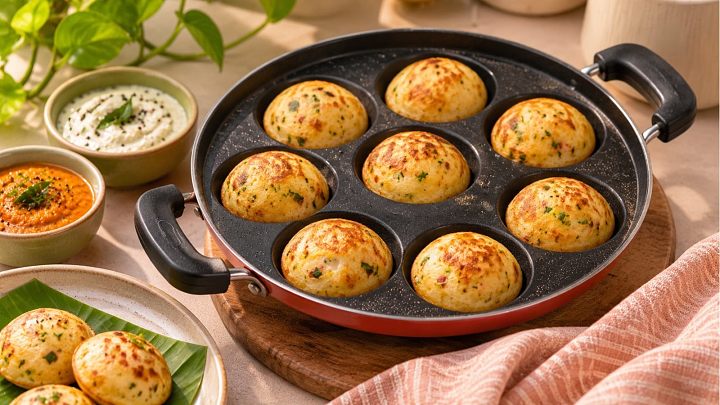
Paniyarams Without The Pan Drama: What To Look For In A Non-Stick Appam Pan
There is something rather satisfying about a plate of paniyarams: crisp, golden edges, a soft centre and just the right amount of chutney on the side. But getting those little rounds evenly cooked can depend as much on t
Ni Consumer Trends Desk··26K nabasa
Paniyarams Without The Pan Drama: What To Look For In A Non-Stick Appam Pan
There is something rather satisfying about a plate of paniyarams: crisp, golden edges, a soft centre and just the right amount of chutney on the side. But getting those little rounds evenly cooked can depend as much on the pan as it does on the batter.
A non-stick paniyaram pan makes the process easier, especially when you’re making breakfast or an evening snack on a busy day. The trick is to look beyond the number of cavities and the promise of an easy-release coating. The pan’s build, handle design and compatibility with your stove deserve a closer look too.
The coating matters more than the label
Most budget-friendly paniyaram pans use an aluminium body with a non-stick coating. This helps the batter release more easily and means you can use less oil while cooking. But not all coatings are described with the same level of detail.
Look for clear information about the coating and follow the manufacturer’s care instructions. Avoid heating an empty non-stick pan, use a low-to-medium flame and reach for wooden or silicone utensils rather than metal spoons. Abrasive scrubbers can damage the surface over time, so a soft sponge is a better choice.
Also, don’t assume that a product described as “non-stick” is automatically scratch-proof or built to last indefinitely. At this price point, careful use is especially important.
Seven, nine or 12 cavities: how many do you need?
The number of cavities determines how many paniyarams you can cook in one batch.
Seven cavities: A practical choice for smaller households or occasional use. The pan may also be easier to handle and store.
Nine cavities: A useful middle ground if you cook for a few people and want a reasonable batch size.
12 cavities: Better suited to larger batches, although the pan may be wider and heavier.
Check the cavity size as well. Smaller moulds make bite-sized paniyarams, while deeper or wider cavities can accommodate more batter. The listing should ideally show the pan’s diameter and cavity dimensions.
Handle heat: don’t overlook the grip
A handle that looks sturdy in a product photograph isn’t necessarily comfortable to use. Check whether it is made from Bakelite or another heat-resistant material, whether it is securely attached and whether the pan has one long handle or two side handles.
A single long handle can be convenient when lifting a smaller pan, while two side handles may offer a more balanced grip on a wider model. Even with heat-resistant handles, keep them away from direct flame and use caution when moving a hot pan.
Don’t forget the stove compatibility
Many entry-level aluminium paniyaram pans are designed for gas stoves. If you use induction, check for an induction-compatible base explicitly; a regular aluminium pan may not work on an induction cooktop. Also look for a flat, stable base so the pan sits securely on the burner.
A lid can be useful when you want the tops of the paniyarams to cook through, but check whether it is included rather than assuming it comes with the pan.
Paniyaram pans to consider
1. Tosaa Non Stick 7 Cavity Appam Patra with Lid, 17 cm – Silver & Black | The Desi Food
A compact option for smaller batches. The seven-cavity design is useful if you don’t need to cook a dozen paniyarams at once. Check the handle material and whether the lid is included on the current listing.
2. Cello Non-Stick 12-Cavity Appam Patra (with Dual Side Handles and Stainless Steel Lid) Online (1 Piece)
A larger-batch option with a 12-cavity layout and a steel lid. The listing describes a Bakelite handle; check whether you’re viewing the single-handle or two-side-handle version before ordering.
3. Anjali Appa Patra Non Stick With Lid Handle Diamond Series 280 Mm
A middle-ground option if seven cavities feel limiting but a 12-cavity pan seems too large. The nine-cup design offers a useful batch size; confirm the coating details and handle construction on the product page.
The final verdict
For a smaller household, a seven-cavity pan is a sensible starting point. If you’re regularly making paniyarams for the family, a 12-cavity model can save time. A nine-cavity pan sits comfortably between the two.
Whichever one you choose, prioritise a clearly described coating, a stable base, a secure handle and the right stove compatibility. And remember: even a good non-stick surface needs gentle handling to stay that way.