Mahalaya 2026: How To Perform Tarpan At Home, Mantras And Who Can Do It
Mahalaya 2026 will be observed on Saturday, October 10, marking Sarva Pitru Amavasya, the final day of Pitru Paksha. On this day, many Hindu families remember their ancestors through Shraddha, Tarpan and other customary
Ni Nibandh Vinod··28K nabasa
Mahalaya 2026: How To Perform Tarpan At Home, Mantras And Who Can Do It
Mahalaya 2026 will be observed on Saturday, October 10, marking Sarva Pitru Amavasya, the final day of Pitru Paksha. On this day, many Hindu families remember their ancestors through Shraddha, Tarpan and other customary offerings. For those who wish to perform a simple Tarpan at home, knowing the appropriate time, basic samagri, direction, offerings and prayer format can help them follow the tradition with care.
Mahalaya Amavasya is particularly significant because it is traditionally associated with offerings for known and unknown ancestors.
Read More: When Is Mahalaya 2026? Date, City-wise Timings, Significance And Rituals
Tarpan and Shradh are not identical rituals. Tarpan generally refers to offerings of water, often accompanied by sesame and other prescribed materials, while Shradh is a broader ancestral rite that can include offerings of food, Pinda and other components. Customs also differ between families, regions and traditions.
Mahalaya 2026: When should Tarpan be performed?
According to Drik Panchang, Mahalaya Amavasya falls on Saturday, October 10, 2026. The Amavasya Tithi begins at 9:35 PM on October 9 and ends at 9:19 PM on October 10.
Kutup Muhurat: 11:45 AM to 12:31 PM
Rohina Muhurat: 12:31 PM to 1:18 PM
Aparahna Kaal: 1:18 PM to 3:37 PM
Pitru Paksha Shradh is generally performed during the Kutup and Rohina Muhurats and continuing into Aparahna Kaal, with Tarpan performed toward the end of the Shraddha.
Traditional rules surrounding ancestral rituals vary considerably according to family custom, regional practice and the particular form of Shradh being performed.
The eldest son or male head of the family as the primary performer. That can reflect a traditional family practice, but it’s not a rule that only a male or eldest son can perform Tarpan.
In contemporary practice, families may follow their own lineage traditions, and the person undertaking the ritual may be guided by the family’s customary priest or religious authority.
The important distinction is between a specific tradition’s prescribed performer and a blanket statement about who is permitted to pray for ancestors.
If the family traditionally assigns the rite to a particular person, that custom can be followed. If there is uncertainty, particularly for a formal Shradh rather than a simple remembrance or Tarpan, consulting a priest can help establish the appropriate procedure.
Read More: When Is Dussehra 2026: Date, Time, Significance And Vijayadashami Muhurat
What is needed for Tarpan at home?
A clean vessel or lota, preferably copper or brass if traditionally used by the family.
Clean water.
Black sesame seeds (til).
Kusha or darbha grass, where prescribed by the family tradition.
Barley or rice, depending on the ritual being followed.
A clean plate or vessel to receive the offerings.
A clean cloth or asana for the person performing the ritual.
The materials used for a formal Shradh can also be more extensive than those used for a simple Tarpan.
How to perform Mahalaya Tarpan at home
Step 1: Bathe and prepare a clean space
Begin by bathing and wearing clean clothes. Traditionally, white or light-coloured clothing may be preferred for ancestral rites, although customs vary.
Choose a clean and quiet place for the ritual. Keep the water vessel, sesame seeds and other required materials ready before beginning.
For a formal Shraddha, follow the instructions of the family’s priest regarding seating, direction and ritual sequence.
Read More: Mahalaya 2026: What Is Mahishasura Mardini And Why Is It Associated With Mahalaya?
Step 2: Sit facing the prescribed direction
For Pitru-related offerings, south is traditionally associated with the ancestors and is commonly prescribed for Pitru Tarpan.
Step 3: Prepare the Tarpan water
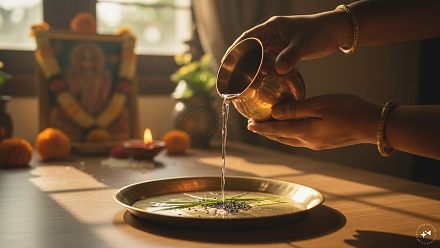
Take clean water in the vessel and add a small quantity of black sesame seeds.
Kusha or darbha grass may also be used according to tradition.
The offering should be made calmly and respectfully, with the mind focused on remembering one’s ancestors.
Step 4: Remember and invoke the ancestors
Before making the offering, mentally remember the departed members of the family.
If the family tradition requires it, their names and gotra can be recalled during the offering.
A commonly used Sanskrit prayer in ancestral rites is:
“ॐ पितृभ्यो नमः” (Om Pitribhyo Namah)
This is a simple salutation to the ancestors. Different traditions prescribe longer mantras and specific Sankalpa formulations, so a formal ritual should use the mantra prescribed by the family’s tradition or priest.
Step 5: Make the water offering
Take a small quantity of the prepared water and offer it in the prescribed manner.
Traditional Pitru Tarpan uses a specific hand position known as Pitru Tirtha. In many ritual traditions, the offering is allowed to flow from the area between the thumb and index finger rather than over the fingertips.
Because hand positions and accompanying mantras can differ between traditions, people unfamiliar with the procedure should avoid treating one particular mudra as mandatory for every form of Tarpan.
For a formal Shraddha, follow the instructions of the priest or the ritual text followed by the family.
Step 6: Name the ancestors where customary
If the names and gotra of the ancestors are known, they may be mentioned according to the family’s ritual tradition.
The exact sequence, such as paternal and maternal lineages, number of generations and the prescribed Sanskrit formula, varies according to the type of rite.
If the names of some ancestors are unknown, Mahalaya Amavasya is traditionally regarded as an important occasion for remembering known as well as unknown ancestors. Drik Panchang describes Sarva Pitru Amavasya as particularly significant for Shradh for all known and unknown ancestors.
Step 7: Offer prayers for all ancestors
After individual offerings, families may make a collective prayer for departed ancestors who are not individually named.
A simple prayer such as “Om Pitribhyo Namah” can be used as a salutation, while families following a particular Vedic or regional tradition should use the prescribed mantra for that tradition.
The emphasis should be on shraddha, faith, reverence and remembrance, rather than attempting a complex ritual without understanding its sequence.
What about fasting during Mahalaya Tarpan?
Some people perform Tarpan by staying empty stomach until the ritual is complete. Some also observe dietary restrictions or perform the ritual before eating, while others may follow different practices. There is no need to turn fasting into a mandatory condition for every home Tarpan.
If an elderly person, child, pregnant woman or anyone with dietary requirements is participating, religious practice should not be framed in a way that encourages them to ignore their nutritional needs.
For a formal Shraddha, follow the family’s established ritual instructions.
What food is offered after Tarpan?
Food offerings are an important part of many Shradh traditions, but the exact menu and sequence vary.
Families may prepare a simple sattvic meal and offer food as prescribed by their tradition. Common preparations can include rice, dal, vegetables, kheer and other vegetarian dishes.
Pancha Bali, the five sacred food, is also offered to cow, crow and dog by some followers.
Should Tarpan water be poured near a Peepal or Tulsi plant?
Yes, it can be poured at the base of a Peepal or Tulsi plant.
Can Mahalaya Tarpan be performed without a priest?
A simple home remembrance and water offering can be performed by families who are comfortable following their own established tradition.
However, formal Shradh ceremonies are more detailed and may involve Sankalpa, Pinda offerings, specific mantras, Brahmin bhojan, donations and other prescribed elements.
Mahalaya Tarpan 2026: A ritual of remembrance
Mahalaya Tarpan is ultimately about remembering and honouring ancestors. While the details of the ritual can differ from one family and tradition to another, the central idea is one of gratitude and remembrance.
For those observing Mahalaya at home, a simple and respectful practice is preferable to attempting unfamiliar ritual steps without guidance. Where a formal Shradh is intended, following the family’s established tradition or seeking guidance from a qualified priest can help ensure that the ceremony is performed correctly.
As Mahalaya marks the close of Pitru Paksha, it also carries a broader cultural significance: it is a moment when families pause to remember those who came before them before turning toward the festive season of Devi Paksha and Durga Puja.