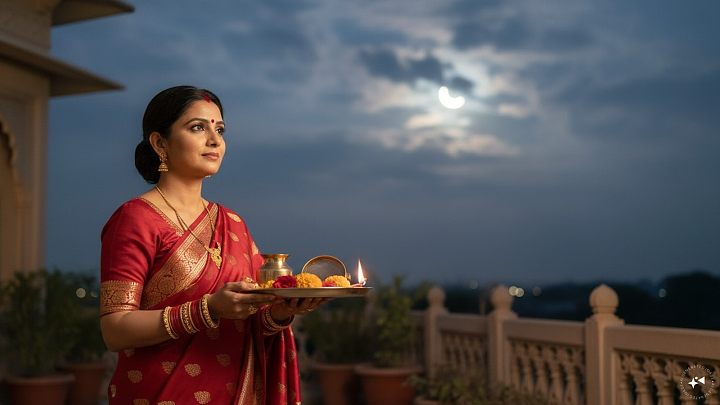
Karwa Chauth 2026: What To Do If You Cannot See The Moon
Karwa Chauth Moon Sighting: Karwa Chauth is one of the most widely observed Hindu festivals, with married women traditionally observing a day-long fast and offering prayers for the long life, health and well-being of the
Ni Nibandh Vinod··26K nabasa
Karwa Chauth 2026: What To Do If You Cannot See The Moon
Karwa Chauth Moon Sighting: Karwa Chauth is one of the most widely observed Hindu festivals, with married women traditionally observing a day-long fast and offering prayers for the long life, health and well-being of their husbands. In 2026, Karwa Chauth will be celebrated on Thursday, October 29, with the evening rituals and fast-breaking linked to the sighting of the Moon.
However, cloudy skies, haze, rain or obstructions from nearby buildings can sometimes make the Moon difficult to see. For devotees who cannot get a clear view of the Moon on Karwa Chauth, traditional alternatives are often discussed as ways to continue the evening worship.
Read More: Karwa Chauth 2026 Moonrise Time In India: When Will The Moon Rise In Delhi, Mumbai, Bengaluru, Kolkata And Other Cities?
Practices can vary across families, regions and religious traditions. Devotees who follow a particular family custom may wish to consult their priest or local Panchang for guidance on how to proceed.
Karwa Chauth 2026: What If the Moon Is Not Visible?
Moon sighting is an important part of the Karwa Chauth observance. After the evening prayers, devotees look at the Moon through a sieve, offer arghya (water offering) and then break their fast.
If the Moon remains hidden behind clouds or cannot be seen from the place of worship, there are several practices that devotees may consider.
These include symbolic worship of the Moon, prayers directed towards the Moon’s expected position and other customary forms of worship.
Read More: Karwa Chauth 2026 Moonrise Time In The US, UK And Canada: Check Timings For Washington, New York, London And Other Cities
Traditional Remedies When the Moon Is Not Visible on Karwa Chauth
Worship the Crescent Moon on Lord Shiva’s Forehead
In Hindu tradition, Lord Shiva is depicted with a crescent Moon on his forehead. Some devotional practices suggest worshipping an idol or picture of Lord Shiva when the actual Moon cannot be seen.
Devotees may offer prayers to Lord Shiva, focus on the crescent Moon depicted on his forehead and seek blessings. Those following this practice may also pray for forgiveness if the expected Moon sighting is delayed or prevented by weather conditions.
Create a Symbolic Moon Using Rice
Another suggested alternative involves creating a symbolic representation of the Moon for worship.
For this practice, devotees may place a red cloth on a wooden platform or chowki and arrange rice grains on it. A symbolic Moon can then be drawn or represented using the grains, followed by prayers and the customary offerings associated with the ritual.
Use a Silver Coin as a Symbol of the Moon
Some suggested practices involve using a silver coin to represent the Moon during worship.
A clean silver coin may be placed on a plate or on a bed of rice. Devotees may then offer roli, akshat (unbroken rice grains) and flowers, followed by prayers.
Check the Moon’s Expected Position and Offer Prayers
When clouds obstruct the view, devotees can check the local Panchang for the expected Moonrise time in their city.
They may then face the direction in which the Moon is expected to rise, offer prayers and follow the guidance of their family tradition regarding arghya.
It is important to remember that Moonrise times vary by location. A time published for Delhi, Mumbai or another city should not automatically be used for a different location.
Consider a Live Video Call as a Practical Alternative
Some families may consider viewing the Moon through a live video call if relatives or friends in another location have a clear view of it.
However, this is a practical suggestion rather than a established religious rule. Whether a remote Moon sighting is acceptable for completing the fast depends on individual beliefs, family customs and the guidance followed by the devotee.
Those who observe specific traditional requirements should seek clarification from their family priest before relying on this option.
Seek Guidance on Worship When the Sky Remains Overcast
If the sky remains completely covered and the Moon cannot be seen, devotees may continue their prayers while seeking guidance on the appropriate next step.
Lighting a diya and offering prayers is part of many practices. Some suggested approaches treat the sacred flame, or Agni, as a witness to prayer.
Devotees may consult their priest or follow the customs of their household to determine how to complete the observance.
Karwa Chauth 2026: Why Local Moonrise Timings Matter
Karwa Chauth will be observed on Thursday, October 29, 2026, in India. The date is determined by the relevant lunar calendar observance, while the local Moonrise time depends on the observer’s location.
For example, a Panchang listing for Mumbai gives an expected Moonrise of approximately 8:56 pm on October 29, 2026. Timings may differ slightly between sources because of calculation methods and location settings. Devotees should check a reliable, city-specific Panchang for the timing applicable to them.
The evening puja, Moon sighting and fast-breaking practices should be followed according to the family’s customary observance.
If clouds, haze or buildings prevent you from seeing the Moon on Karwa Chauth 2026, avoid assuming that one alternative ritual applies to everyone. Symbolic Moon worship, prayers to Lord Shiva and other devotional practices may be followed in some traditions, but their acceptance varies.
Checking the local Moonrise time and seeking guidance from a trusted family priest can help devotees decide how to proceed while respecting their religious customs.