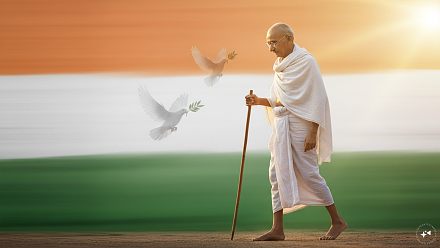
International Day Of Non-Violence 2026: Why It Is Observed On October 2
International Day of Non-Violence 2026 Date: Every year, October 2 is observed as the International Day of Non-Violence across the world. The date holds a special connection with India as it marks the birth anniversary o
Ni Nibandh Vinod··11K nabasa
International Day Of Non-Violence 2026: Why It Is Observed On October 2
International Day of Non-Violence 2026 Date: Every year, October 2 is observed as the International Day of Non-Violence across the world. The date holds a special connection with India as it marks the birth anniversary of Mahatma Gandhi, whose philosophy of non-violence, or Ahimsa, became central to his approach to social and political change.
Read More: Happy Gandhi Jayanti 2026: Top 80+ Wishes, Messages, Quotes, Images, Facebook And WhatsApp Status For October 2
In India, October 2 is also celebrated as Gandhi Jayanti. The United Nations observes the date as the International Day of Non-Violence to promote the principles of peace, tolerance, understanding and non-violence through education and public awareness.
Read More: Why Is ‘Mahatma Gandhi’ Calling You? What These Phone Calls Mean
Why Is International Day of Non-Violence Celebrated on October 2?
October 2 was chosen because it is the birth anniversary of Mahatma Gandhi, who was born on October 2, 1869, in Porbandar, Gujarat.
Mahatma Gandhi became one of the most prominent proponents of non-violent resistance during India’s freedom movement. His approach was rooted in Ahimsa, or non-violence, and Satyagraha, which emphasised truth and peaceful resistance in the face of injustice.
Read More: Gandhi Jayanti 2026: History, Significance, Facts, Celebration And All You Need To Know
The United Nations says Gandhi’s philosophy and strategy of non-violence have inspired movements for civil rights and social change around the world.
International Day of Non-Violence: History
The United Nations General Assembly established the International Day of Non-Violence through Resolution 61/271, adopted on June 15, 2007.
The resolution decided that the International Day of Non-Violence would be observed on October 2 every year. It also called for the message of non-violence to be spread through education and public awareness.
Read More: 75+ Happy Gandhi Jayanti Messages, Greetings, Wishes, Images And Quotes For 2026
The resolution highlighted the connection between non-violence, tolerance, human rights, democracy, development, mutual understanding and respect for diversity. It also reaffirmed the universal relevance of non-violence and the importance of building a culture of peace, tolerance and understanding.
The first International Day of Non-Violence was observed on October 2, 2007.
International Day of Non-Violence: Significance
The day serves as an opportunity to promote peaceful ways of addressing conflict and injustice. The UN describes the observance as a means of disseminating the message of non-violence through education and public awareness.
Read More: Happy Gandhi Jayanti 2026: 20 Powerful Quotes By Bapu That Continue To Inspire Generations
Its significance extends beyond Gandhi’s role in India’s independence movement. The broader principle is that dialogue, tolerance, respect for human rights and peaceful action can play an important role in addressing social and political differences.
The UN resolution also links non-violence with democracy, development, human rights, mutual understanding and respect for diversity.
Mahatma Gandhi’s Philosophy of Ahimsa
Ahimsa is commonly understood as non-violence or the avoidance of causing harm. For Gandhi, however, it was more than simply refraining from physical violence. It was closely connected with truth, self-discipline, tolerance and a commitment to peaceful action.
Read More: Gandhi Jayanti 2026: 10 Life Lessons From Mahatma Gandhi Through Rare Photos
Gandhi’s philosophy was reflected in Satyagraha, his method of non-violent resistance. Instead of responding to injustice through violence, Satyagraha sought to confront injustice through truth, non-cooperation, civil resistance and personal discipline.
Gandhi’s ideas later influenced movements for civil rights and social change in different parts of the world. The United Nations continues to describe him as a pioneer of the philosophy and strategy of non-violence.
Gandhi, Ahimsa And India’s Freedom Movement
Non-violent resistance became a defining feature of several major campaigns associated with Gandhi during India’s struggle for independence.
Gandhi advocated peaceful mass participation, non-cooperation and civil disobedience as ways of challenging colonial rule. His philosophy combined the principles of Satya, or truth, and Ahimsa, or non-violence.
The Government of India’s official tourism portal notes that Gandhi’s philosophy of Satya, Ahimsa and Swaraj became important principles of the independence movement and that his approach to non-violent resistance influenced civil rights movements around the world.
International Day of Non-Violence 2026: Why It Remains Relevant
The observance continues to focus attention on peaceful ways of dealing with conflict, intolerance and discrimination.
In his 2026 message for the International Day of Non-Violence, UN Secretary-General António Guterres paid tribute to Gandhi’s legacy and highlighted dialogue and non-violence as approaches to addressing injustice. He also pointed to the importance of empathy, dignity and shared humanity in a period marked by division, tension and conflict.
The UN’s wider observance also connects the idea of non-violence with peacebuilding, human rights education, peaceful relations and the prevention of conflict.
International Day of Non-Violence and Gandhi Jayanti
For India, October 2 has a dual significance. It is Gandhi Jayanti, marking Mahatma Gandhi’s birth anniversary, and it is also the United Nations’ International Day of Non-Violence.
Gandhi Jayanti is observed across India with programmes and ceremonies honouring Gandhi and his principles. October 2 is also a national holiday in India.
The international observance gives the date a wider global significance, linking Gandhi’s legacy with the universal principles of peace, tolerance, understanding and non-violence.