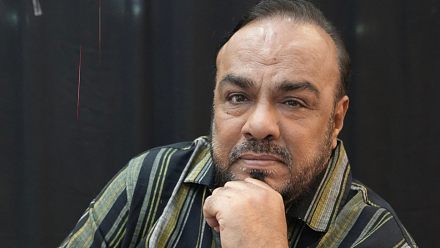
Mehboob On Rangeela, AR Rahman, Maa Tujhe Salaam And Today’s Music Industry: ‘You Have To Change With Time’ | Exclusive
Mehboob rewrote one of Rangeela’s most famous songs on the back of a boarding card. The first version of ‘Kya Kare Kya Na Kare’ had already been recorded when Ram Gopal Varma called him from Chennai with a problem. The e
Ni Yatamanyu Narain··52K nabasa
Mehboob On Rangeela, AR Rahman, Maa Tujhe Salaam And Today’s Music Industry: ‘You Have To Change With Time’ | Exclusive
Mehboob rewrote one of Rangeela’s most famous songs on the back of a boarding card. The first version of ‘Kya Kare Kya Na Kare’ had already been recorded when Ram Gopal Varma called him from Chennai with a problem. The emotion was right, but the words were too polished for Munna. “This character cannot speak like this,” was essentially the note. Mehboob got on a flight, looked at the boarding card in his hand and began stripping the lyricist out of the lyric. What remained was Munna.
Thirty-one years later, that story still explains a great deal about the way Mehboob thinks about songs. He does not romanticise complexity for its own sake. A film lyric, he insists, has to know who is speaking, what that person would actually say and where the song sits inside the story. Sometimes that means writing twenty minutes of lyrics for an AR Rahman composition and then sitting together to discover ‘Hai Rama’ somewhere inside it. Sometimes it means being told by Ismail Darbar to “thoda halka ho jao” until you understand that simplicity is not the enemy of poetry. And sometimes the biggest compliment comes not from another writer, but from a waiter telling your director, “Aapka writer hum log ki zabaan likhta hai.”
There is some wistfulness when Mehboob talks about the older way of making music. Nights in studios stretched over tea, coffee and conversations that had nothing to do with the song until, somehow, they did. One lyricist could live with an entire screenplay and give an album a common tongue. Songs were expected to carry a film forward rather than briefly decorate it. He knows that world has changed. Songs are shorter, albums have splintered into singles, and writers may now receive a tune on their phones instead of spending hours in the same room as the composer. His response, however, is not to mourn indefinitely. If the song is only ninety seconds long, he says, then the craft has to reveal itself within those ninety seconds.
In an exclusive conversation with News18 Showsha, Mehboob revisits the making of Rangeela and the beginning of his partnership with AR Rahman, recalls how ‘Tadap Tadap’ travelled from one film into another, and explains why ‘Maa Tujhe Salaam’ deliberately avoided the familiar language of patriotic sacrifice. He also speaks about the health problems that kept him away from regular film work without ever making him stop writing, the disappearance of cohesive soundtrack albums, why lyricists still deserve greater recognition, and his frustration with an industry that repeatedly mines old songs instead of giving new ones enough time to become someone else’s nostalgia.
Here are the excerpts:
Q. Mehboob sir, Rangeela completed 31 years this year. The songs you wrote for the film have remained evergreen, and the album also marked the beginning of an iconic partnership between you and AR Rahman. What do you remember about your very first meeting with him for this project?
There is actually a small story behind that.
Before Ramu ji called me to Chennai, I was working with him on another film. I was in Hyderabad at the time. One day, I switched on the television and there was a programme or documentary about Rahman playing. I remember watching it and thinking, “Yaar, iske saath kab kaam karenge?” He had already become such a major music director by then.
Q. You were working on Drohi around that time?
Drohi was there, yes, and there were some Telugu films as well. In hindsight, I sometimes feel as though God was preparing me for what was going to come later.
Because just a few months after I had watched that programme and thought about working with Rahman, Ramu ji called me. He said, “I have signed Rahman for Rangeela, and we have to meet.”
So I went to Chennai to meet him.
And obviously, I had already formed an image of Rahman in my head. Roja had happened by then. He was this huge name. When I finally went there, I remember looking at him very carefully. He was sitting there, very quiet, very composed, almost lost in thought.
You build a certain image of somebody before meeting them, especially when their work has already made such an impact. So that first meeting stayed with me.
Q. Rangeela was also being made at a time when Rahman’s sound felt completely new to Hindi cinema. His rhythms, compositions and entire musical vocabulary were very different from what Hindi film music had been accustomed to. As a lyricist, did you have to consciously break some of your old writing habits to adapt to that sound? How challenging was that?
I have always said that Ramu ji had already given me two films before Rangeela, so I had got the practice of writing on tunes.
The musical approach there was different from what we were used to here. So, in a way, I had already been prepared for it.
That is why I did not find it difficult at all. In fact, I enjoyed the rhythms. I enjoyed that new kind of sound and the new working habits that came with it.
Rahman also worked a lot at night, and I was already somebody who stayed awake very late. I had always had this habit of reading and writing at night. Staying awake until two or three in the morning was completely normal for me.
So even in terms of the working hours, I did not feel that I had entered some completely unfamiliar world. I never found that process difficult. I enjoyed it.
Q. What is striking about Rangeela is that every song seems to speak a different language. Munna cannot sound like Mili, and a song like Tanha Tanha cannot possibly use the same vocabulary as Kya Kare Kya Na Kare. Were you consciously building a different vocabulary for each character while writing the album?
It happened very naturally because you had to understand the feeling and personality of each character.
For some situations, a certain lightness and a slightly poetic quality were necessary.
Then you have Mili. She is educated. She is an aspiring actress. So there are certain phrases and expressions that she can naturally use because her language and her background allow her to speak that way.
Munna, on the other hand, has a completely different vocabulary.
There is actually one incident connected to this that I remember very clearly.
Q. Is this the story about the original version of Kya Kare Kya Na Kare?
Yes. When I first wrote that song, I had written it while keeping the character and the situation in mind, but the language was a little more poetic.
There was something along the lines of, “Soorat se bhi aankhein mila, do chaar…” That kind of writing.
We recorded that version.
Then I came back to Bombay. After that, Ramu ji called me and said, “Main baar-baar gaana sun raha hoon.”
He felt that the emotion was correct, but the words had become too poetic for Munna. Essentially, he was saying, “This character cannot speak like this.”
So I went back to Chennai.
And I still remember this very clearly. When I was taking the flight, I got my boarding card, and I started rewriting the lyrics on that boarding card itself.
That is how the language began changing.
I thought, “If I am writing for this character, I have to write the way he actually speaks.”
And once you understand that, the writing becomes very natural.
Q. So the rewrite was essentially about stripping away the lyricist’s poetry and allowing Munna himself to speak?
Exactly. You have to listen to the character.
There is another incident I remember. One day, Ramu ji was sitting in a restaurant. A waiter came up to him and said something like, “Sir, aapka jo writer hai na, woh hum log ki zabaan likhta hai.”
Imagine that.
A very ordinary person comes up and says, “He writes the way we speak.”
When Ramu ji told me that, I was extremely happy.
Because then you feel that you have achieved something. If somebody from that world can listen to the song and say, “Yeh hum logon ki zabaan hai,” then somewhere you have managed to find the language of that character.
For a lyricist, that is a huge compliment.
Q. Thirty-one years later, do you feel Hindi film songs have become less attentive to character? That songs today are sometimes written without asking how that particular person in the film would actually speak?
You may be right. I cannot say this very confidently because, to be very honest, I do not listen to that much of what is happening in show business today. So perhaps this is happening.
But it should not happen.
The song should belong to the character.
If a character speaks in a particular way, the song should not suddenly make him sound like somebody completely different.
That was something we were very conscious about in Rangeela.
With Munna, for example, we deliberately kept the language very simple and very open. Even lines such as “Chhodo chhodo…” have that quality. They are not trying to sound literary.
Munna needed simple language because that is how he speaks.
So when you write for a character, you have to remain within that world. The vocabulary has to come from him, not from the lyricist trying to show how beautifully he can write.
Q. In Tanha Tanha, you write about female desire and sensuality quite openly, but the song never feels crude or reduces the woman to an object. When you were writing it, were you consciously trying to maintain that balance between sensuality and the woman retaining her own agency?
Honestly, the idea of looking at a woman as an object was never there in my mind in the first place.
For me, the central feeling was simply, “Tanha tanha yahan pe jeena…” What is the joy in living alone?
We were also involving Jackie’s character in the song to some extent because, if you look at the film, Jackie is lonely too. There is that aspect of his life as well. So, in a way, the song could slightly mislead you into thinking about both Jackie and Urmila and where these emotions were headed.
But I was not sitting there thinking so deeply about sensuality or objectification. My thought was simply to write a good song around that feeling of loneliness and the desire for companionship.
For me, Tanha Tanha is actually a very graceful song. At the same time, of course, it is also very sensual.
And then there is Mili herself. She is an aspiring actress. She dreams of becoming an actress, and through the film you can see her gradually moving towards that world. So the song also had to belong to that imagination and that phase of her journey.
When I wrote it, Ramu ji liked it a lot. There was hardly any need to change it. And then, of course, it became an Asha ji song.
Q. Of all the songs on the album, Hai Rama is my personal favourite because its musical structure is so unusual. It is almost a conversation between two characters, but the dialogue itself is intensely lyrical. We rarely hear songs structured like that anymore. Did Rahman first compose it and then you wrote to the composition, or did the lyrics come before the tune?
No, no. Whenever you work with Rahman, you have to write on the tune. The lyrics do not come first.
What happened with Hai Rama was quite interesting. Rahman had created this entire musical piece, and it was around 20 minutes long.
Ramu ji brought the whole thing to me.
Now imagine what I did. I wrote lyrics for the entire 20 minutes!
I thought Ramu ji would eventually cut it down and select whatever portions he wanted. But then the question became, how do you actually create a proper song structure out of something that long?
So Rahman said, “Let’s sit together.”
We sat in his studio, he played the entire piece, and then we started selecting and editing the lines together. He would work on his computer, we would discuss which portions should remain, where one section should come in, where another should go, and that is how the final structure of the song emerged.
So the actual song structure of Hai Rama, the way you hear it today, was created through that process of us sitting together and shaping this much longer composition.
That was the beauty of working that way. You could sit together, listen to something, discuss it and discover the song inside it.
Q. That also seems very different from the way a lot of music is made today. Earlier, lyricists, composers and filmmakers would physically sit together for hours. You have spoken about spending nights working with composers such as AR Rahman as well. Today, someone can simply send a tune on the phone and say, “Write something on this.” Do you think losing that environment has been detrimental to songwriting?
See, times change. That is simply a fact. Our era was different. We became accustomed to working in a certain way. But today the world is different, and we have changed with it too.
If somebody sends me a tune today, I can write on it. That is not a problem.
But yes, there was something about that earlier process which does not really exist in the same way anymore.
You would sit together throughout the night. Tea would come, coffee would come. You would talk about the world, you would discuss completely unrelated things, then suddenly you would return to the song.
There was brainstorming happening all the time without anybody necessarily calling it “brainstorming”.
That whole atmosphere contributed to the work.
For me particularly, those nights were an important part of the creative process. You were not simply receiving a tune and supplying lyrics to it. You were spending time with the people involved, understanding what everybody was thinking, talking about life, and somewhere in the middle of all that, the song would emerge.
That experience has largely disappeared now.
Q. You recently wrote Ishq Tamasha with Adnan Sami, which is an independent song rather than something tied to a film. Does writing independently make you feel freer as a lyricist, or does having the boundaries of a screenplay and a specific situation sometimes make the writing easier?
Independent songwriting definitely removes certain boundaries.
When you are writing for a film, you are working within a particular framework. There is a story, there is a character, there is a situation, and you know that there are certain boundaries you should not cross.
With an independent song, you step outside that box.
Whatever you feel, whatever you want to express, you can explore it. There is no director sitting there telling you that the character cannot say this or that the situation does not permit that.
So that has its own pleasure.
But I also really enjoy writing for situations. A good situation itself can be very exciting for a writer because it gives you something specific to respond to.
Both experiences are enjoyable in different ways.
With an independent song, though, you become your own master to a much greater extent. You can decide what you want to say and how you want to say it. That freedom is great fun.
Q. What was the brief from Adnan Sami for Ishq Tamasha? Did he come to you with a specific idea or emotion that he wanted you to capture?
There was no rigid brief like that. We had the tune, and we sat together with it.
That is something I really enjoy about working with Adnan. He also belongs to that school of working where people actually sit together and discuss things.
We would discuss the theme. Tea would come, coffee would come. Then we would start talking about the world and completely different things. After some time somebody would say, “Chalo yaar, kaam karte hain.”
Four or five hours could easily pass like that.
We kept listening to the tune and discussing what kind of concept could work with it. Because it was an independent song, there was no screenplay telling us what the story had to be. The concept had to come from us.
We kept thinking, “What could the story be? What could this song actually be about?”
And somewhere during those conversations, the idea of Iss Tamasha came to us.
I remember thinking about that expression and saying that I really liked it. From there came this idea of a relationship itself turning into a tamasha if the person you depend on also leaves you. That is how the emotional thought behind the song began taking shape.
Once that thought arrived, we knew what world the song belonged to.
And Adnan created a beautiful composition. He also sang it beautifully. Eventually, the song connected with people and became a hit, which was wonderful.
Q. When an artiste returns after a considerable gap, there can be this expectation that the work must somehow prove that they still sound contemporary. While writing Ishq Tamasha, did you ever feel any pressure to make the lyrics sound specifically like they belonged to 2026?
No. I did not feel any such pressure. I say the same thing in almost every interview: just give your best.
Now, if it is 2026 and the music has to sound contemporary, perhaps Adnan has thought about that musically. That is his area. He may have approached the composition or production with that in mind.
But my job is to write what feels right to me.
You write according to the instincts and habits you have developed as a writer. You cannot keep sitting there thinking, “I have to write this for today’s generation,” or, “I have to make this sound modern.”
Arre bhai, just write a good song.
Write something that feels good to the listener, something that touches the heart, something that people can connect with.
The moment you start forcing yourself to sound “modern”, it stops sounding natural.
So whatever had to be done musically to make it contemporary, Adnan would have thought about that. As far as the lyrics are concerned, I wrote them the way I naturally write.
Q. Many of your major albums, whether Rangeela or Hum Dil De Chuke Sanam, have a very strong lyrical identity because one lyricist wrote the entire film. Today, it is quite common for different songs in the same album to be assigned to different lyricists. What gets lost when an album no longer has one consistent lyrical voice?
That practice of giving different songs to different people has become quite common now. But if you look at the older way of working, the process was completely different.
When we were writing a film, the director would sit with us and narrate the entire story.
Q. The whole story, not merely the situations for the songs?
The whole story. Then he would explain each situation and why that particular song was coming at that point.
There was another important thing earlier. Songs actually carried the film forward.
They were connected to the film. You did not simply say, “Yahan ek love song daal dete hain,” and put a romantic song there because the film needed one.
A song was part of the narrative.
And when it is part of the narrative, the lyricist knows who this character is, what has happened to him before this song and what is going to happen to him after it. All of those things remain somewhere in your mind while you are writing.
That is a huge advantage when you are writing for a film.
Now, if you have six or seven people involved, three different lyricists, multiple music directors, there can naturally be confusion. How much of the story will each person understand? How will everybody arrive at the same language and the same sound for that family of characters?
Personally, I am a little against that approach.
If you look back at our musical history, many films had a certain continuity because the people creating the songs understood the entire world of the film. The result was that the soundtrack itself began to feel like one complete story.
Take Rangeela. You know what Munna is, who Mili is, what Jackie’s character is. Once all of that is clear to you, the language comes from those people.
That continuity matters.
Q. You have spoken about how Ismail Darbar helped you understand that poetry and film lyrics are two different disciplines. After so many years of songwriting, what do you think is the biggest mistake a poet can make when writing for cinema for the first time?
I would not say it is some huge or catastrophic mistake. The main thing a poet has to understand is that in cinema, you sometimes have to express a very deep thought in very simple words.
You have to use a language that ordinary people can understand.
That is really the difference.
When you are independently writing poetry, you can write poetry for poetry’s sake. You can go as deep or as complex as you want because the poem belongs entirely to you.
Film songwriting is different.
I remember Ismail would constantly tell me, “Thoda halka ho jao. Thoda halka ho jao.”
Simplify it.
And sometimes I would get frustrated.
There was even an occasion when I tore the paper because I was so frustrated with having to keep changing what I had written.
But Ismail was extremely patient with me.
He would let me get angry. Twenty minutes later, when my anger had cooled down, he would say, “Ab bolo, kya likhna hai?”
He explained it to me very simply. He said, “Poetry likho. Film mein ek gaana poetry ka de denge. Baaki gaane simple words mein likho.”
That stayed with me.
Once I understood that, things became much easier.
Then you write something such as Chand Chhupa Badal Mein. Look at those songs from that period. The words are very simple, but that does not mean the emotion is shallow.
Once I understood that simplicity itself could carry depth, it was no longer difficult.
Q. You mentioned earlier that Tadap Tadap had originally been created for Mukul Anand’s project Dus, where the song was conceived in a very different context, with a Sufi flavour. It eventually became Sameer’s heartbreak song in Hum Dil De Chuke Sanam. Emotionally, what survived between those two completely different versions?
Actually, the song itself was not completely different.
Q. So the original lyrics were already similar?
Yes. The mukhda and the first antara were already there.
At that stage, that was as much of the song as we had written.
When it eventually came into Hum Dil De Chuke Sanam, I wrote the second antara after understanding the film and the exact situation.
That is when I wrote:
“Agar mile Khuda toh…”
That portion came later.
I had now understood where the song was being placed in the story. Salman’s character is being separated from the person he loves. Once that situation was in my mind, the second antara came from that pain.
So “Agar mile Khuda toh poochhunga…” was written after I got the film and understood the situation.
The mukhda and first antara, however, were already with us from before.
The earlier conception had more of a Sufi or qawwali-like treatment. But emotionally, the core of the song was already there.
Q. Maa Tujhe Salaam has now become much bigger than the album it originally came from. Whether it is Independence Day, Republic Day, an Indian sporting victory or almost any major national celebration, the occasion can feel incomplete without that song. When you were writing it, did you have any sense that it might eventually belong to generations of listeners in this way?
Absolutely not. Not at all.
What we did know was the audience we wanted to reach. We were consciously thinking about young people.
And when we later started seeing children singing it, that itself made us very happy. We thought, “Chalo, bachche gaa rahe hain.”
But did we imagine that it would become this big? That people would give it so much love and almost embrace it to their chests? No. We could never have imagined that.
Of course, the composition has played an enormous role in what the song eventually became. The music is a very big part of its life.
But once we knew that we wanted to speak to young people, we consciously brought the language down to something very direct and simple.
There was also one argument I had about the way patriotism was traditionally expressed in songs.
Whenever we wrote patriotic songs, there was often a lot of talk about sacrifice. Hum jaan de denge. Khoon baha denge.
And I said, of course, if the country demands it, we will give our lives. That goes without saying.
But do we have to keep saying only that?
Can we talk about our country in another way?
Can we approach patriotism from a different emotion?
That was important to me.
Q. So you consciously wanted to move away from the conventional vocabulary of patriotic sacrifice?
Yes. One thing I had observed was that so many Indians live outside India.
They may be living somewhere else physically, but in their hearts they remain Indian.
That thought stayed with me.
And gradually, the concept became that this is not simply somebody returning to a country. It is somebody returning to his mother.
He is coming back to Maa.
That changed everything.
Once that concept came, the first line emerged from that emotion.
And perhaps that is why the thought became universal.
Look at it today. Even people who are 18 or 25 years old connect with the song with exactly the same energy.
When India won the World Cup, you saw Virat Kohli and the others singing it. They were singing the whole song.
That tells you something.
Today, if there is an Independence Day programme in a school and somehow that song does not play, it almost feels as though something is missing.
What more can a writer ask for?
At that point, you can only thank the people.
They have given this song so much respect and so much love that it no longer really belongs to us in the same way.
Through you, I would actually like to thank people for the amount of love they have given Maa Tujhe Salaam over all these years.
Q. Sir, stepping away from writing was not really a choice for you. You had to do it because of your health. Did that make the phase even more difficult, because emotionally you had never really left songwriting, but physically you were not always able to work?
See, there comes a time in life when, as they say, you are tested.
I had a problem with my back, and there were some other health issues as well. Then there was a period when one challenge seemed to follow another. Sometimes you reach a phase in life where you feel that the person above is testing you.
One thing I have always believed, and I tell my family the same thing, is that there will always be positivity and negativity around you. You have to choose positivity.
I was in a lot of pain at the time. There was a stage when I could not even stand for more than five or eight minutes. I simply could not manage beyond that.
The doctors supported me a lot, and gradually things started improving.
But during that entire period, there were two things I never stopped doing. I did not stop writing, and I did not stop reading.
If I could not go out or work normally, what could I do? I read books. I used books to pass my time. I continued studying and reading whatever I could.
So my time passed, my knowledge increased, and in a way, there was also a certain brushing-up of the mind. I decided to take advantage of that period rather than simply look at what I had lost.
Of course, I could not do many films during those years. That is a different matter. I may have worked less, but I learnt more.
Q. Your life itself has been quite a journey. Have you ever thought about writing your autobiography?
A few people have told me that. They keep saying, “Why don’t you come out with a book?”
Let us see.
There is a saying that everything has its own appointed time. Har cheez ka waqt muqarrar hai.
If that too is meant to happen, then we will write it.
Q. By the time you properly returned to the industry, almost everything had changed. Streaming had arrived, there was the culture of reels, songs had become considerably shorter, and even the idea of a cohesive film album had become more fragmented. Which of these changes was the hardest for you to adjust to?
Let me tell you something. Anand Bakshi sahab was like a guru to us. He was extremely affectionate towards me.
There is an incident I will never forget. He was unwell at the time, and we had gone to meet him. My younger sister had always wanted to meet Bakshi sahab. And who would not want to meet somebody so great?
When she finally met him, she introduced herself and said, “Bakshi sahab, main Mehboob sahab ki behen hoon.”
And Bakshi sahab said, “Mehboob toh mera jaanasheen hai.”
Even now, when I remember that, I get goosebumps.
One of the things Bakshi sahab always taught us was that you have to change with time.
He would repeatedly say that it is very important to move with the times because a person cannot remain exactly the same forever. If the world changes and you refuse to change with it, how will you continue?
So yes, the scene has changed.
There is less music in films now. Songs have become one-and-a-half minutes long. Sometimes they are almost being used like background music.
But that is where your craft should come in.
If somebody gives you only a minute and a half, show your karigari within that minute and a half. If you can still create something memorable within those limitations, that is your achievement as a writer.
I have accepted the present time.
Fine. If somebody wants a one-and-a-half-minute song, I will try to write something worthwhile within those one and a half minutes.
You have to adapt. Adaptation is extremely important.
And who knows? They say the hands of a clock keep moving. Perhaps tomorrow things will turn again. Maybe three-minute songs will return, four-minute songs will return, five-minute songs will return, and we will once again have two or three antaras.
That would be great fun!
Q. You have also said earlier that lyricists deserve the same kind of recognition that singers and composers receive. Has the streaming era improved that situation at all, or has it made things worse?
I would say things have remained more or less the same. They have not completely deteriorated, but neither have they dramatically improved.
However, I have noticed one positive change.
People have started asking, “Who wrote this song?”
They are paying attention to the writer now.
That matters.
My only point is this: when you sing a song, all those expressions that appear on your face come from somewhere. You cry, you laugh, you smile, you romance. Those emotions have been put into words by somebody.
So give a little recognition to the person who wrote those words as well.
Music and lyrics belong together. A song needs both. Neither can really complete the song without the other.
Q. Our industry also celebrates nostalgia enormously. But sometimes it feels as though we do not invest the same amount of patience in new music, the kind of patience that would allow a song released today to become somebody’s nostalgia ten or twenty years later. Do you think that could become a serious problem?
I think these phases always come and go. This phase will pass too. Nostalgia has its own place. I have nothing against nostalgia. But my point has always been that India is filled with talent. Our country is filled with music.
So make new songs. Create new things. I always advocate that. The old songs have already been made. They are there. They have earned their place.
How long are you going to keep presenting the same things again and again? Sometimes I do not understand the purpose of doing that.
Do we not have talent anymore? Tell me that.
By the grace of God, India is a country overflowing with talent.
So create good songs. Put some effort into it. Scratch your head a little. Think. Search for something new.
There are so many talented people here. Give them the opportunity to create the songs that people will remember tomorrow instead of constantly returning to the songs they already remember today.
Q. Sir, what are your upcoming projects? Are you currently working on anything that you can talk about?
There are films that I am working on, but I cannot reveal their names right now because there are certain production protocols.
I am working on three or four films at the moment.
Q. That is great. Are there singles as well?
Yes, there are singles too. There is independent work as well as film work. As and when these projects come out, you will get to hear them.
Q. I personally hope that you and Rahman sir come together for another album someday. The album era has almost disappeared now and everything seems to revolve around singles. People from my generation, those of us who are around 30 and grew up listening to complete albums, really miss that culture. I certainly do.
The album culture is not really there anymore. Right now, it is mostly singles.
But I also pray that the culture of albums comes back.