‘Didn’t Want To Add Weight Of Tragedy’: Amrita Bagchi On Playing Ajay Ahuja’s Wife In Safed Sagar
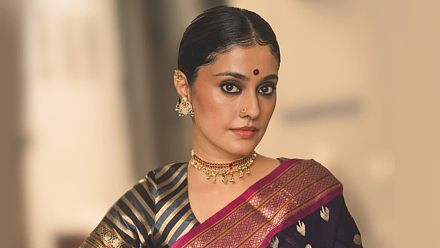
Actor Amrita Bagchi, who plays Alka Ahuja, the wife of Squadron Leader Ajay Ahuja, in Safed Sagar, says the role demanded restraint rather than melodrama. From meeting Alka Ahuja and understanding her memories of her hus
Ni Kamalika Sengupta··151K nabasa
‘Didn’t Want To Add Weight Of Tragedy’: Amrita Bagchi On Playing Ajay Ahuja’s Wife In Safed Sagar
Actor Amrita Bagchi, who plays Alka Ahuja, the wife of Squadron Leader Ajay Ahuja, in Safed Sagar, says the role demanded restraint rather than melodrama. From meeting Alka Ahuja and understanding her memories of her husband to spending time in Air Force environments, Bagchi says the experience helped her approach the character as a real woman living her life—without allowing the knowledge of a tragic ending to dictate her performance.
What was your experience of working on Safed Sagar?
The experience was incredible because the entire team was determined to present the truth in a realistic way. When films or series like this are made, you cannot approach them with melodrama. What intrigued me most about taking up the project was the creators. Oni Sen, Abhijit Parmar and definitely Kushal Srivastav, who has an Air Force background, brought a very particular understanding to the project. The best part of my preparation was that they never wanted me to mimic or copy Alka (wife of Squadran leader Ahuja) ji. I was simply told to meet her, observe her and make my own notes. Later, they would guide me on what they wanted from the character.
When I met Alka ji, I understood why they had given me that instruction. They wanted me to remove the gravitas and heaviness that one might naturally associate with the story. As actors, we tend to anticipate tragedy. We know what is going to happen to the character and unconsciously start putting that knowledge into our performance. But nobody knows when they are living through a particular moment that it is going to end tragically. The makers did not want me to play the character with that awareness.
So, I approached the role in two ways. First, through my meeting with Alka ji. I listened to her speak about Squadron Leader Ajay Ahuja and observed her closely. The second was through the guidance of Abhijit, Onir and Kushal, who supported me throughout the process.
Tell us about your preparation and your meeting with Squadron Leader Ajay Ahuja’s wife, Alka Ahuja.
My interaction with Alka ji was extremely enlightening. For many years, she did not receive the validation that she is receiving now, 25 years later. There has been a transition in Alka ji over these years. I could not simply ask her, ‘How were you back then?’ Instead, as she narrated her memories and walked me through her life with Ajay ji, I began to see glimpses of the woman she had been. I realised that she is someone who has always had tremendous resilience. She is a strong person, and that was very clear to me. She has always made her own decisions.
Ajay ji, from what I understood, also ensured that she was able to do what she wanted. They had an astonishing friendship, and that aspect of their relationship was very important for me to understand. There was a particular scene where Alka takes Ajay ji’s sweater measurements before he leaves for war. That was a very challenging scene for me because I knew the ending. I knew that he would not return. But there was no reason for Alka to be worried at that particular moment. They were going to take photographs, and they had done such things before. Ajay ji was absolutely Superb in such operatio, and there was nothing for her to be worried about.
There was also the incident involving some money that she wanted to send to him through Baldy. She handed over the money, and eventually it remained in their pockets. Later, when the coffin arrived, it was not the right size and another one had to be brought. The money was ultimately used for that. That particular detail is not part of the film, but I knew the complete story. I kept wondering how I would perform the scene knowing everything that was going to happen. The makers helped me understand how to separate what I knew as an actor from what Alka knew as a wife at that moment.
What was it like shooting in Air Force environments and experiencing that discipline?
It was a very good experience. We had to hand over our phones, and personally, I enjoyed that. It contributed to the bonding within the team. We would sit together, look at the sky, drink tea and have Maggi. We were actually able to enjoy the environment and the experience without constantly being distracted by our phones.
We also met several Air Force families, and they helped us in every possible way. They would even bring us cakes at two in the morning that they had baked for us. In many ways, we felt as though we had gone back to the 1990s. We played Antakshari and spent time together. Those experiences became an important part of the process.
Is there any particular memory from the shoot that you will always remember?
Every single day was special, but one day that stands out was when we shot the sequence featuring ‘Kali Kali Aankhen’. Normally, we were shooting in different pockets and the entire team was not together. But that day, everyone came together. We had already shot different portions and this particular sequence showed another side of Squadron Leader Ajay Ahuja. He was a very fun-loving person. We came across a photograph in which Ajay ji was playing like a puppet. When I saw that photograph, I realised just how much fun and life he brought into his relationships. That day was particularly special for all of us.
How has the response been after the release?
Alka ji’s response has been very positive. Her son also messaged me. Alka ji told me, ‘You did very well.’ She said she could not completely gauge how she herself had been at that age, but she got a sense of the home they used to have. There were no mobile phones or videos at that time, so these memories are particularly precious for her. She told me that the series had brought back memories of Ajay ji and the life they had shared. She also told me that other people had messaged her about my performance. Her response was very important to me—it felt like receiving my report card from the person whose life I was portraying.
Do you think more such stories should be made?
Absolutely. We salute the work that our armed forces do, and there should be more realistic films and series about these heroes. But such stories should be told realistically. People should understand the human cost of war and what war actually means for the families who live through it. It is important to remember not just the uniform and the sacrifice, but also the lives, relationships and families behind those sacrifices.