"[The classification] doesn't mean that anyone should panic," said the Environment Agency's area director for Wessex, Ian Withers.
"It reinforces the importance of water and looking after it and we would urge people to take extra care to use less wherever they can.
"It also means that we can work together with water companies to make sure they do everything necessary to preserve and prolong the water that is in Wimbleball," he said.
Successive heatwaves over the summer put excessive strain on the water supply and led Wessex Water to implement its first hosepipe ban for 50 years, as demand reached 440 million litres per day.
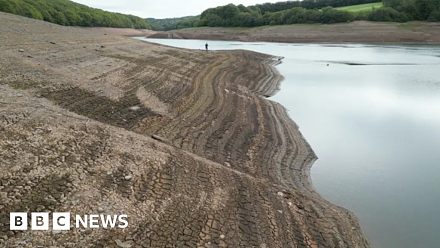
The record-breaking temperatures were then followed by below-average rainfall in the early part of autumn, which has left reservoirs well below their usual levels of about 75% for this time of year.
"September rainfall was less than half the long-term average and we haven't had enough rain to recharge the reservoir to a level that we would like," said Withers.
"While recent rainfall is helping, water resources remain under significant pressure and South West Water continues to rely heavily on water stored in reservoirs," added Sam Bottomley, South West Water's director for drinking water services.
Much of the UK, including the rest of Somerset, remains in a state of drought.
But a spokesperson for the Environment Agency said no other parts of the Wessex Water area were close to reaching severe drought.
According to Wessex Water, reservoir levels across Somerset are at an average capacity of 24%, well below the long-term average for this time of year.
Here are the current water levels of reservoirs in the area:
Both the Environment Agency and the water companies say the declaration will not affect residents.
"Our customers shouldn't be concerned and we're working extremely hard to maintain supplies," said Will Willoughby, director of water supply at Wessex Water.
"We've got a grid network that means that we can move water from those areas that have got more water to those that don't.
"At the moment, we're using that really effectively to bring water into the area that Wimbleball supplies to prevent and reduce the run rate on the reservoir," he added.
The Environment Agency said moving water around the grid did not put added pressure on other areas and the effects on the environment were being monitored.
The Environment Agency said it needed enough rainfall to refill Wimbleball reservoir and other water storage sites and "a sustained period of wetter-than-average weather over the coming months [is needed] before water levels recover fully".
"Many people understandably think a drought is over once it starts raining," said Bottomley.
"After such a prolonged dry period, rainfall first has to replenish dry soils and the wider environment before rivers return to seasonal levels," he explained.
Residents and businesses are therefore being urged to continue to try and save water.
Will Willoughby, director of water supply at Wessex Water, said "customers responded well" to the initial hosepipe ban and he asked them to continue making small changes around water use.
The severe drought classification raises wider questions around investment in water retention and infrastructure.
"We haven't built a reservoir in this country for some decades," said Withers.
"Previously, investment wasn't made in our water infrastructure as well as it could have been and that's now being addressed," he added.