US Midterm Elections 2026: From Black Woman Governor To Muslim Senator, The Many Firsts
The 2026 US midterm elections are turning out to be about much more than which party will control Congress. As votes are counted and victories are declared across the country, the results are also redrawing the boundarie
Por Pragati Ratti··32K lecturas
US Midterm Elections 2026: From Black Woman Governor To Muslim Senator, The Many Firsts
The 2026 US midterm elections are turning out to be about much more than which party will control Congress. As votes are counted and victories are declared across the country, the results are also redrawing the boundaries of political representation in America, with women, Black candidates, Native Americans and members of the LGBTQ+ community breaking barriers that have stood for generations. Follow Live updates here
From Georgia electing the first Black woman governor in American history to Ohio preparing to welcome its first woman governor, the elections have produced a remarkable list of milestones. Some victories have ended decades-long political dominance, while others have opened doors that had remained firmly shut to particular communities.
The results have also delivered surprises in traditionally Republican strongholds, underlining how the political mood of the country is changing under President Donald Trump.
Here are some of the biggest historic firsts emerging from the 2026 US midterm elections.
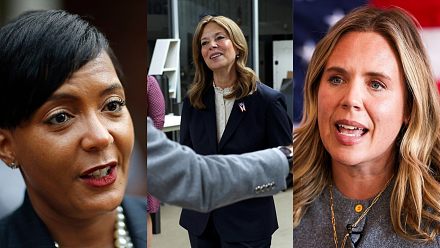
1. Keisha Lance Bottoms becomes America’s first Black woman governor
One of the most significant breakthroughs of the election night came from Georgia, where Democrat Keisha Lance Bottoms has made history by becoming the first Black woman elected governor in the United States.
The former Atlanta mayor defeated Republican businessman Rick Jackson, overcoming a campaign in which her opponent reportedly spent more than $200 million of his personal fortune.
The victory is significant on two fronts. It breaks a historic racial and gender barrier in American politics and flips Georgia’s governorship to the Democrats after more than two decades of Republican control. The state’s governor’s office had been in Republican hands since 2002.
Bottoms, who served as Atlanta’s mayor during the Covid-19 pandemic and the protests following the killing of George Floyd, campaigned on issues including healthcare access, minimum wages, abortion rights and economic affordability.
Her victory also carries considerable symbolic weight in the Deep South, where Black voters have long played a crucial role in Democratic electoral victories but have remained underrepresented in the highest elected state offices.
2. Amy Acton set to become Ohio’s first woman governor
Ohio has another historic milestone to celebrate. Democrat Amy Acton has defeated Republican Vivek Ramaswamy to become the state’s first woman governor.
The victory is particularly significant in a state that has been under Republican gubernatorial control for 16 years. Acton is also the first Democrat to win the governorship since 2006.
A physician by training, Acton came into the national spotlight during the Covid-19 pandemic when she served as Ohio’s health director. Her public health experience became a central part of her political identity, although her pandemic record also came under sustained attack during the campaign.
She campaigned on affordability, prescription drug access and property-tax relief, while Ramaswamy focused on tax cuts, energy costs and law and order.
Acton’s victory demonstrates that Democrats have managed to make significant inroads even in states that backed Trump convincingly in the 2024 presidential election.
3. Annie Andrews makes history as South Carolina’s first elected woman senator
In another major breakthrough, Democrat Annie Andrews has won South Carolina’s Senate race, becoming the first woman elected to represent the state in the US Senate.
A paediatrician by profession, the 45-year-old defeated Republican Darline Graham in a closely watched contest that delivered an unexpected Democratic victory in a traditionally Republican state.
The seat had been held by Republicans since 1998. Graham had been appointed to serve the remainder of her brother Lindsey Graham’s term following his death in July, before securing the Republican nomination for the election.
Andrews built her campaign around healthcare access, affordability and tackling corruption in Washington. Her professional background as a doctor also helped her make healthcare a central issue.
Her victory is significant beyond the gender milestone. It represents a major political upset in a state that Donald Trump won by 18 percentage points in 2024. It also gives Democrats an unexpected Senate pickup as they seek to strengthen their position in Congress.
4. Abdul El-Sayed Wins Michigan Senate
One of the most closely watched Senate contests has produced another historic breakthrough. Democrat Abdul El-Sayed has defeated Republican Mike Rogers in Michigan’s US Senate race, according to Decision Desk HQ’s results tracker.
El-Sayed has become the first Muslim American elected to the US Senate.
A physician, epidemiologist and former director of the Detroit Health Department, El-Sayed entered the contest with a progressive agenda focused on healthcare, economic inequality and campaign finance reform.
His campaign also faced controversy over his Muslim identity and his positions on the Israel-Gaza conflict. President Donald Trump had attacked him during the campaign, using inflammatory rhetoric that El-Sayed and his supporters criticised as Islamophobic.
The Michigan contest was particularly important because it involved an open Senate seat being vacated by Democrat Gary Peters.
Decision Desk HQ’s reported results put El-Sayed at 53.34 per cent against Rogers’ 44.90 per cent, with 714,825 votes to 601,649.
5. Deb Haaland becomes the first Native American woman governor
The New Mexico gubernatorial race has delivered another landmark moment, with Democrat Deb Haaland becoming the first Native American woman elected governor of a US state.
A member of the Laguna Pueblo community, Haaland has already been a trailblazer in American politics. In 2018, she was among the first two Native American women elected to the US House of Representatives. She subsequently became the first Native American to head a Cabinet department when President Joe Biden appointed her secretary of the Interior.
Her latest victory takes Indigenous representation to another level, placing a Native American woman in charge of a state’s executive government.
Her election is particularly meaningful given the long history of political exclusion experienced by Native American communities. As Haaland herself told the Associated Press when discussing the significance of representation: “Somebody has to be the first. I just don’t want to be the last.”
6. Gina Hinojosa becomes Texas’ first Latina governor
Texas, one of America’s most politically significant Republican strongholds, has also witnessed a historic change. Democrat Gina Hinojosa has defeated three-term Republican Governor Greg Abbott, becoming the state’s first Latina governor.
Her victory is notable both for its demographic significance and the political upset it represents. Texas has been a Republican stronghold in presidential and gubernatorial contests for years, making the Democratic breakthrough particularly consequential.
Hinojosa will also be the first woman to lead Texas since Ann Richards left office in 1995.
The result gives Hispanic representation a historic milestone in a state where Latino voters constitute a significant part of the electorate. It also adds to a remarkable election night for Democratic women candidates across the country.
7. Peggy Flanagan becomes the first Native American woman elected to the US Senate
The US Senate has another historic addition with Minnesota Lieutenant Governor Peggy Flanagan becoming the first Indigenous woman elected to the chamber.
A citizen of the White Earth Band of Ojibwe, Flanagan defeated Republican Michele Tafoya in Minnesota’s Senate contest.
Her victory is particularly important for Native American representation in national politics. Although Native Americans have served in Congress before, no Native American woman had previously been elected to the US Senate.
Flanagan’s political journey has included years of work on education, healthcare and Indigenous rights. Her election marks a significant step forward for communities that have historically had limited representation in the country’s highest legislative chamber.
8. Chris Pappas becomes the first openly gay man elected to the US Senate
Another important milestone has emerged from New Hampshire, where Democratic Congressman Chris Pappas has won the Senate race, becoming the first openly gay man elected to the United States Senate.
Pappas defeated former Republican senator John E. Sununu for the state’s open Senate seat.
His victory is a landmark for LGBTQ+ representation in a chamber where openly gay men had not previously been elected. Pappas, who has represented New Hampshire in the House of Representatives, had maintained that his campaign was about representing voters rather than making history.
The victory nevertheless carries significance for a political institution that has gradually become more diverse over the years.
9. Byron Donalds becomes Florida’s first Black governor
The historic breakthroughs have not been limited to Democrats. Republican Congressman Byron Donalds has won Florida’s gubernatorial race, becoming the state’s first Black governor.
Donalds’ victory is particularly notable because it makes him the first Black Republican elected governor of a US state.
His election, alongside Bottoms’ victory in Georgia, means two Southern states will have Black governors for the first time in their histories.
The development also demonstrates that the 2026 election’s representational milestones are not confined to one political party.
10. Amy Klobuchar becomes Minnesota’s first woman governor
Minnesota has also broken a longstanding gender barrier with Democrat Amy Klobuchar winning the gubernatorial election to become the state’s first woman governor.
Klobuchar, who has served as a US senator from Minnesota, will now move from Capitol Hill to the governor’s office.
Her victory is part of a broader pattern emerging from this election: women are not merely increasing their numbers in legislative chambers but are also breaking through to the highest executive positions in states across America.
11. David Crowley becomes Wisconsin’s first Black governor
Wisconsin has joined the list of states making history, with Democrat David Crowley winning the gubernatorial race to become its first Black governor.
Crowley, who previously served as Milwaukee County executive, has broken a significant racial barrier in a state that has never elected a Black person to its highest executive office.
His victory adds another name to an expanding list of Black leaders taking charge of state governments. Alongside Georgia’s Keisha Lance Bottoms and Florida’s Byron Donalds, Crowley’s win underlines the growing diversity among America’s governors.
It also means the number of Black governors in the country is set to rise considerably from the small handful who have held the office in the nation’s 250-year history.
12. Juliana Stratton’s victory means Illinois will have two women senators of colour
Democrat Juliana Stratton has defeated Republican Don Tracy in Illinois, securing another significant milestone for representation in the US Senate.
Stratton, who currently serves as Illinois lieutenant governor, will succeed retiring Democratic Senator Dick Durbin.
Her victory means Illinois will become the first state represented by two women senators of colour. She will serve alongside Democratic Senator Tammy Duckworth, who is of Thai heritage.
It will also take the number of Black women serving in the US Senate to three, marking an important moment for representation in a chamber where women of colour have historically been significantly underrepresented.
13. Rebecca Bennett delivers a major Democratic upset in New Jersey
One of the closely watched congressional contests has also produced a significant breakthrough for Democrats. Rebecca Bennett has defeated Republican incumbent Tom Kean Jr. in New Jersey’s 7th Congressional District.
A former Navy helicopter pilot with 15 years of military experience, Bennett entered the race as a political newcomer. At 39, she also brought a different professional background to the contest, having worked as a healthcare industry executive.
Her victory is particularly notable because Kean had won re-election comfortably in 2024 and entered the contest with considerable name recognition and financial resources.
The Associated Press called the race for Bennett on election night, making it one of the significant Republican-held House seats to flip to the Democrats.
Her win adds to the broader Democratic gains across competitive districts as the party seeks to regain control of the House.
14. Stacey Plaskett breaks another barrier in the US Virgin Islands
Another historic development has come from the US Virgin Islands, where Stacey Plaskett has become the first Black woman elected to lead a US territory.
The milestone adds another dimension to the election’s broader story of representation, extending beyond state governorships and seats in Congress.
Her victory is particularly significant given the historic underrepresentation of Black women in executive political offices across the United States and its territories.
A changing face of American politics
Beyond individual victories, the 2026 midterm elections have delivered a broader message about the changing composition of American political leadership.
According to the Associated Press, nearly 300 women, including incumbents, were running for seats in the US House and Senate. The gubernatorial contests also featured a record number of women candidates, with 19 Democratic women and seven Republican women seeking governorships.
The Senate results have been equally consequential. Democrats have secured control of the chamber, with historic victories in states including South Carolina, Kansas and Texas. In Kansas, Adam Hamilton’s victory marks the first time a Democrat has won a US Senate seat in the state since 1932. James Talarico’s victory in Texas similarly ends a Democratic Senate drought dating back to 1988.
These results are unfolding alongside a broader political setback for Republicans, with Democrats also making significant gains in the House and in gubernatorial races.
What makes this election particularly remarkable is that the historic breakthroughs have come from across racial, ethnic, gender and sexual identities, and from both sides of the political aisle.
For a country that has spent much of its history debating who gets to occupy positions of power, these victories carry significance well beyond party arithmetic. They represent communities entering political spaces where they were once largely absent.
The real test, however, will begin after the celebrations. Breaking a barrier is one thing; governing effectively, delivering on campaign promises and ensuring that these breakthroughs translate into lasting political change is another.
But for the candidates who have made history this November, the significance of election night is already unmistakable: several offices in American politics will never look quite the same again.