‘There Are Parallels Everywhere’: Tharoor On Whether Congress Can Emulate Democrats’ Midterm Gains In 2029
Congress can draw encouragement from the setbacks suffered by populist and right-wing leaders across the world, including US President Donald Trump’s Republican Party in the 2026 midterm elections, but political developm
Por Shankhyaneel Sarkar··47K lecturas
‘There Are Parallels Everywhere’: Tharoor On Whether Congress Can Emulate Democrats’ Midterm Gains In 2029
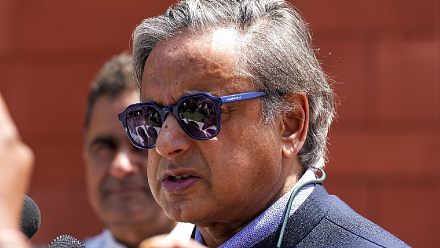
Congress can draw encouragement from the setbacks suffered by populist and right-wing leaders across the world, including US President Donald Trump’s Republican Party in the 2026 midterm elections, but political developments abroad cannot be treated as a blueprint for India, Congress MP Shashi Tharoor has said.
Speaking to CNN-News18 anchor Poonam Burde, Tharoor was asked whether the political setback suffered by Republicans in the US could offer a template for the Congress to challenge Prime Minister Narendra Modi and the BJP in the 2029 Lok Sabha elections.
“Intelligent people always like to look around and see sort of parallels and examples that strengthen their argument. I think that’s all there is,” Tharoor said, cautioning against drawing direct comparisons between political developments in different countries.
He said the Congress believed that the anti-incumbency factor could work against the BJP, much as it had against Trump and his party in the US. However, Tharoor stressed that every country had its own political circumstances.
“I think looking at how anti-incumbency worked out with Mr Trump, we feel that there is a good possibility it’ll work out against the BJP regime here,” he said.
Tharoor also cited Brazil and Hungary as examples of political developments that could offer encouragement to the Opposition in India. Referring to Brazilian President Luiz Inacio Lula da Silva’s electoral comeback, he said Lula’s ability to defeat a candidate associated with a populist, nationalist and right-wing political message could offer lessons for Indian political parties.
“Lula’s ability to fight back against a candidate who very much reminds you of the populist nationalist chauvinist right-wing message that the BJP gives in India and Lula managed to win in Brazil can also give heart to people in India,” he said.
He added that a politics focused on ordinary voters, poorer sections and people at the margins of society could find resonance in India.
Tharoor also pointed to Hungary, where Viktor Orbán, whom he described as someone considered “the Narendra Modi of Hungary”, was defeated earlier this year.
“If you want to find parallels to inspire you, you can find parallels everywhere,” he said, while underlining that such comparisons should not be taken as predictions of electoral outcomes in India.
“Each country has its own realities. I’m not going to be simplistic in saying that one or the other is possible,” he added.
THAROOR SAYS INDIA’S ECONOMIC REALITIES DIFFER FROM US
Earlier in the interview, Tharoor cautioned against comparing the economic concerns driving American voters with the challenges faced by Indians.
Burde had pointed to India’s projected economic growth of 7%, against a 2.3% projection for the US, and cited figures suggesting that nearly 500 million Indians had moved out of poverty. She asked whether the economic contrast could explain the different political conditions in the two countries.
Tharoor said the poverty figures being discussed in India related to people living below a threshold of $4 a day — a level of subsistence that, he argued, most Americans had not experienced since the Great Depression.
“If you think of American consumers in Indian terms, you’re really thinking of the Indian middle class,” he said, adding that American voters were more likely to judge the administration on salaries, affordable consumer goods and fuel prices.
In India, he said, the economic concerns were often more fundamental.
“Food inflation is real. A lot of people are paying far more for food items than they can afford to pay and they’re not happy about that. Unemployment is real,” Tharoor said.
He also flagged graduate unemployment, arguing that young people who study at reputed institutions often find themselves without jobs or meaningful opportunities.
“All of this, Poonam, I think you have to understand, puts us in a very different place, a much worse place than America,” he said.
Tharoor argued that this could make anti-incumbency in India more pronounced than what was witnessed in the US.
“Which is why if people are going to say, well, this sarkar has put us in this condition and therefore we’ll vote against it, I think the anti-incumbency factor could be much more severe in India than perhaps it was in the United States,” he said.
Towards the end of the interview, Tharoor also took a swipe at the conditions under which Indian voters would eventually get to express their political preferences, saying that the country would find out when voters got a “fair and free chance minus Mr Gyanesh Kumar to actually cast their votes and determine their own political destiny.”