‘Terrorist, Why Did You Come Here?’ Muhammad Yunus Faces Fury Of Bangladeshi Expats In New York
Bangladesh’s former interim government chief adviser Muhammad Yunus faced angry protests from Bangladeshi expatriates at New York’s John F Kennedy International Airport on Monday, with demonstrators accusing him of under
Por Prisha Vibhavari··57K lecturas
‘Terrorist, Why Did You Come Here?’ Muhammad Yunus Faces Fury Of Bangladeshi Expats In New York
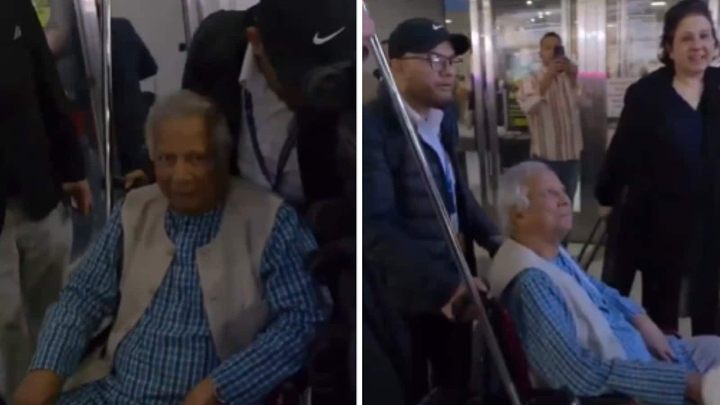
Bangladesh’s former interim government chief adviser Muhammad Yunus faced angry protests from Bangladeshi expatriates at New York’s John F Kennedy International Airport on Monday, with demonstrators accusing him of undermining democracy and being responsible for deaths during his tenure.
Yunus arrived at the airport on October 12 aboard a Qatar Airways flight from Doha. A video circulating on social media showed a group of people confronting him after he reached Terminal 8, Dhaka-based Daily Sun newspaper reported.
What Did Expats Say
“You, terrorist, why did you come here? You have destroyed the democracy in my country!” a man was heard shouting at Yunus in the footage.
Muhammad Yunus has been spotted at JFK airport, New york.
“You, terrorist why did you come here. You have destroyed the democracy in my country!” https://t.co/SjUMUc7WIg
— subash kumar (@Krishan10_) October 13, 2026
The video shows people hurling accusations at the former chief adviser as he was being taken out of the airport in a wheelchair. Some called him a “terrorist”, accused him of killing Bangladeshis and police personnel, and shouted, “Go back”.
Security personnel subsequently escorted Yunus away from the scene. People present at the airport said Yunus and Lamia Morshed, who was accompanying him, briefly moved back inside the airport amid the confrontation, according to the report.
The identities of those involved in the incident and further details surrounding the confrontation could not be immediately confirmed.
Also Read: Ex-Adviser Claims Bangladesh Army Chief Opposed Yunus As Interim Leader: ‘He Raised Two Objections’
The protesters also alleged that around two lakh people had been arrested in Bangladesh and blamed Yunus for the deaths of thousands of police personnel. The allegations made by the demonstrators could not be independently verified.
Yunus Faced Criticism Over Law And Order
Yunus led Bangladesh’s interim administration after former prime minister Sheikh Hasina was ousted in a student-led uprising in August 2024. His government faced criticism from political opponents over its handling of violence and unrest in the aftermath of Hasina’s departure.
The Awami League and other critics accused the interim administration of failing to prevent attacks on political supporters and maintain law and order.
The period also saw concerns raised over attacks on Hindu communities and places of worship, allegations of arbitrary arrests and custodial deaths, and questions about accountability for alleged abuses.
In January 2026, an ordinance introduced by Yunus’s administration restricted routine criminal investigations into certain actions by participants in the July–August 2024 uprising covered by its protections.
Under the framework, allegations of killings, including those involving police personnel, were referred to the National Human Rights Commission (NHRC) to assess whether the acts constituted political resistance or criminal conduct.
India-Bangladesh Ties Also Came Under Strain
Relations between India and Bangladesh also deteriorated during Yunus’s tenure. His remarks in China in March 2025 about India’s northeastern states drew criticism in India, while disagreements over minority safety and other bilateral concerns added to tensions.
Also Read: ‘My Absence Is Not Silence’: Sheikh Hasina Vows Return To Bangladesh, Says Awami League ‘Cannot Be Erased’
New Delhi repeatedly called for restraint in public rhetoric and greater attention to the protection of minorities in Bangladesh.
Yunus Handed Over Power After Elections
Yunus stepped down as head of Bangladesh’s interim administration on February 16, ahead of the transfer of power to an elected government.
In his farewell address, the Nobel Peace Prize laureate urged the country to preserve democratic practices and civil liberties.
“Today, the interim government is stepping down. But let the practice of democracy, freedom of speech, and fundamental rights that has begun not be halted,” he said.