Student Movement Could Topple Vucic’s 12-Year Rule As Serbia Heads To High-Stakes Polls
Serbia is set for a crucial parliamentary election on Sunday, as a student-led movement seeks to break Aleksandar Vucic’s 12-year hold on power and bring about a major shift in the country’s political landscape. The vote
Por Aanchal Sinha··34K lecturas
Student Movement Could Topple Vucic’s 12-Year Rule As Serbia Heads To High-Stakes Polls
Serbia is set for a crucial parliamentary election on Sunday, as a student-led movement seeks to break Aleksandar Vucic’s 12-year hold on power and bring about a major shift in the country’s political landscape. The vote presents the most significant challenge to the long-serving leader since his Serbian Progressive Party (SNS) came to power in 2012.
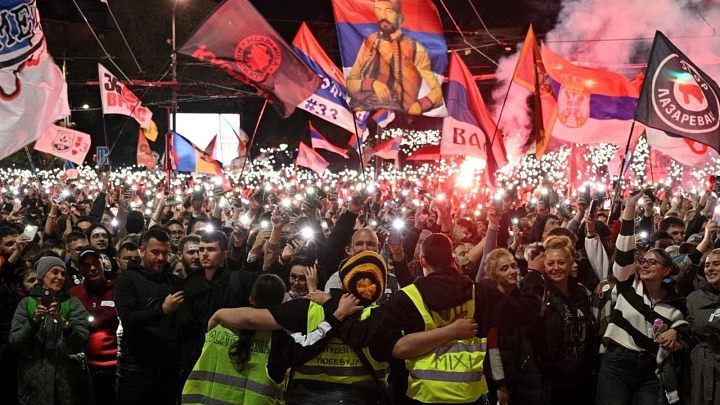
The Student List, which emerged from nearly two years of anti-corruption protests, is at the centre of the electoral challenge. The movement gained momentum after 16 people died when a concrete canopy collapsed at a railway station in Novi Sad on November 1, 2024.
Protesters blamed alleged corruption and irregularities in infrastructure work for the disaster, which triggered widespread public outrage against the government. So far, no official has been held accountable.
Student demonstrations soon developed into one of Serbia’s biggest protest movements in a generation. The campaign attracted support from people concerned about corruption, political interference and what they view as an increasingly authoritarian system.
CAN THE STUDENT LIST TURN PROTESTS INTO POWER?
The students are now taking their campaign from the streets to the ballot box, fielding a list of 250 candidates chosen through student-led assemblies at universities across Serbia. The candidates include academics, professionals, actors and farmers, many of whom have never been involved in electoral politics.
Leading the list is Ilija Srdanovic, a cardiologist and professor at Novi Sad University. However, he is not the movement’s designated leader and would not automatically become prime minister if the group wins.
The movement has deliberately steered clear of a traditional leadership structure. It argues that collective decision-making offers an alternative to the concentration of power that it accuses Vucic’s government of promoting.
Speaking to the BBC, Srdanovic described his participation as an opportunity to stand with students seeking change. He said the candidates represented the values of a civilised society, which he believes the current regime has undermined.
The election, for the students, is not simply about replacing the ruling party. Their campaign centres on accountability, freedom of speech and public safety, with the slogan “Serbia or Mafia?” challenging perceptions of connections between political power and organised crime.
The government has rejected allegations of corruption and links to criminal networks, insisting that it is taking action against organised crime.
WHAT’S FUELLING ANGER AGAINST VUCIC’S GOVT?
Public dissatisfaction with the government extends well beyond university campuses and protest sites. In Krnjaca, a suburb of Belgrade, student volunteers going door to door encountered residents willing to discuss issues ranging from corruption to neglected infrastructure.
Among the concerns raised were poorly maintained roads, a bridge linking the suburb to central Belgrade and a sewage system that repeatedly breaks down during heavy rainfall.
Residents complained that promises to resolve these problems had not been fulfilled, despite Serbia’s economic expansion and the arrival of luxury car showrooms alongside neglected public spaces.
Corruption remained a recurring concern among residents. Critics have also alleged that the ruling SNS has close links with organised crime, claims that the government denies.
FROM A RAILWAY DISASTER TO BALLOT BATTLE
The student movement emerged following the November 1, 2024, collapse of a concrete canopy at the railway station in Novi Sad, Serbia’s second-largest city. The incident killed 16 people and triggered widespread anger.
The station had recently been renovated as part of a major infrastructure project promoted by Vucic, which included a high-speed railway connection between Belgrade and Budapest.
Protests spread across the country after the disaster. The movement gained further momentum when students holding a vigil for the victims in Belgrade were attacked by a group reportedly linked to the ruling party.
As the protests grew, students maintained their distance from established opposition parties and resisted the formation of a conventional leadership structure.
This approach has helped the movement avoid the internal disputes and personal attacks that have frequently weakened Serbia’s opposition groups.
By bringing together candidates from different professional backgrounds, the Student List aims to distinguish itself from the existing political establishment rather than present itself as another conventional opposition party.
VUCIC’S BIG BET ON SNAP POLLS
Vucic remains a formidable contender after holding several key positions, including deputy prime minister, prime minister and president, since 2012. His supporters credit him with sustaining economic growth and advancing modernisation through investments in highways, railways, schools and hospitals.
A significant section of the electorate continues to support his image as a strong leader who safeguards Serbia’s national interests.
However, his critics accuse the government of weakening democratic institutions, dominating the media landscape and failing to establish accountability for the Novi Sad railway station disaster.
In September, Vucic stepped down as president, five months before the end of his second and final constitutional term, to contest the election to return as prime minister.
By calling snap elections, he appeared to be seeking a fresh mandate before the student movement could consolidate its political challenge.
The students have continued their campaign, attracting large crowds at rallies and reaching out to voters directly. Their final campaign gathering in Belgrade’s Slavija Square reportedly drew around 150,000 people, while the SNS organised its own event featuring Vucic as the sole speaker.
The contrasting approaches highlight the central choice confronting Serbian voters: a political system dominated by a single leader or a movement promising collective decision-making and a departure from established political practices.
Vucic has also accused the student movement of receiving foreign backing and attempting to destabilise the state. The students have rejected these allegations. The ruling party has separately faced criticism over media bias and the use of public resources during previous elections.
VUCIC, STUDENTS IN A NECK-AND-NECK RACE
The outcome remains uncertain, with opinion polls offering conflicting assessments of the contest. While some surveys put the students ahead, others indicate stronger support for the ruling party.
An Ipsos poll published on Thursday placed the SNS at 47 per cent and the Student List at 40 per cent. An earlier survey conducted by Serbia’s Centre for Research, Transparency and Accountability and Stanford University found greater support for the student movement.
The contrasting figures highlight the uncertainty surrounding an election that could prove to be a turning point in Serbian politics. Analysts have cautioned that a close result, combined with disputes over the legitimacy of the outcome, could increase the risk of unrest after voting.
International election observers reported a substantial advantage for the ruling party in the 2023 parliamentary election, pointing to unequal media coverage and the misuse of public office and resources.
The election could also affect Serbia’s international relationships. Vucic has sought to balance ties with the European Union, Russia and China, maintaining relations with Moscow and Beijing while keeping the prospect of EU membership open.
The Student List, by contrast, has concentrated largely on domestic concerns and provided fewer details about its foreign policy priorities. Vucic has questioned whether the movement would preserve Serbia’s relationships with Russia and China, warning that a change of government could jeopardise those ties.
The students have prioritised tackling corruption, restoring accountability and improving public institutions. Their biggest challenge is to turn the momentum of a mass protest movement into enough electoral support to unseat a leader who has dominated Serbian politics for more than a decade.