Oval Office Declared National Monument: What Does Trump's First Post-Midterm Action Mean?
In his first major executive action following a stinging electoral defeat for his Republican Party, US President Donald Trump signed a presidential proclamation designating the Oval Office, the Outer Oval Office, and the
Por Oindrila Mukherjee··40K lecturas
Oval Office Declared National Monument: What Does Trump's First Post-Midterm Action Mean?
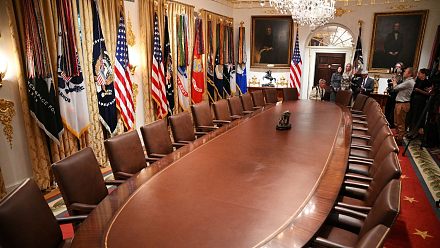
In his first major executive action following a stinging electoral defeat for his Republican Party, US President Donald Trump signed a presidential proclamation designating the Oval Office, the Outer Oval Office, and the Cabinet Room as a national monument managed by the National Park Service.
President Trump invoked the 1906 Antiquities Act to grant the historic executive suites formal status as the “Oval Office National Monument”.
This move aims to establish an added layer of federal protection for these specific executive working spaces as a discrete historic structure of national significance, extending beyond the longstanding designation of the White House as a national historic landmark.
Before signing the document on Thursday (November 5), Trump framed the designation as an essential measure to safeguard the rooms for future generations while describing them as “very important spaces”.
“I’m going to be signing a document, which will make them into a landmark for the ages,” Trump told reporters.
He said the proclamation will “make it impossible for anybody ever to destroy this incredible space” and prevent future occupants from dismantling the rooms or carrying out architectural changes.
Far from binding the hands of future administrations, however, the official proclamation explicitly leaves interior decoration powers intact and remains vulnerable to complete revocation by subsequent commanders-in-chief.
WHAT IS THE SIGNIFICANCE?
The signing ceremony came immediately after the November 3 midterm elections, in which the Republican Party suffered severe defeats.
Democrats were projected to reclaim control of both the House of Representatives and the Senate, dramatically shifting the balance of power in Washington and ushering in an era of heightened legislative scrutiny for the Trump administration.
The timing of the announcement drew swift condemnation from political opponents. Critics accused Trump of ignoring pressing voter anxieties surrounding affordability and the ongoing war in Iran, obsessing instead over personal building and renovation ventures across the capital.
Unpopular with the wider electorate, his capital projects dominated his schedule in the immediate wake of the election. The day after the midterm ballots were tallied, he virtually ignored his party’s loss, opting instead to showcase construction work on a lavish new White House ballroom. Thursday’s monument signing marked his third appearance of the week focused entirely on his Washington architectural undertakings.
Inside the West Wing, the political tension was palpable. The signing event itself was not broadcast on major American television networks, a consequence of the President barring CNN from the rotating media pool that covers presidential events. But, he offered a tacit acknowledgement of the new legislative landscape: resting directly in front of him on the Resolute Desk was a red baseball cap embroidered with the word “VETO”.
While threatening to deploy his executive veto against Democratic legislative initiatives, he said he remained willing to work with the rival party.
WHY DID TRUMP DO THIS?
Behind Trump’s designation of the Oval Office a “national monument” is his stated desire to protect the extensive, gold-coloured interior redesigns he has introduced since returning to power in early 2025.
He said the move was expressly intended to prevent successors from tearing down or altering the layout and gilded decor installed during his second term.
“I just thought it was very important that nobody be allowed to come in and take it down and try and do something with it,” Trump told reporters. “It won’t be able to be taken down, destroyed, touched, or anything else. It’s called actually a national monument. It will not be allowed to be touched by anybody, destroyed, ripped down by stupid people, in order to build something in a slightly different shape.”
He even issued an unusual pledge to personally intervene after his presidency, threatening to “come back here and I’ll make sure it never happens” if “anybody ever decides to come and start knocking down walls”.
WHAT HAS TRUMP ADDED TO THE OVAL OFFICE?
Since entering the White House for his second term, Trump has placed an unmistakable personal imprint on the executive offices.
Here is a list of his additions:
Gold cherubs nestled within the pediments above doorways, shipped directly from his Mar-a-Lago estate in Florida
Gold vermeil figurines arranged along the mantle and decorative medallions installed on the fireplace
Gilded Rococo-style mirrors affixed to the doors and ornamental gold eagles perched on side tables
Numerous golden wall appliqués, gold-framed portraits of prominent historical Americans retrieved from storage, and a copy of the Declaration of Independence displayed on the wall.
Trump also extended his decorating focus to the neighbouring Cabinet Room, where he highlighted new chandeliers installed to correct what he characterised as “very bad lighting”.
Trump noted the room’s heritage, having been constructed in 1909 under President William Howard Taft and modified in 1934 under President Franklin D Roosevelt, declaring it “a symbol of our country and the greatness of our country”.
BUT DOES THIS ACTION SAVE THE OVAL OFFICE FROM CHANGES?
The legal reality, however, is that future presidents still retain the power to redecorate the office or revoke Trump’s orders.
During the announcement, Trump laid out expansive claims regarding the legal weight of the monument declaration saying it will strip future administrations of the authority to make unilateral adjustments.
“No major modification without the approval of Congress,” he said. “So if they want to say, ‘Let’s not have oval anymore, let’s make it square,’ what happens is they have to go back to Congress and hopefully the Congress, the people in Congress, will be smart enough not to let that happen.”
He further said the administration will send the document to Congress to be ratified into a legally binding federal landmark.
Legal scholars, historians, and the text of the proclamation itself directly contradict these assertions.
Here is how:
Statutory text permits redecoration: Despite Trump’s claims of shielding his furnishings, the official proclamation explicitly stipulates that nothing in its provisions shall “restrict the President’s authority to redecorate the monument, select furnishings, or make ordinary operational and security modifications that do not substantially impair the monument’s historic structure or architectural character”. Incoming leaders remain entirely free to strip away his gold-coloured ornamentation, swap furniture, repaint the walls, and introduce their own interior designs.
Revocation authority: Legal experts stressed that any future president retains the executive authority to modify or completely revoke national monument designations created under the Antiquities Act. The irony? Trump himself established precedent during his first term by dismantling and drastically scaling back monument designations established by predecessors, such as the Bears Ears National Monument.
No congressional ratification requirement: While Trump said major changes will legally require congressional approval and review, legal experts said no such statutory requirement exists within the text of the proclamation. Instead, the proclamation directs the Secretary of the Interior to oversee the monument and mandates internal “documentation, review, and consideration of alternatives before any action that would substantially alter or demolish the monument”.
The Trump administration is already in the midst of reshaping federal landmarks across Washington, an agenda that has generated considerable political pushback and legal challenges.
While professing a desire to stop future presidents from “knocking down walls” in the West Wing, Trump himself oversaw the demolition of the White House East Wing to clear space for his opulent ballroom. The project has sparked immediate congressional pushback: Connecticut Senator Richard Blumenthal, the ranking Democrat on the Homeland Security Committee’s Permanent Subcommittee on Investigations, dispatched letters demanding financial disclosures from known donors to the ballroom, warning of compulsory measures if they fail to comply.
Before the midterms, Trump visited the Lincoln Memorial Reflecting Pool to promote his renovation of the site. His administration has also floated proposals for a grand triumphal arch and other sweeping changes to the capital’s federal landscape.
These moves have triggered multiple lawsuits contending that the President initiated construction without obtaining required statutory and regulatory approvals. Further, the Oval Office order has stoked fresh speculation that he may be laying the groundwork for additional construction in the West Wing following recurrent hints that he intends to evict the press corps from the White House briefing room situated adjacent to the Oval Office.