JD Vance's 2028 Dilemma After Midterm Rout: Can He Inherit Trump's MAGA Base Without The Baggage?
For much of Donald Trump’s second term, Vice-President JD Vance has been viewed as the natural successor to the president and the man who could carry the Make America Great Again (MAGA) movement into the next election cy
Por Apoorva Misra··95K lecturas
JD Vance's 2028 Dilemma After Midterm Rout: Can He Inherit Trump's MAGA Base Without The Baggage?
For much of Donald Trump’s second term, Vice-President JD Vance has been viewed as the natural successor to the president and the man who could carry the Make America Great Again (MAGA) movement into the next election cycle.
But as the Republican Party reels from its heavy losses in the 2026 midterm elections, Vance faces a more complicated question: Can he inherit Trump’s political base without also becoming accountable for the administration’s unpopular decisions?
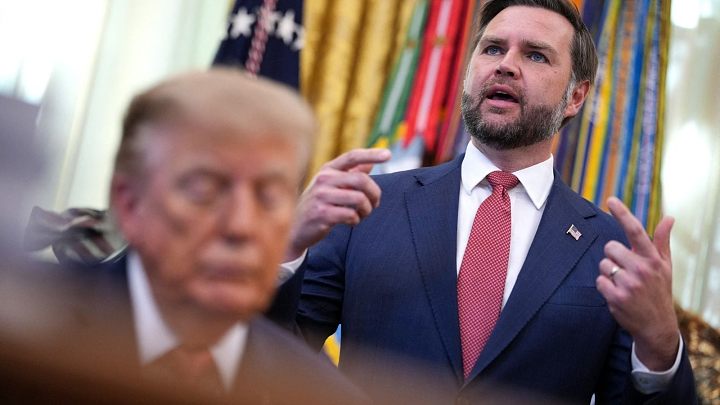
The challenge was visible almost immediately after the election results came in. While Trump continued to defend his decision to launch military action against Iran, Vance publicly blamed the conflict for the Republican Party’s defeat, marking one of his clearest breaks with the president on a major policy issue.
“The reason we lost is the war,” Vance wrote in a lengthy post on X on Wednesday. He argued that voters who had supported Trump in 2024 but were now turning to Democrats wanted the administration to end the war, focus on the cost of living and inflation, put America first and reconsider its relationship with Israel.
Vance also questioned whether the conflict had been worth the political cost, pointing to the loss of control of the Senate. Trump, however, maintained that launching the war was the right decision and said he would not have done anything differently.
The contrast could be significant for a vice-president whose political future is increasingly tied to the question of who leads the Republican Party after Trump.
The Trump Connection
Vance’s rise within the Republican Party has been closely linked to his association with Trump. Once a critic of the former president, he became one of his most vocal allies and was selected as his running mate in 2024. His position as vice-president, access to the party’s leadership and visibility on the campaign trail have placed him in a strong position to make a future presidential bid.
The Washington Post reported on November 1 that Vance had headlined 17 rallies since the Republican midterm convention in September, giving him an opportunity to build a national profile and establish relationships with Republican officials. His campaign appearances have also allowed him to develop a political style that is somewhat different from Trump’s.
Where Trump has dismissed concerns about affordability and described the US economy as being in a “Golden Age”, Vance has acknowledged that the administration still has work to do on housing costs, fuel prices and other economic concerns, the Post reported.
That distinction could matter as Vance attempts to appeal beyond Trump’s most loyal supporters. But it also creates a difficult balancing act. He has consistently defended the administration’s record, and voters may not distinguish between his own positions and the policies he has helped implement.
Iran War Puts Spotlight On Differences With Trump
The Iran conflict has emerged as an important test of that balancing act.
Vance has previously described himself as a sceptic of foreign military interventions. As a former Marine who served in Iraq, he has criticised open-ended overseas conflicts and argued that the US should avoid repeating the mistakes of earlier military engagements.
After Trump launched the war against Iran, Vance was notably less vocal in defending the operation than several other senior administration figures. He also became the face of an unsuccessful effort to negotiate an end to the fighting.
The Associated Press reported that around six in 10 voters surveyed in its AP Voter Poll considered the US military action against Iran the wrong decision. However, the survey also indicated that the war was not the most important issue for most voters: around half identified the cost of living or government corruption as crucial to their congressional vote, compared with roughly one-third who said the same about the Iran war.
Vance’s post-election remarks therefore serve two purposes: they acknowledge the political consequences of a policy that has divided voters, while also drawing attention to issues on which he may seek to differentiate himself from Trump.
Whether this amounts to a lasting policy divergence or an attempt to respond to the election result remains to be seen.
The MAGA Conundrum
The question for Vance is not simply whether he can distance himself from Trump. It is how much distance he can create without alienating the movement that could determine the Republican presidential nomination.
Trump remains influential within the Republican Party, and his endorsement could carry considerable weight in a primary contest. The Washington Post reported in August that Trump had privately told donors, “At the end of the day, we need to elect JD.” However, the president has continued to keep his public options open, repeatedly declining to formally endorse Vance and mentioning Secretary of State Marco Rubio as another potential contender.
Rubio presents a different kind of challenge. While he has said he would support Vance if the vice-president decides to run, he has also emerged as a possible candidate in his own right. The two men have different political backgrounds and approaches, particularly on foreign policy, and could appeal to different sections of the Republican coalition.
The midterm results have added another complication. Democrats secured control of both chambers of Congress, while Republicans suffered setbacks even in states that Trump had carried comfortably in 2024. In Ohio, Vance’s former Senate seat also changed hands, with Democrat Sherrod Brown defeating Republican incumbent Jon Husted. Democrat Amy Acton defeated Vivek Ramaswamy in the governor’s race.
These results do not automatically determine Vance’s prospects in a Republican primary. But they give his critics an opportunity to question whether the Trump-Vance administration’s political appeal can extend beyond its most committed supporters.
The Road To 2028
Vance has not formally announced a presidential bid and has said he would decide after the midterm elections whether to run in 2028, according to the Associated Press. For now, his immediate task is to navigate the political fallout from the Republican defeat while continuing to remain a central figure in the administration.
His challenge is that the two political identities he needs to maintain may not always sit comfortably together. As Trump’s vice-president, he has benefited from the MAGA movement’s support and the president’s political influence. As a potential presidential candidate, however, he will need to demonstrate that he can offer something beyond a continuation of the current administration.
The Iran war has offered an early glimpse of how he might attempt that distinction. But questions over the economy, immigration, foreign policy and the administration’s wider record will also follow him into any future campaign.
For Vance, inheriting Trump’s movement may be one challenge. Convincing voters that he can lead it on his own terms could prove another.