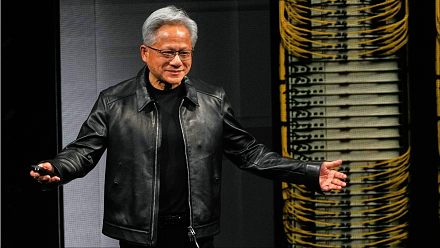
'Groundless': China Hits Back At US Allegations Of Suspected Spy Plot Targeting Nvidia CEO Jensen Huang
China on Friday dismissed a US media report alleging that a suspected Chinese intelligence asset had attempted to cultivate a close business relationship with Nvidia CEO Jensen Huang, calling the claims “groundless specu
Por Vani Mehrotra··58K lecturas
'Groundless': China Hits Back At US Allegations Of Suspected Spy Plot Targeting Nvidia CEO Jensen Huang
China on Friday dismissed a US media report alleging that a suspected Chinese intelligence asset had attempted to cultivate a close business relationship with Nvidia CEO Jensen Huang, calling the claims “groundless speculation” intended to smear Beijing.
Chinese Foreign Ministry spokesperson Guo Jiakun rejected the allegations during a regular media briefing in Beijing, pushing back against a report by The New York Times that said US intelligence agencies had identified a Chinese businesswoman as a suspected Chinese asset who had approached the head of the US chipmaking giant.
“The relevant report is based on groundless speculation and is purely aimed at smearing and slandering China,” Guo said, according to a statement reported by the South China Morning Post.
The allegations have brought renewed attention to the growing scrutiny surrounding China’s access to advanced semiconductor technology, particularly as Washington tightens restrictions on the export of high-end artificial intelligence (AI) chips to Beijing.
Who Is The Chinese Executive At The Centre Of The Allegations?
According to The New York Times report published on Thursday, US intelligence agencies had identified a Chinese businesswoman, Alice Huang, also known as Huang Le, as a suspected Chinese intelligence asset.
Huang is an executive at Megaspeed, a Singapore-based data centre company. US agencies reportedly believed that she had been passing information to Beijing and had attempted to develop a close business relationship with Nvidia chief Jensen Huang.
The two Huangs are not related, the reports clarified.
The New York Times, citing unnamed officials with access to classified intelligence, reported that Megaspeed had previously attracted US scrutiny over suspicions that it was helping China circumvent American export controls on advanced semiconductors.
The report also suggested that the relationship between Alice Huang and the Nvidia chief could have provided the Chinese executive with insights into US President Donald Trump’s thinking on artificial intelligence, an issue expected to feature in discussions between Trump and Chinese President Xi Jinping next month.
Trump was reportedly briefed on the intelligence findings roughly a year ago but chose not to act on the information, according to an AFP report.
Nvidia Responds To Allegations, Says Interactions Were Normal
Nvidia has pushed back against suggestions that its chief executive’s interactions with Alice Huang were unusual or that sensitive information was shared.
In a statement to the South China Morning Post on Friday, an Nvidia representative said Megaspeed was no different from several other regional cloud customers and that meetings between Huang and the company’s customers were part of his responsibilities as chief executive.
“Jensen’s interactions with Ms Huang are not unusual or unexpected,” the spokesperson said.
In a separate statement to AFP, Nvidia maintained that its regional cloud customers received only ordinary business information and not sensitive company secrets or information relevant to national security.
“Our regional cloud customers receive ordinary business information, not sensitive NVIDIA trade secrets, and zero information relevant to national security,” the spokesperson said.
The company also rejected allegations that Megaspeed had diverted or smuggled advanced AI chips to China, saying the matter had already been investigated.
“The diversion allegations against this regional cloud were thoroughly investigated and debunked last year,” Nvidia told the South China Morning Post.
The controversy comes against the backdrop of intensifying competition between Washington and Beijing over advanced technology and semiconductor capabilities.
The United States has imposed restrictions on exports of its most advanced AI chips to China, citing national security concerns and seeking to limit Beijing’s access to technology used to train and operate sophisticated AI models.
Nvidia, once a major supplier to the Chinese market, has faced increasing difficulties navigating the restrictions, which have significantly curtailed its ability to sell advanced chips in the country.
Meanwhile, Beijing has been accelerating efforts to achieve semiconductor self-sufficiency, with domestic companies seeking to strengthen their position in the AI chip market.
Chinese manufacturers, including Huawei Technologies and Moore Threads, have been gaining ground as demand for locally developed semiconductor technology grows.
Beijing-based Moore Threads, often described as China’s “little Nvidia”, reported a nearly 1,774 per cent increase in third-quarter revenue to 1.55 billion yuan (around $232.4 million) on Wednesday.
The company attributed the growth to strong domestic demand for graphics processing units used in AI model training and inference. Its customers include cloud service providers, telecommunications operators and computing centres.