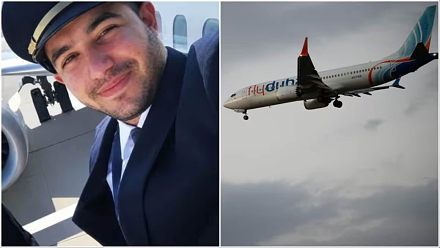
Did Flydubai Crew Help Omani Co-Pilot? Passenger Questions Their Role In Mid-Air Cockpit Attack
A passenger who helped overpower the co-pilot accused of attacking the captain of a flydubai flight has urged authorities to examine what happened on board after the attacker was restrained.
Por Anushka Vats··67K lecturas
Did Flydubai Crew Help Omani Co-Pilot? Passenger Questions Their Role In Mid-Air Cockpit Attack
A passenger who helped overpower the co-pilot accused of attacking the captain of a flydubai flight has urged authorities to examine what happened on board after the attacker was restrained.
Asaf Rajuan, who was travelling from Dubai to Tel Aviv with his wife and two daughters, said he remained uneasy even after passengers managed to subdue the co-pilot. He has specifically questioned the actions of two flight attendants and wants investigators to establish whether their conduct during the emergency requires further scrutiny.
Rajuan also wants the two pilots who were travelling as passengers and later took charge of the aircraft to speak publicly about what they witnessed.
The incident took place on September 30 aboard flight FZ1073. The aircraft was forced to divert to Tabuk, Saudi Arabia, after the co-pilot allegedly attacked the captain using an emergency axe.
Rajuan’s claims about the attendants have not been independently verified. The UAE’s official account, released on October 9, said a flight attendant helped passengers overpower the attacker. Authorities also said the co-pilot claimed he had acted alone, while stressing that investigations into possible accomplices and other connections were still under way.
Passenger Describes Chaos Inside Aircraft
Rajuan was seated in 7D when the emergency unfolded. He was travelling with his wife and daughters, who were close to turning 12 and 14.
According to his account, a woman suddenly ran through the cabin shouting that a person had a knife. When Rajuan looked towards his family, he saw passengers being thrown into the air.
He said he briefly believed his daughters had died.
He then rushed towards the front of the plane, where passengers were attempting to stop the attacker. Rajuan said the captain had already managed to weaken the co-pilot, making it possible for passengers to overpower him.
Rajuan sustained a small injury to his head. He later said he was covered in blood, although most of it did not belong to him.
Rajuan Raises Questions About Attendants
His concerns about the cabin crew emerged more clearly during an interview with N12’s Ulpan Shishi on Friday.
Rajuan alleged that one of the attendants appeared to loosen the restrained co-pilot after passengers had brought him under control. He said other passengers noticed what was happening and confronted the crew member.
He also recalled an incident involving the injured captain. According to Rajuan, an attendant approached the captain while he was receiving medical attention and had a tablet with him. Passengers became concerned when they believed the attendant was attempting to give the captain a pill.
Rajuan has, however, stopped short of claiming that the attendants were involved in the alleged attack.
When asked directly whether they had worked with the attacker, he said, “I have no proof.”
He told The Jerusalem Post that tensions continued inside the cabin. He described arguments and physical confrontations with the attendants and said one of them asked whether he was a police officer.
Rajuan also said passengers were discouraged from recording the incident. At that stage, he feared the situation could escalate again and worried that another weapon might be produced.
Confusion over the aircraft’s location added to the uncertainty. Passengers checked their GPS and discussed whether the aircraft was over Iraq, Jordan or Saudi Arabia.
“I became paranoid,” Rajuan said.
He acknowledged that the experience made him suspicious of those around him. However, he believes the incidents involving the attendants should be examined as part of the investigation.
What Happened In The Cockpit?
Rajuan is also seeking an account from the two additional pilots who were on board.
There were four pilots connected to the flight — the captain, the co-pilot accused of attacking him, and another captain and co-pilot who were travelling in the passenger cabin.
The second crew had been placed on the flight as a precaution. Possible diversions in the region could have extended the journey and pushed the original crew beyond their permitted working hours. Their presence was not linked to any known threat before the incident.
Another passenger, an Israeli businessman identified as Tal, previously told The Jerusalem Post that he helped get the additional pilots towards the cockpit while passengers were struggling with the attacker.
“I had to shake them to get them to move to the front and take control of the plane,” he said.
Tal said there was a period when nobody was in control of the cockpit. One of the pilots eventually took over, while the other took longer to recover from the shock. The precise timing and sequence of events inside the cockpit have not been independently confirmed.
The UAE’s account gives a different part of the sequence. It said the relief captain noticed unusual movement around the cockpit door, entered using an access code and joined passengers and a flight attendant in overpowering the attacker. The two relief pilots then regained control and landed the aircraft safely in Tabuk.
The official account did not address Tal’s description of the pilots’ initial reaction or the reported period when the cockpit was empty.
Prosecutors have confirmed that both relief pilots gave statements to investigators, although their names have not been released.
Rajuan now wants their account of the emergency, including what they observed about the cabin crew.
“I hope that Israel will investigate it as it should be,” he said. “Because it’s something that needs answers.”