Can Trump Nuke Iran After Midterm Meltdown? What A US Nuclear Strike Could Mean For India
Can Trump nuke Iran? Following the decisive Democratic victory in the 2026 US midterm elections—an electoral defeat that senior administration officials directly attributed to the deeply unpopular conflict with Tehran—th
Por Pathikrit Sen Gupta··46K lecturas
Can Trump Nuke Iran After Midterm Meltdown? What A US Nuclear Strike Could Mean For India
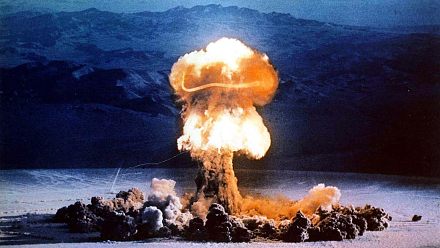
Can Trump nuke Iran? Following the decisive Democratic victory in the 2026 US midterm elections—an electoral defeat that senior administration officials directly attributed to the deeply unpopular conflict with Tehran—the debate over Washington’s military options in West Asia has intensified. As Commander-in-Chief of the Armed Forces, President Donald Trump retains sole, unconstrained command authority under American constitutional protocol to order a strategic or tactical nuclear strike at any time, without requiring Congressional approval or cabinet consensus.
The theoretical rationale behind such an extreme manoeuvre stems from severe physical constraints in modern conventional warfare. Iran’s most sensitive nuclear enrichment infrastructure sits deeply buried beneath dense granite rock formations, such as the heavily fortified Pickaxe Mountain facility in Isfahan. Military analysts point out that conventional bunker-buster munitions—even the heaviest earth-penetrating bombs in the US arsenal—might fail to rupture or neutralise facilities shielded by hundreds of feet of solid granite.
This technical limitation has led certain defence strategists and political commentators to argue that a low-yield, earth-penetrating tactical nuclear weapon represents the only military asset capable of destroying such deeply buried infrastructure. However, actually executing a nuclear option would break an eight-decade global non-use taboo, provoking immense opposition from military leadership, international legal bodies, and foreign partners who view the fallout as strategically catastrophic.
Dismantling Non-Proliferation and Igniting Global Escalation
A nuclear detonation in West Asia would completely reshape the global security environment. Beyond the immediate destruction and radioactive contamination across energy-producing regions in the Persian Gulf, the strike would dismantle decades of global non-proliferation frameworks.
Geopolitical experts caution that setting a modern precedent for nuclear deployment would encourage other armed powers to lower their own tactical operational thresholds. Major adversary nations like Russia and China would immediately recalibrate their strategic postures, while regional non-state actors would launch unrestrained asymmetric warfare, triggering uncontrollable, multi-front instability.
Multi-Front Economic and Strategic Fallout for India
For India, a military escalation of this magnitude in West Asia would create immediate and severe vulnerabilities across energy, human security, trade, and diplomacy.
Crushing Energy Inflation and Supply Disruption
India imports more than 80 per cent of its crude oil needs, with a massive volume passing directly through the Strait of Hormuz. A nuclear strike or retaliatory strikes blocking Gulf shipping lanes would cause global crude oil prices to skyrocket. This supply shock would immediately spark severe domestic inflation in India, inflate fuel prices at the pump, expand the current account deficit, and cause heavy depreciation of the Indian Rupee.
Human Risk for the Expatriate Community
Over eight million Indian citizens reside and work across Gulf Cooperation Council countries. Escalating warfare, localised radiation risks, or widespread regional instability would place millions of Indian workers in immediate peril. Executing mass evacuation operations from a volatile war zone would pose an unprecedented logistical and financial challenge for New Delhi, while any economic shutdown in the Gulf would permanently harm the billions in inward remittances flowing into Indian households.
Loss of the Chabahar Port and Eurasian Access
India has invested heavily in developing the strategic Chabahar Port in southeastern Iran as a vital commercial gateway to bypass land barriers and trade directly with Afghanistan, Central Asia, and Eurasia. Severe conflict on Iranian soil would completely freeze port operations and infrastructure links, derailing India’s long-term regional connectivity projects and trade ambitions.
Complex Diplomatic Pressure
New Delhi maintains delicate, high-stakes relationships with Washington, Tel Aviv, Tehran, and the Gulf monarchies. A US nuclear deployment would force Indian diplomacy into an extremely difficult posture. New Delhi would face intense Western pressure to support security measures, while simultaneously needing to preserve non-aligned strategic autonomy, protect its energy ties, and manage domestic economic stability.
Could Radioactive Fallout Reach India?
Meteorologically, prevailing high-altitude wind currents—the Westerlies—blow from west to east, meaning any atmospheric plume generated in central Iran would naturally drift over Pakistan and towards western Indian states like Gujarat, Rajasthan, and Punjab. However, atmospheric models and radiation experts note that the 2,000 to 2,500-kilometre distance acts as a major geographical shield.
Heavier radioactive particles would drop out of the sky over Iranian, Afghan, or Pakistani territory long before reaching Indian borders, significantly diluting the airborne radiation levels. While the physical threat of direct radiation sickness in India remains minimal, potential radioactive contamination of the Arabian Sea or Persian Gulf desalination plants poses a far more severe long-term environmental and water-security risk for the entire region.