What Is Ghost Month? 7th Month Of The Chinese Calendar When People Leave Food Outside, Offer Seats To Spirits And More
As the seventh month of the traditional Chinese lunar calendar begins, streets and neighbourhoods in many Chinese communities take on a different character. Incense burns outside homes and temples, food appears on makesh
Por Lifestyle Desk··28K lecturas
What Is Ghost Month? 7th Month Of The Chinese Calendar When People Leave Food Outside, Offer Seats To Spirits And More
As the seventh month of the traditional Chinese lunar calendar begins, streets and neighbourhoods in many Chinese communities take on a different character. Incense burns outside homes and temples, food appears on makeshift altars, and paper offerings are carefully set alight. In some places, stages come alive with music and Chinese opera—but the best seats in the house may deliberately remain empty.
This is Ghost Month, a period shaped by centuries-old Buddhist, Taoist and folk traditions surrounding ancestors, wandering spirits, remembrance and the relationship between the living and the dead.
Unlike a single-day festival, Ghost Month broadly refers to the seventh lunar month, during which the Hungry Ghost Festival—known as ‘Zhong Yuan Jie’ in Taoist tradition and associated with Yulanpen or Ullambana in Buddhist tradition—is observed.
Traditions differ considerably between regions, dialect communities and families, so there is no single universal way of observing the month.
Why Is The Seventh Lunar Month Called Ghost Month?
According to traditional beliefs, Ghost Month is a time when the boundary separating the worlds of the living and dead becomes more permeable during the seventh lunar month.
According to the National Heritage Board of Singapore, Chinese Buddhist and Taoist traditions commonly hold that the gates of the underworld open during this period, allowing spirits to roam among the living. These are believed to include ancestors returning to observe their descendants as well as wandering or “hungry” spirits who have nobody to make offerings on their behalf.
That distinction explains an important part of the month. Ghost Month is not simply about fear of supernatural beings. Much of its ritual practice revolves around filial piety, remembrance and care for the deceased.
Families honour their own ancestors, while offerings may also be made for anonymous or forgotten spirits. The burning paper offerings are viewed by practitioners as a way of maintaining kinship with deceased relatives and providing them symbolically with comforts in the afterlife. Offerings to anonymous spirits may similarly be made to ease their suffering.
The Buddhist Story Behind The Hungry Ghost Festival
Another layer of the tradition comes from Buddhism and the story associated with Mulian, a disciple traditionally identified with Maudgalyayana.
In the popular account, Mulian discovers that his deceased mother is suffering in the afterlife and attempts to help her. The story became closely associated with filial devotion and rituals performed for departed souls.
Hong Kong government material on the Hungry Ghost Festival describes the tradition of Mulian venturing into the underworld in an effort to rescue his suffering mother. Buddhist observance of the period is associated with Yulanpen, or Ullambana, and special chanting, offerings and remembrance of ancestors.
Taoist traditions, meanwhile, recognise Zhong Yuan Jie, making today’s Ghost Month customs a complex mixture of religious traditions and local folk practices rather than something derived from a single source.
What Happens During Ghost Month?
Walk through communities where the seventh month is actively observed, and one of the most visible customs is the preparation of offerings.
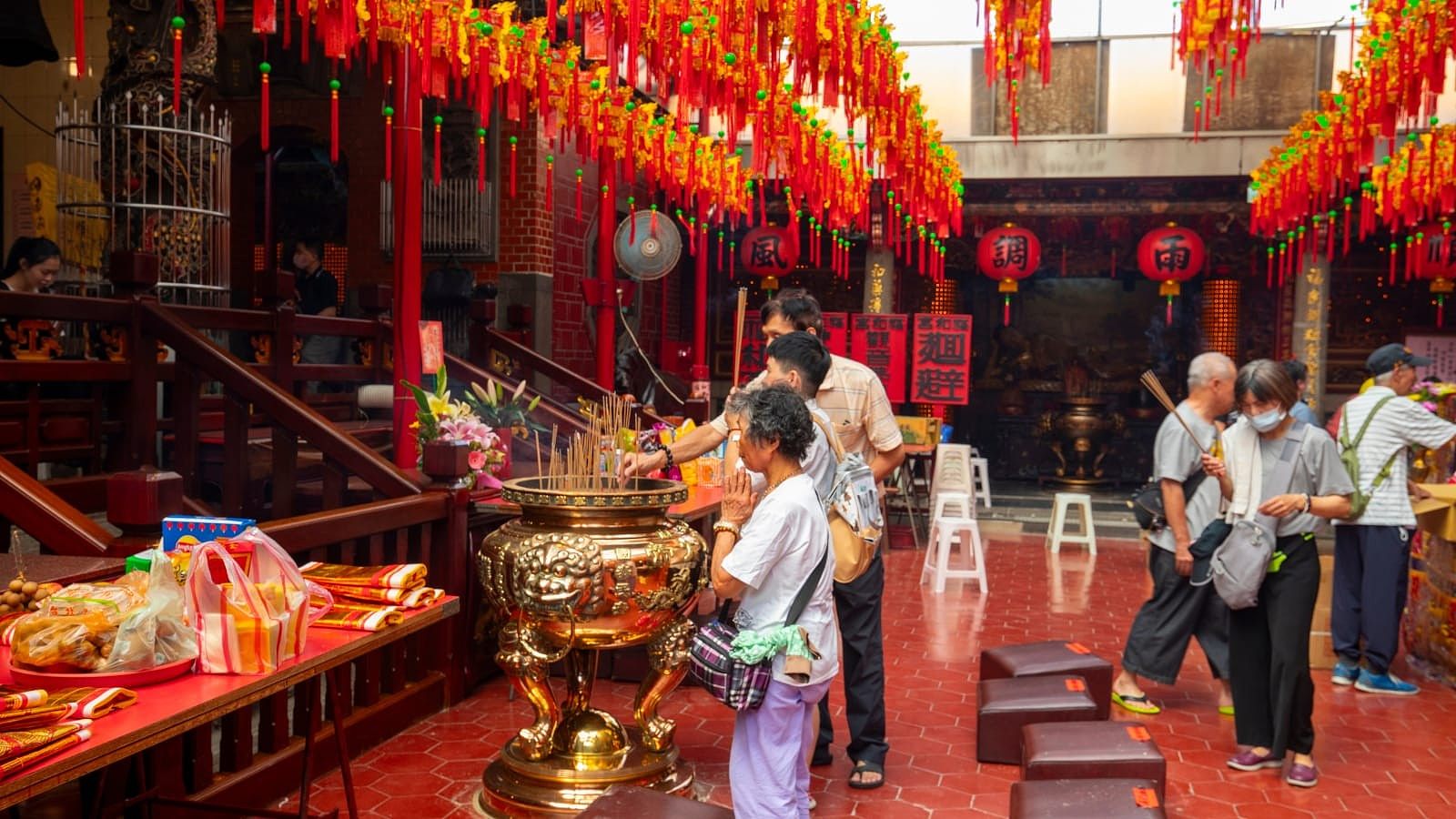
Families and community groups may place food, tea, incense and other offerings on temporary altars. Joss sticks are burned, prayers are offered, and paper objects are ceremonially burned for the deceased.
Paper offerings have a particularly interesting symbolism.
Historically, they have represented things that the deceased might need or enjoy in the afterlife. The National Heritage Board traces the practice of burning Chinese paper offerings at least as far back as China’s Song dynasty and describes it as a physical expression of ancestor worship and filial piety.
The ritual is therefore less about destroying an object and more about symbolically transferring it from the world of the living to that of the dead.
Why You May See Food Left Outside
Food is another central element. Meals, fruit, tea and other items may be placed outside homes, temples or communal spaces. Some offerings are intended for ancestors, while others are directed towards wandering spirits who are believed to have no descendants caring for them.
This idea gives the term “hungry ghost” a deeper meaning. The phrase is associated with spirits who are considered “hungry” because they have no descendants making offerings for them.
Rather than treating these unknown spirits as enemies, many rituals are designed to feed, comfort or appease them.
Why Are Empty Seats Left At Performances?
One of Ghost Month’s most fascinating traditions can be seen in Singapore, where getai, literally “song stage”, performances are closely associated with the seventh lunar month.
These lively shows can feature singing, dancing, comedy, elaborate lighting and contemporary entertainment. Yet amid all the activity, an unusual rule is traditionally observed: the front row is left empty.
Those seats are symbolically reserved for the spirits.
Getai is considered an important cultural practice associated with Zhong Yuan Jie and specifically notes the tradition of leaving the first row vacant for “spirit” visitors.
Chinese opera and other performances also form part of seventh-month celebrations in some communities. Hong Kong government sources document Hungry Ghost Festival activities that include processions, rituals and Chiu Chow opera.
Ghost Month Dos: What People Traditionally Do
There is no universal rulebook, but common observances revolve around respect for ancestors and spirits.
Make offerings respectfully: Families may prepare food, tea, incense and paper offerings for ancestors or wandering spirits.
Remember ancestors: Ghost Month provides another opportunity to maintain symbolic bonds between generations. Research documented by Singapore’s National Heritage Board places the Hungry Ghost Festival alongside Qingming as a continuing practice through which familial ties with the deceased are reaffirmed.
Attend community rituals and performances respectfully: Temple ceremonies, opera, communal dinners and getai performances can be important religious and cultural events rather than simply entertainment.
Leave designated offerings alone: Food, incense and paper objects placed along roadsides or at temporary altars may have ritual significance. For observers, disturbing them can be regarded as disrespectful.
Why Some People Avoid Weddings And Major Decisions
Ghost Month is also famous for its taboos. One of the better-documented customs is avoiding major new beginnings.
During the seventh lunar month, many Chinese traditionally avoid activities such as weddings, major purchases and new business ventures.
The underlying folk reasoning is that a month associated with wandering spirits and the dead may not be considered an auspicious time to begin an important new chapter.
This is why some families may choose another lunar date for a wedding, business launch or major purchase.
Is Ghost Month The Same As The Hungry Ghost Festival?
Not exactly. Ghost Month commonly refers to the entire seventh lunar month and the beliefs and practices surrounding it.
Hungry Ghost Festival, Zhong Yuan Jie or related Yulan observances refer more specifically to festival rites held within that month.
The exact festival date and length can vary according to tradition and community. Singapore heritage material, for example, describes Zhong Yuan Jie within the seventh lunar month, while Hong Kong communities may hold Yu Lan activities over several days at different points during the month.
That regional variation is important. There is no single “Chinese Ghost Month” ceremony followed identically across China, Hong Kong, Taiwan, Singapore, Malaysia or Chinese diaspora communities.
More Than A Month Of Ghost Stories
The name “Ghost Month” can make the tradition sound ominous, but focusing only on supernatural taboos misses much of its meaning.
Its customs tell a larger story about memory, family and responsibility towards those who came before. Burning paper offerings can represent continued care for deceased relatives; setting out food acknowledges both ancestors and forgotten souls; performances symbolically entertain visitors from another realm; Buddhist rites emphasise compassion and filial devotion.
In that sense, the seventh lunar month is as much about the living as the dead.
For generations of observers, it offers a period in which the deceased are not treated simply as people who have disappeared. Through food, incense, prayer, performances and remembrance, they are temporarily given a place again within the world of their descendants—and even an empty seat in the front row.