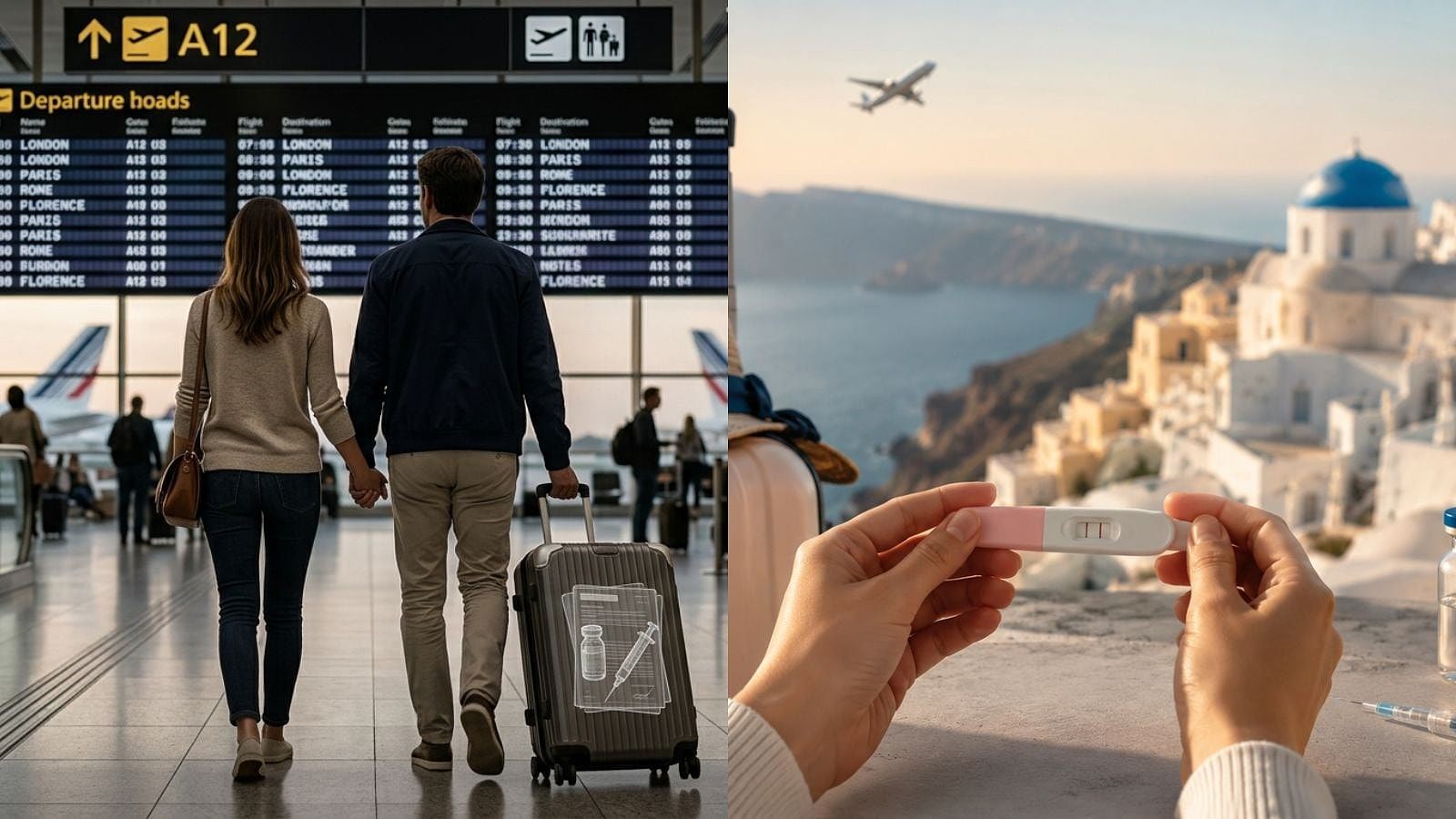
Inside The Rise Of 'Fertility Tourism': When Having A Baby Means Booking A Flight
“Come with me as I fly abroad for IVF”. This was the caption of a video on Instagram, and showed a couple’s journey from Manchester to Czech Republic. And it’s not the only one. Medical tourism has been around for eons,
Por Mallika Bhagat··12K lecturas
Inside The Rise Of 'Fertility Tourism': When Having A Baby Means Booking A Flight
“Come with me as I fly abroad for IVF”. This was the caption of a video on Instagram, and showed a couple’s journey from Manchester to Czech Republic. And it’s not the only one. Medical tourism has been around for eons, and India infact ranks among the countries best known for it. But now, ‘Fertility Tourism’ is a growing niche within that segment, and social media videos offer ample proof of this.
A growing number of people are choosing to have their fertility treatment done overseas, and Europe has become the obvious answer.
A Market That’s Only Getting Bigger
The numbers back up the shift. The global fertility tourism market was valued at 1.6 billion dollars in 2024, and is expected to hit 6.1 billion dollars by 2030, a growth rate of just over 25 percent a year. Turkey held the largest share in 2024, with Spain expected to grow fastest going forward. Treatment using a patient’s own eggs already accounts for over half the market, and patients aged 35 to 44 make up the largest share of those travelling for it.
The reasons behind the boom are quite straightforward: infertility affects roughly one in six people worldwide, according to the World Health Organization, and around 80 million couples globally deal with it. As costs at home keep climbing and options abroad keep improving, more of them are deciding that having a baby is worth a plane ticket.
Why The Math Doesn’t Add Up At Home
The cost is the real trigger. A study released in July by the Women’s Reproductive Health Foundation found that one IVF cycle in the US now averages over 29,000 dollars. Add genetic testing, embryo storage, pregnancy care and delivery, and the full cost of an IVF-conceived birth can cross 54,000 dollars. Most patients need two or three cycles before it works, so that number climbs fast. Insurance rarely helps and many US plans simply don’t cover fertility treatment, and in some states, uncertainty over future fertility laws adds one more reason to look elsewhere.
View this post on Instagram
A post shared by Vicky (@vicky_infertility_ivf)
The Countries Making The Case
Spain and Greece lead the list, but they’re not the only ones. Spain has the largest network of assisted-reproduction clinics in Europe and decades of experience treating international patients, mostly in Madrid, Barcelona and Alicante. Greece has built its name on lower costs and a Mediterranean setting, with most of its leading clinics in Athens and Thessaloniki. The Czech Republic, centred around Prague, offers some of the most competitive prices on the continent. North Cyprus and Denmark come up often too, and globally, Turkey currently leads the entire fertility tourism market.
The price gap is stark. IVF using a patient’s own eggs costs somewhere between 12,000 and 18,000 dollars in the US. In Europe’s most popular destinations, the same treatment runs between 3,000 and 5,500 euros, even before travel is added, the difference holds. In Greece specifically, that number can be as low as 2,500 euros. In the Czech Republic, from 2,100 euros.
Spain has the largest network of assisted-reproduction clinics in Europe and decades of experience treating international patients, mostly in Madrid, Barcelona and Alicante. (Credit: Instagram)
Why IVF Is Cheaper Abroad
The gap isn’t about cutting corners. Clinics in these countries simply run on lower operating costs, and specialists in Europe, Argentina, Mexico or Barbados are paid less than their counterparts in the US, Canada or Australia. High patient volumes also let clinics abroad bring their per-cycle costs down. Many even fold in procedures that would cost extra elsewhere; the ICSI fertilisation technique and blastocyst-stage embryo culture, for instance, usually come standard in the base package rather than as add-ons.
View this post on Instagram
A post shared by Alana Beth Lowe (@alanabeth_lowe)
Scroll Long Enough And You’ll See It
Open Instagram and the trend is already visible without anyone calling it fertility tourism. Hashtags built around the IVF journey now carry hundreds of thousands of posts between them – patients documenting injections, scan days, embryo transfers, and increasingly, the flights and hotel rooms that come attached to all of it. Fertility clinics abroad have caught on too, running their own social content aimed squarely at patients scrolling from another country.
There’s an obvious awkwardness sitting underneath all of this. IVF is intensive medical treatment: injections, anaesthesia, lab work, a narrow window to get everything right. Turning that into a trip can feel strange to say out loud, and it isn’t for everyone. But for couples already living with the stress of infertility, a change of scenery between appointments seems to make the process easier to sit through, not harder.
View this post on Instagram
A post shared by Whitney | The Local Edit (@thelocaleditbywhitney)
But the growing popularity comes with an important caveat: IVF is medical treatment first and travel second. Laws around donor eggs, surrogacy, embryo testing and other fertility procedures vary considerably between countries.
For anyone considering treatment abroad, the destination should therefore be chosen based on medical expertise and regulation, not simply the cheapest package or the prettiest Instagram feed.