Food Processor Vs Mixer Grinder: Which Saves More Time In The Kitchen?
A food processor and a mixer grinder can both make everyday cooking easier, but they save time at different stages of the process. A food processor tackles much of the work you would otherwise do with a knife, grater or
Por Consumer Trends Desk··30K lecturas
Food Processor Vs Mixer Grinder: Which Saves More Time In The Kitchen?
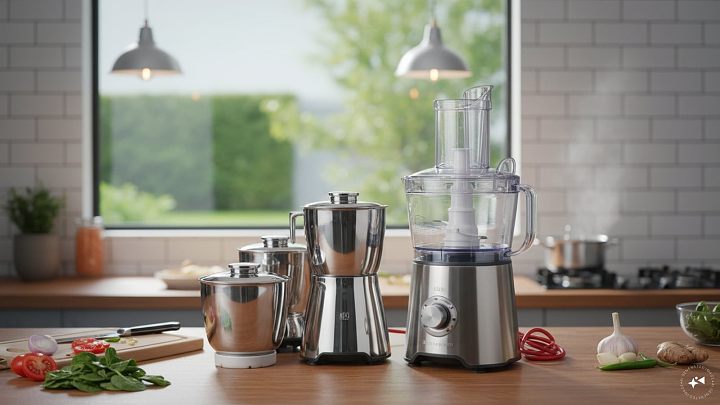
A food processor and a mixer grinder can both make everyday cooking easier, but they save time at different stages of the process. A food processor tackles much of the work you would otherwise do with a knife, grater or your hands. A mixer grinder takes care of grinding and blending.
The difference matters in an Indian kitchen. If dinner regularly starts with chopping several onions, slicing vegetables, grating carrots and kneading atta, a food processor can cut down a substantial amount of hands-on preparation. If your cooking involves coriander chutney, ginger-garlic paste, freshly ground spices and wet masalas, a mixer grinder is likely to be far more useful.
There is also the question of quantity. Chopping half an onion hardly justifies setting up a food processor, while preparing vegetables for a family meal might. Similarly, a small mixer grinder jar is far more convenient when you need just enough chutney for breakfast.
So, the appliance that saves more time isn’t necessarily the one that can perform more functions. It is the one that takes over the jobs you find yourself doing most often.
Which should you buy?
Buy a food processor if:
You regularly chop, slice or shred large quantities of vegetables.
You cook for a family and meal preparation takes a long time.
You frequently grate carrots, cabbage, cheese or other ingredients.
You want a machine that can knead atta.
You batch-cook or prepare several meals at once.
You would like to spend less time doing repetitive knife work.
Grinding chutneys and masalas is already taken care of by another appliance.
Buy a mixer grinder if:
You cook Indian food regularly.
You frequently make chutneys, masalas and ginger-garlic paste.
You grind whole spices at home.
You need both wet and dry grinding.
You regularly make gravies, purees or batters.
You often prepare small quantities.
You want one basic appliance that can handle several everyday Indian cooking jobs.
For most Indian households buying just one appliance, a mixer grinder is likely to be the more versatile choice. But if you already own one and chopping, slicing, grating and kneading are the jobs slowing you down, adding a food processor can make a much bigger difference to preparation time.
Top picks
Best food processor for everyday prep: INALSA Easy Prep 800W Food Processor
Best premium food processor + mixer grinder: Bosch PureMixx Plus MP8515A1KI
Best modern mixer grinder: Atomberg Zenova 1000W Mixer Grinder
Best mixer grinder for most families: Philips HL7756 750W Mixer Grinder
Best for heavy-duty grinding: Bosch Pro MGM8842MIN 1000W Mixer Grinder
Quick comparison
Feature
Food processor
Mixer grinder
Primary purpose
Chopping and food preparation
Wet and dry grinding
Chopping
Excellent
Limited
Slicing
Excellent
Usually not available
Shredding and grating
Excellent
Usually not available
Atta kneading
Available on many models
Usually not available
Chutneys
Depends on attachments
Excellent
Wet masalas
Limited to good
Excellent
Dry spices
Limited
Excellent
Gravies and purees
Good
Excellent
Large quantities
Excellent
Good
Small quantities
Less convenient
Excellent with a small jar
Cleaning
More parts to wash
Usually simpler
Counter space
Usually more
Usually less
Best for
Families with lots of vegetable and dough prep
Everyday Indian cooking and grinding
How does a food processor work?
A food processor uses a motor to drive interchangeable blades and discs inside a relatively wide processing bowl. Changing the attachment changes what happens to the food.
A chopping blade can quickly break down vegetables and other ingredients, while slicing and shredding discs produce more uniform pieces. Models with dough attachments can also knead atta, removing another job that normally has to be done by hand.
The INALSA Easy Prep, for example, combines an 800W motor with a 1.4-litre processing bowl and seven accessories. It can chop, slice, shred, make French fries, mince and knead dough, making it better suited to someone who wants to automate several stages of meal preparation rather than simply grind ingredients.
Where food processors perform best
The advantage becomes much clearer when you’re cooking for several people.
Imagine preparing a meal that requires sliced onions, grated carrots, shredded cabbage and atta for rotis. These are individually simple jobs, but together they can take a fair amount of time before you have even started cooking.
A food processor is particularly useful here because the same motor base can handle several of these jobs by changing the attachment. It can also give you more consistent slices or shreds than hurried knife work.
This makes it especially useful for larger families, people who cook in batches and anyone who likes preparing vegetables for several meals at once.
Combination machines can extend that convenience further. The Bosch PureMixx Plus MP8515A1KI combines food-processing functions with mixer-grinder jars and offers more than 40 functions, including atta kneading, chopping, slicing and coarse grinding. It is aimed more at someone who wants one appliance system to cover both preparation and grinding.
Where food processors struggle
For very small jobs, the time-saving advantage can disappear.
If you need to chop half an onion, getting out the processing bowl, fitting the blade and washing everything afterwards may take longer than using a knife.
A standard food processor also shouldn’t automatically be treated as a replacement for a mixer grinder. Small quantities of chutney, whole spices and thick masala pastes are better suited to the smaller jars and grinding blades found on mixer grinders.
There is also more to store. A processor may come with multiple discs, blades, a bowl, lid and other attachments, so it makes more sense if you will actually use those functions regularly.
How does a mixer grinder work?
A mixer grinder uses a motor base with different jars and blade configurations designed for grinding and blending different quantities and textures.
The larger jar is typically useful for liquidising, wet grinding and larger preparations, while smaller jars can handle chutneys, spices and masala pastes. This flexibility is one of the main reasons mixer grinders have become such a standard appliance in Indian kitchens.
The Philips HL7756, for instance, has a 750W motor and three stainless-steel jars. Rather than trying to slice or shred vegetables, it concentrates on the jobs most households expect a mixer grinder to perform.
Where mixer grinders perform best
Think about what happens while preparing a typical Indian meal.
You may need ginger-garlic paste for the sabzi, a small amount of freshly ground masala for dal and coriander chutney to serve alongside the meal. A mixer grinder lets you move between these preparations using different jars.
The smaller jar is particularly important. Making a small quantity of chutney or spice powder in a large food processor bowl can be frustrating because the ingredients may simply spread around the bowl rather than process properly.
Power also becomes relevant for tougher and more frequent grinding. The Bosch Pro MGM8842MIN steps up to a 1000W motor and comes with multiple jars, making it more suitable for a household that expects to use the appliance heavily.
Where mixer grinders struggle
A mixer grinder doesn’t eliminate much of the manual vegetable preparation involved in cooking.
You may be able to pulse an onion or tomato, but you won’t get the controlled slicing, shredding and grating that a food processor provides. If you’re preparing a large salad, shredding cabbage or slicing potatoes, you will probably still need to do that work manually.
Most conventional mixer grinders cannot knead atta either.
So while a mixer grinder can save a lot of time once ingredients are ready to be ground or blended, it doesn’t necessarily shorten the work that happens before that stage.
Which is better for Indian cooking?
If you are choosing only one appliance for an Indian kitchen, the mixer grinder has the advantage.
The reason becomes clearer when you think about actual meals. Rajma may require ginger-garlic paste. A curry might need an onion-tomato masala. A South Indian breakfast could involve coconut chutney. Another recipe might call for freshly ground spices.
A mixer grinder is designed to move between precisely these types of jobs. The same logic is reflected in the blender-versus-mixer-grinder comparison, where multiple jar sizes and the ability to handle chutneys, masalas and spices make the mixer grinder particularly useful for regular Indian cooking.
But that doesn’t necessarily mean it saves the most time.
For a family that already owns a mixer grinder, a food processor may have a much bigger impact on the amount of time spent in the kitchen because it automates jobs that are otherwise performed manually.
There is also a middle ground. The Philips HL7707/01 combines a 750W mixer grinder with food-processing functionality, while the Bosch PureMixx Plus offers both mixer-grinder jars and a dedicated processing bowl. These make more sense for someone who genuinely needs both functions but doesn’t want two separate motor bases.
Which is easier to use and clean?
For small, everyday jobs, the mixer grinder generally wins.
If you’re making a small bowl of chutney, you may only use one jar and lid. Once you’re finished, there isn’t much equipment to wash.
Food processors tend to involve more components. Depending on what you’re preparing, you may have a bowl, lid, pusher and blade or disc to clean.
But cleaning shouldn’t be considered in isolation. If a food processor has just sliced four onions, grated several carrots, shredded cabbage and kneaded enough atta for the family, washing a few additional components may still leave you well ahead on time.
For one or two people who generally prepare small meals, that calculation may favour the mixer grinder. For a family regularly doing substantial vegetable and dough preparation, it can favour the food processor.
Which offers better value?
Value depends heavily on the work you want the appliance to take over.
The Philips HL7756 costs Rs 3,799 at the price shown and offers a 750W motor with three stainless-steel jars. For someone setting up an Indian kitchen and needing one appliance for chutneys, masalas, wet grinding and other everyday jobs, it is likely to offer more immediately useful functionality.
The INALSA Easy Prep costs Rs 5,299 at the price shown. It is more expensive, but its appeal is completely different. Someone who cooks for four or five people every day and dislikes chopping, grating and kneading could potentially save far more hands-on time with it.
At the higher end, the Bosch PureMixx Plus costs Rs 9,408 at the price shown. You’re paying more, but you’re also getting mixer-grinder jars and food-processing functions in the same appliance system.
The Atomberg Zenova offers another compromise. Its 1000W BLDC mixer grinder comes with four jars and a chopper. It doesn’t provide the complete slicing, shredding and kneading capability of a full food processor, but it may suit someone who mainly needs a mixer grinder and wants occasional help with chopping.
The better-value appliance, therefore, isn’t necessarily the cheaper one. It is the one whose functions you will actually use several times a week.
Common usage scenarios
Situation
Better choice
Chopping several onions
Food processor
Slicing potatoes
Food processor
Shredding cabbage
Food processor
Grating carrots
Food processor
Kneading atta
Food processor
Preparing vegetables for a large family
Food processor
Batch meal preparation
Food processor
Coriander or mint chutney
Mixer grinder
Coconut chutney
Mixer grinder
Ginger-garlic paste
Mixer grinder
Onion-tomato masala
Mixer grinder
Grinding whole spices
Mixer grinder
Wet grinding
Mixer grinder
Small quantities
Mixer grinder
Frequent Indian cooking
Mixer grinder
Regular chopping plus grinding
Combination food processor + mixer grinder
FAQs
1. Can a food processor replace a mixer grinder?
Not completely for most Indian kitchens. Combination models may include dedicated grinding jars, but a conventional food processor is primarily designed for chopping, slicing, shredding and similar preparation. If you regularly make chutneys, spice powders and thick masalas, a mixer grinder is usually more practical.
2. Can a mixer grinder replace a food processor?
Not if slicing, shredding, grating and kneading are important to you. Some mixer grinders include chopper attachments, but a conventional mixer grinder isn’t designed to perform the full range of preparation jobs handled by a food processor.
3. Which saves more time for a family?
If the family cooks large meals and already has a way to grind masalas and chutneys, the food processor may save more hands-on time because it can take over several repetitive preparation jobs. If you’re choosing your first appliance, however, a mixer grinder is likely to be used for a wider range of everyday Indian cooking.
4. Is a food processor worth buying if I already have a mixer grinder?
It can be. If chopping, slicing, grating and kneading take up a significant part of your meal-preparation time, the two appliances complement rather than duplicate each other.
5. Do I need both?
Not necessarily. If you cook Indian food regularly and are buying only one, a mixer grinder is the more logical starting point. If you already have one but want to reduce manual preparation, a food processor can be a useful second appliance.
Disclaimer: The product descriptions mentioned in the article are solely based on the primary and secondary research conducted by our experts. To keep you ahead of the curve with these latest products, News18 utilises affiliate links. This means if you decide to shop through our recommendations, we may earn a small referral commission at no extra cost to you. Please be advised that News18 is not responsible for any claims under the Consumer Protection Act, 2019, or other applicable laws regarding the final performance, quality, or safety of these products.