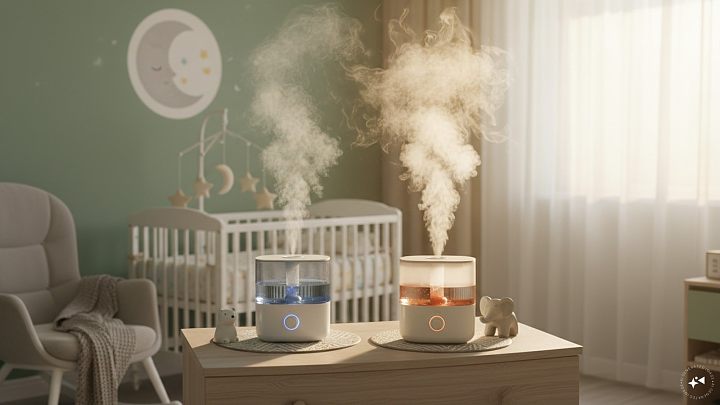
Cool Mist vs Warm Mist Humidifier: Which Is Safer For Babies?
For parents, choosing a humidifier for a baby’s room is not just about adding moisture to the air. The type of mist matters too, particularly because babies can be more vulnerable to burns and because poorly maintained h
Por Consumer Trends Desk··5K lecturas
Cool Mist vs Warm Mist Humidifier: Which Is Safer For Babies?
For parents, choosing a humidifier for a baby’s room is not just about adding moisture to the air. The type of mist matters too, particularly because babies can be more vulnerable to burns and because poorly maintained humidifiers can release microorganisms or minerals into the air.
Cool-mist humidifiers release moisture without heating the water to produce steam. Warm-mist humidifiers, meanwhile, heat water before releasing warm mist or steam. The biggest safety difference is the temperature involved.
The American Academy of Pediatrics recommends cool-mist humidifiers for children because warm-mist vaporizers can cause burns from hot water or steam. The US Environmental Protection Agency also advises keeping steam vaporizer humidifiers out of children’s reach because steam and boiling water may cause burns.
That doesn’t automatically make every cool-mist humidifier completely safe. Cool-mist and particularly ultrasonic models still need regular cleaning because microorganisms and minerals can potentially be dispersed into the air.
For this comparison, we looked at three cool-mist humidifiers and three warm-and-cool mist humidifiers available online and compared the two categories on baby safety, burn risk, cleaning, humidity control and everyday use.
Which should you buy?
Buy a cool-mist humidifier if:
You are particularly concerned about burn risks around a baby.
You want to avoid hot water and steam in the nursery.
You are buying a humidifier specifically for a baby’s sleeping area.
You want a humidifier that does not heat water before releasing moisture.
You want an ultrasonic or other cool-mist model for everyday humidification.
You can clean the water tank regularly and use appropriate water.
You want a model with features such as auto shut-off and adjustable mist output.
Buy a warm-mist humidifier if:
You specifically prefer warm-mist operation.
You want a warm-and-cool model that can be used in different situations.
The humidifier can be placed completely out of a baby’s reach.
You can ensure that hot water and steam will never be accessible to the child.
You are comfortable following the manufacturer’s cleaning and maintenance instructions.
You want a larger-capacity model for general household use.
You understand that warm-mist operation requires greater care around young children.
Top picks
Budget-friendly bedroom and nursery use: AGARO Verge 2.5L
Baby bedroom and adult use: Dr Trust Luxury Cool Mist 4.5L – 907
Baby nursery and small rooms: ROSEKM 2.0L Ultrasonic Humidifier
Premium warm-and-cool humidification: Pure Enrichment HumeXL Pro
Large-room warm and cool mist: Reffair Caligo 900 6L
Large rooms and humidity control: Levoit 6L Warm & Cool Mist
Quick Comparison
Feature
Cool-mist humidifier
Warm-mist humidifier
Mist temperature
Cool or room-temperature mist
Warm mist produced by heating water
Burn risk
No hot steam or boiling water
Higher if a child can access the unit
Baby safety
Generally preferred for young children
Requires greater care around babies
Cleaning
Important, particularly for ultrasonic models
Still important because water remains in the tank
Mineral dispersion
Can occur with ultrasonic models
Generally lower with steam-based models
Power dependence
Requires electricity
Requires electricity
Noise
Usually quiet, depending on technology
Usually quiet, depending on model
Energy use
Generally lower because it does not heat water
Higher because water is heated
Placement
Keep out of baby’s reach
Keep completely out of baby’s reach
Best for
Nurseries, bedrooms and everyday humidification
Adults or carefully supervised spaces
How does a cool-mist humidifier work?
Cool-mist humidifiers add moisture to the air without heating the water to produce steam. Ultrasonic models use high-frequency vibrations to turn water into tiny droplets that are released as a fine mist.
This makes cool mist particularly attractive for a baby’s room because there is no hot steam or boiling water involved. The American Academy of Pediatrics recommends cool-mist humidifiers for children because they avoid the burn risk associated with steam vaporizers.
Models such as the AGARO Verge, Dr Trust Luxury and ROSEKM shown in our picks are designed around cool-mist operation. The AGARO Verge offers adjustable mist output, a 360-degree nozzle and auto shut-off, while the ROSEKM is a 2L ultrasonic model marketed for bedrooms and baby nurseries.
Where cool-mist humidifiers perform best
Cool-mist humidifiers are particularly useful when the main priority is baby safety. Since they do not rely on hot water or steam, there is no heated water inside the operating mist outlet that could cause a burn if a child gets too close.
They can also be useful in bedrooms when dry air causes discomfort. The American Academy of Paediatrics says a humidifier or vaporizer can help moisten the air and may help clear a child’s nasal passages.
Where cool-mist humidifiers struggle
The biggest consideration is maintenance. Ultrasonic humidifiers can disperse minerals and microorganisms from the water tank into indoor air if they are not properly maintained. The EPA recommends emptying portable humidifiers daily and cleaning them every third day. It also recommends using water with low mineral content, such as distilled water, to reduce mineral dispersal.
That means parents should not treat a cool-mist humidifier as a fill-and-forget appliance. The tank needs regular cleaning, and water should not be allowed to stand for extended periods.
How does a warm-mist humidifier work?
Warm-mist humidifiers heat water before releasing moisture into the air. The EPA classifies warm-mist humidifiers as a type of steam vaporizer in which steam is cooled before leaving the machine.
The Pure Enrichment HumeXL Pro, Reffair Caligo 900 and Levoit 6L models in our picks offer warm-and-cool mist operation, giving users the flexibility to choose between the two modes.
That flexibility can be useful for households that want one appliance for different situations. However, when the appliance is being used around a baby, the warm-mist function requires considerably more care because heated water and steam can cause burns.
Where warm-mist humidifiers perform best
Warm-mist humidifiers can be useful when users specifically want heated-water humidification. Combination models can also provide both warm and cool mist, making them more versatile for general household use.
For adults, this can make a warm-and-cool model appealing. The Reffair Caligo 900 and Levoit 6L, for example, combine larger water tanks with warm-and-cool mist operation.
Where warm-mist humidifiers struggle
The main disadvantage around babies is the burn risk. The EPA advises keeping steam vaporizer humidifiers out of children’s reach because steam and boiling water may cause burns.
A warm-mist humidifier therefore needs careful placement. It should never be positioned where a baby or young child can touch, pull, tip or otherwise interfere with the appliance.
Cool mist vs warm mist: Which is actually safer?
If the comparison is purely about baby safety, cool mist has the advantage.
The reason is straightforward: there is no hot steam or boiling water that can cause a burn if the appliance is accidentally touched or knocked over. The American Academy of Pediatrics recommends cool-mist humidifiers for children for this reason.
But cool mist isn’t risk-free. A poorly maintained humidifier can become a source of microorganisms and mineral particles. The EPA recommends emptying the tank, wiping surfaces dry and refilling it daily, while portable humidifiers should be cleaned every third day.
Humidity levels also matter. Excessive indoor humidity can encourage mould and other biological growth. Consumer Reports notes that indoor relative humidity of around 30% to 50% is generally considered optimal, while the EPA advises not humidifying indoor spaces above 50%.
Which is better for Indian homes?
Cool mist is generally the more practical choice when the humidifier is intended for a baby’s bedroom. It eliminates the hot-water and steam hazard while still providing moisture when the air is dry.
Warm-and-cool models can make sense for families who want one humidifier for adults and children, but parents should use the cool-mist setting around babies and keep the appliance safely out of reach.
For many households, the safest approach is therefore to choose a cool-mist humidifier for the nursery and focus just as much on cleaning, fresh water and humidity control as on the type of mist.
Common usage scenarios
Common usage
Cool-mist humidifier
Warm-mist humidifier
Better choice
Baby nursery
No hot steam
Requires greater care around hot water
Cool mist
Baby sleeping area
Generally safer when kept out of reach
Higher burn concern
Cool mist
Dry indoor air
Very convenient
Very convenient
Both
Small bedroom
Compact options available
Compact options available
Both
Large room
Large-capacity models available
Large-capacity models available
Both
Homes with young children
No hot steam
Requires strict placement precautions
Cool mist
Easy cleaning
Requires regular cleaning
Requires regular cleaning
Both
Concern about mineral dispersion
Can be an issue with ultrasonic models
Generally lower with steam-based models
Warm mist
Warm-and-cool flexibility
Available on combination models
Available on combination models
Both
Primary safety concern
No hot water or steam
Requires greater caution
Cool mist
So, which should you choose?
If safety is your main concern, cool mist is the stronger choice because it removes the hot-water and steam burn hazard associated with warm-mist and steam-vaporizer models.
If versatility matters more, a warm-and-cool model can be useful for households that want one appliance for different users and situations. However, around a baby, the cool-mist setting is the safer option.
For a small nursery or baby’s bedroom, cool-mist models such as the AGARO Verge, Dr Trust Luxury and ROSEKM can be considered. For larger spaces or households looking for warm-and-cool flexibility, the Pure Enrichment HumeXL Pro, Reffair Caligo 900 and Levoit 6L offer combination operation.
Whatever model you select, keep it out of the baby’s reach, use it according to the manufacturer’s instructions and maintain it carefully.
FAQs
1. Is a cool-mist humidifier safer than a warm-mist humidifier for babies?
Yes. Cool-mist humidifiers are generally considered safer for young children because they do not produce hot steam or contain boiling water that can cause burns.
2. Can I use a warm-mist humidifier in a baby’s room?
It can be used only with strict precautions and should be completely inaccessible to the child. The EPA specifically advises keeping steam vaporizer humidifiers out of children’s reach because steam and boiling water may cause burns.
3. Are ultrasonic cool-mist humidifiers safe for babies?
They can be used, but cleaning and water quality are important. Ultrasonic humidifiers can disperse minerals and microorganisms from their water tanks, so regular cleaning and low-mineral water are important considerations.
4. How often should I clean a humidifier?
The EPA recommends cleaning portable humidifiers every third day and emptying, wiping dry and refilling the water tank daily. Always follow the manufacturer’s instructions as well.
5. What humidity level is suitable when using a humidifier?
Indoor relative humidity around 30% to 50% is generally considered appropriate, while the EPA advises not humidifying indoor spaces above 50%.
6. Where should I place a humidifier for a baby?
Keep it close enough for the mist to reach the baby’s sleeping area but completely out of the child’s reach. The American Academy of Pediatrics recommends placing a humidifier near a child but safely out of reach and cleaning it regularly.
7. Which is easier to use around babies: cool mist or warm mist?
Cool mist is generally easier from a safety perspective because there is no hot water or steam to create a burn hazard. However, it still requires regular cleaning and careful humidity control.
Disclaimer: The product descriptions mentioned in the article are solely based on the primary and secondary research conducted by our experts. To keep you ahead of the curve with these latest products, News18 utilises affiliate links. This means if you decide to shop through our recommendations, we may earn a small referral commission at no extra cost to you. Please be advised that News18 is not responsible for any claims under the Consumer Protection Act, 2019, or other applicable laws regarding the final performance, quality, or safety of these products.