Bengaluru Restaurants Under Scanner After Used Oil Seized: How Many Times Can Cooking Oil Be Reused?
Recent food-safety inspections in Bengaluru have put restaurant kitchens under the spotlight. In the latest crackdown, officials found 132 kg of food articles unfit for consumption and 15 litres of used cooking oil at ea
Por Mallika Bhagat··27K lecturas
Bengaluru Restaurants Under Scanner After Used Oil Seized: How Many Times Can Cooking Oil Be Reused?
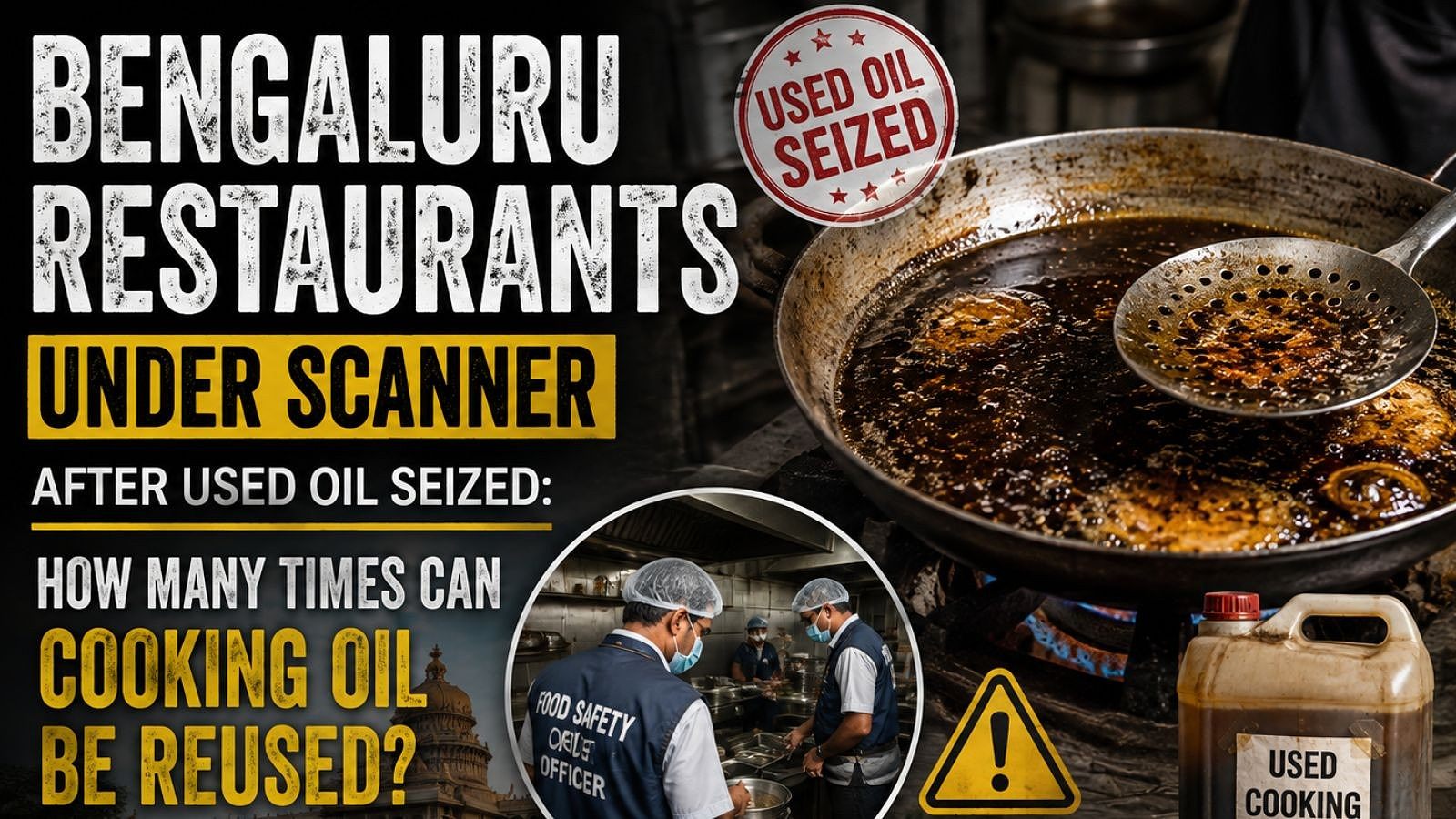
Recent food-safety inspections in Bengaluru have put restaurant kitchens under the spotlight. In the latest crackdown, officials found 132 kg of food articles unfit for consumption and 15 litres of used cooking oil at eateries inspected in and around UB City. One high-end lounge kitchen was also shut over unhygienic conditions and food-safety violations.
The findings have made us ask the same question again: what happens to cooking oil when it is heated and reused repeatedly? A recent social media post by a doctor, describing dark cooking oil as looking like “tar”, has also gone viral. While the post makes several health claims, the broader concern it raises is valid: repeatedly heating and reusing oil can alter its chemical composition and reduce its quality.
When oil is heated again and again, especially at high temperatures, it undergoes chemical changes. It can develop oxidation products and other breakdown compounds. The longer and more frequently the oil is heated, the more its quality can deteriorate. This is why food-safety authorities discourage repeated reuse of cooking oil.
And this is not just a restaurant issue. Karnataka’s Food Safety and Drug Administration has been collecting used cooking oil from food establishments under the Repurpose Used Cooking Oil (RUCO) initiative. Between 2024 and 2026, authorities collected 45.87 lakh litres of used cooking oil, which is diverted for uses such as biodiesel and soap rather than being returned to the food chain.
For consumers like you and me, it is almost impossible to know how many times the oil in a restaurant’s fryer has already been used. Oil that has become unusually dark, smells rancid, produces excessive smoke or foam, or changes the taste of food can be a warning that it has deteriorated. However, colour alone cannot tell you whether oil is safe or unsafe.
This isn’t tar; it is cooking oil, and not from a roadside thela, but from a five-star hotel in Karnataka.
Ideally, cooking oil subjected to deep-frying should be discarded after a single use. Repeated thermal degradation generates a hazardous buildup of lipid peroxides, toxic… pic.twitter.com/BVAFS2wUKA
— THE SKIN DOCTOR (@theskindoctor13) August 10, 2026
The health concern is linked to the compounds produced when fats and oils repeatedly undergo high-temperature heating. Excessive intake of degraded fats is undesirable and may contribute to oxidative stress and inflammation. But it would be inaccurate to say that eating food cooked in reused oil automatically causes cancer or heart disease; the health effects depend on the type of oil, how it was heated, how often it was reused and how much is consumed.
How To Tell If Your Cooking Oil Has Gone Bad
It turns very dark: Oil that has become noticeably darker after repeated frying may have undergone significant degradation.
It starts smoking quickly: If the oil begins smoking at temperatures where it normally wouldn’t, it may have broken down.
It smells strange: A sharp, stale, burnt or rancid smell is a warning sign that the oil should not be used.
It starts foaming: Persistent or excessive foaming during frying can indicate that the oil has deteriorated.
The food tastes bitter or rancid: If fried food suddenly has an unpleasant, stale or burnt taste, check the oil.
The oil becomes unusually thick or sticky: A change in texture or viscosity can be another sign that the oil has been repeatedly overheated.
There are visible particles: Burnt crumbs and food particles left in oil can accelerate its deterioration, particularly when the oil is repeatedly heated.
It behaves differently while frying: Excessive bubbling, smoking or an unusual reaction when food is added can indicate that the oil is no longer in good condition.
Can You Reuse Oil After Frying?
Yes, but reusing cooking oil repeatedly is not a good idea. Every time oil is heated, especially at high temperatures, it undergoes chemical changes. Repeated heating can lead to the formation of oxidation products and other compounds that may affect food quality and health. For deep-frying, choose oils that combine high heat stability, neutral flavour and good reusability, like peanut, avocado, rice bran, palm, vegetable, canola and safflower oils.
If you have used oil at home once for shallow or deep frying, you don’t necessarily have to throw it away immediately. Strain it to remove food particles, allow it to cool, and store it properly in a clean, airtight container. However, it is better not to keep reheating the same oil again and again.
The number of times oil can be reused also depends on what was cooked, how hot the oil became and how long it was heated. Oil used to fry foods at very high temperatures or oil that contains lots of crumbs and batter will generally deteriorate faster.