Alexander Zverev’s Mother Refused To Let Diabetes Define His Future: A Lesson For Parents
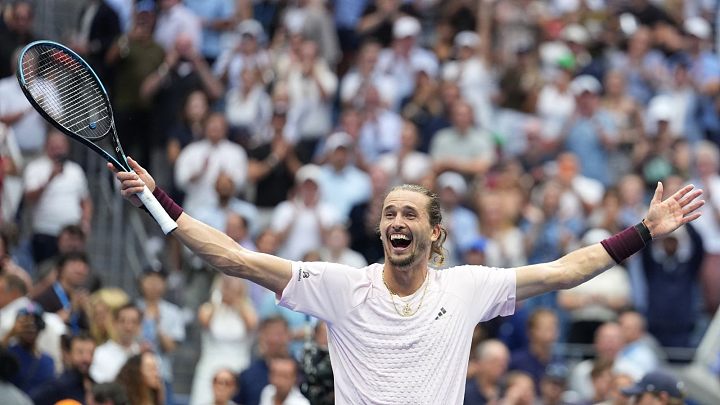
Alexander Zverev had just won the US Open, the second Grand Slam title of a remarkable 2026 season, when he chose to talk about something much bigger than tennis. During his victory speech at Arthur Ashe Stadium on Septe
Por Swati Chaturvedi··25K lecturas
Alexander Zverev’s Mother Refused To Let Diabetes Define His Future: A Lesson For Parents
Alexander Zverev had just won the US Open, the second Grand Slam title of a remarkable 2026 season, when he chose to talk about something much bigger than tennis. During his victory speech at Arthur Ashe Stadium on September 13, the German tennis star turned his attention to his mother, Irina, and to a moment from his childhood that could easily have shaped the course of his life.
Zverev was four years old when he was diagnosed with type 1 diabetes. According to the tennis star, doctors told his family that his life and his ability to participate in sport could be severely limited.
His mother refused to accept that as a prediction of her son’s future. “When your 4-year-old son gets diagnosed with diabetes and doctors in the office tell you that life and sports will be very limited for that child, it takes a very, very strong mother to walk out of those offices and say, ‘My son will be whatever he wants to be,’” Zverev said during his speech.
“If he wants to be a tennis player, he’ll be a tennis player. If he wants to do something else, he’ll do something else, but this illness will not define us.”
Those words were perhaps the most poignant part of a night that was otherwise about sporting history. Zverev defeated American Ben Shelton 6-3, 7-6(2), 5-7, 6-2 to claim his first US Open title and his second Grand Slam of 2026, having won the French Open earlier this year.
But his tribute to his mother offers a lesson that extends well beyond tennis, particularly for parents raising children with diabetes or another long-term health condition.
A diagnosis is not a child’s identity
When a child receives a medical diagnosis, it can be tempting for adults to reorganise their entire understanding of that child around it.
There are appointments to manage, medication schedules to remember, symptoms to watch, precautions to take and new rules to learn. Understandably, health can begin to occupy a huge amount of family life.
But there is a crucial difference between caring for a child’s condition and allowing that condition to become the story of who they are.
That distinction sits at the heart of Zverev’s tribute. His mother’s message was not that diabetes did not matter. It was that diabetes did not get to decide what her son was allowed to dream about.
A child can have diabetes and still want to become a sportsperson. They can have asthma and want to dance. They can live with a chronic condition and want to travel, perform, compete, create, make friends or simply do all the ordinary things their peers are doing.
The diagnosis may change the way they do some of those things. It does not necessarily have to determine which things they are allowed to imagine.
The difference between protection and limitation
For parents, this can be one of the hardest balances to find. When a child has a health condition, caution is natural. Parents want to prevent complications, avoid unnecessary risks and protect their child from situations that could become dangerous.
But protection and limitation are not always the same thing. Zverev’s childhood story illustrates the value of asking: “How can we make this possible safely?” rather than “Is this possible at all?”
For children with type 1 diabetes, for example, sport is possible, but it requires planning. Exercise can affect blood glucose levels, and children may need individual guidance around insulin, food, glucose monitoring and activity. Those decisions should be made with the child’s diabetes care team rather than based on assumptions about what they can or cannot do.
The important psychological message, however, can remain simple: the need to manage a condition does not mean a child has to shrink their ambitions.
Let children be children not just patients
One of the most powerful things a parent can give a child with a health condition is an identity that extends beyond their medical care. They are not just “the child with diabetes”.
They are the child who loves football. The one who spends hours drawing. The one who wants to be a singer. The one who is obsessed with dinosaurs. The one who is brilliant at maths. The one who makes everyone laugh.
Those identities matter. Medical routines can become a significant part of childhood, but they should ideally exist alongside school, friendships, hobbies, play, curiosity and independence, not replace them.
For parents, that can mean making space for the child to talk about things other than their condition. It can mean encouraging hobbies while working out the necessary safety arrangements. And, as children grow older, it can mean gradually giving them age-appropriate responsibility for their own care rather than allowing the illness to become something that adults permanently manage for them.
Don’t turn achievement into proof that the illness was “overcome”
There is another important lesson in Zverev’s story. It would be easy to look at a two-time Grand Slam champion who was diagnosed with type 1 diabetes at four and frame the story as: he overcame his illness and became a champion anyway.
But that is not necessarily the healthiest message for every child. A child living with a health condition does not need to win a Grand Slam, become an Olympian or achieve something extraordinary to prove that their diagnosis has not limited them.
Success can be much smaller and much more personal. It might be a child confidently joining a school sports day. Going on a sleepover. Learning how to manage part of their routine independently. Trying something they were initially frightened of. Making a new friend. Finding an activity they love.
The goal is not to create a child who feels pressure to become exceptional despite their condition.
The goal is to help them believe they are allowed to build a meaningful life with it.
“You can still dream” is different from “you must prove everyone wrong”
There is a subtle but important distinction in the message Zverev attributed to his mother.
She did not, as he tells it, insist that he had to become a professional tennis player.
She told him that if he wanted to become one, he could pursue it. That difference matters.
Parents of children with health conditions can sometimes swing between two extremes: becoming so protective that a child stops taking healthy risks, or becoming so determined to prove that the condition will not hold their child back that the child feels pressure to constantly overcome it.
Neither is necessary. A better message is closer to what Zverev remembers hearing from his mother: Your condition is something we will learn to manage. It is not a verdict on what your life can look like.
Independence is part of the journey
As children grow, that message can evolve. A four-year-old needs adults to manage almost everything. A teenager may gradually learn to recognise symptoms, understand their medication, communicate their needs and make informed decisions about their activities.
That process can be difficult for parents because letting go can feel frightening. But independence is not the opposite of protection. It is one of the ways protection evolves. The long-term aim is not for a parent to stand between a child and every possible risk. It is to help the child acquire the knowledge, confidence and support system to navigate the world safely.
That can be especially important for children who grow up feeling that adults are constantly monitoring their health. They need to know that their parents trust them too.
Zverev’s real victory was bigger than a trophy
Zverev’s US Open victory will be remembered in tennis history. He won his first title in New York after coming painfully close in 2020, when he led Dominic Thiem by two sets and served for the championship before eventually losing. His 2026 season has now produced two major titles, following his French Open triumph.
But the most moving part of his victory speech had little to do with the trophies.
It was his recognition of the woman who, years earlier, refused to let a diagnosis become a prophecy. Zverev called his mother “the most important and strongest person” he knows, saying that it took an “unbelievably strong woman” to do what she did.
And perhaps that is the lesson worth carrying beyond the tennis court. For parents raising children with chronic illnesses or other health conditions, the goal is not to pretend the condition doesn’t exist. It is to make sure the child knows that they exist beyond the condition.
There will be difficult days. There will be medical appointments, adjustments, disappointments and things that require extra planning. But there should also be dreams.
There should be sport, music, friendships, adventures, ambitions and the freedom to change one’s mind about what comes next. Because a diagnosis may become part of a child’s story. It does not have to become the title of it.