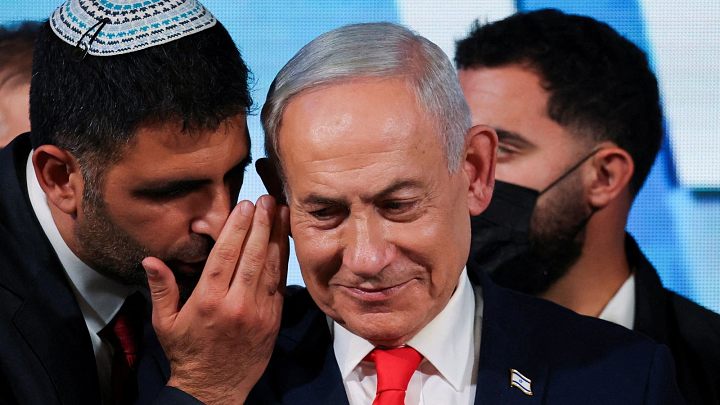
Netanyahu’s Bloc Falls Short Of Majority In Israel Elections, Arab Parties Emerge As Kingmakers
Israeli Prime Minister Benjamin Netanyahu’s right-wing bloc has fallen short of a parliamentary majority despite a strong showing among Jewish voters, leaving the country facing uncertainty over who will form its next go
লেখক Prisha Vibhavari··47K বার পড়া
Netanyahu’s Bloc Falls Short Of Majority In Israel Elections, Arab Parties Emerge As Kingmakers
Israeli Prime Minister Benjamin Netanyahu’s right-wing bloc has fallen short of a parliamentary majority despite a strong showing among Jewish voters, leaving the country facing uncertainty over who will form its next government after a closely fought election.
With more than 85% of ballots counted following Tuesday’s vote, Netanyahu’s alliance was projected to secure 53 seats in the 120-member Knesset, below the 61 needed for a majority.
The opposition camp led by former military chief Gadi Eisenkot was projected to win 48 seats, leaving neither side with a clear path to power.
The outcome puts Israeli Arab parties in a potentially decisive position, with their representation expected to rise to 19 seats. Both Netanyahu, Israel’s longest-serving prime minister, and Eisenkot have indicated they will attempt to form the next government.
President Isaac Herzog, who must choose the candidate tasked with forming a government, appealed to political parties to explore possible arrangements rather than push the country towards another election.
“We must do everything we can, certainly after yesterday, to avoid another round of elections,” Herzog said on Wednesday, urging parties to keep “an open mind”.
Also Read: Vote-Buying, Threats: Netanyahu’s Likud Claims Poll Was ‘Stolen’ By Arab Parties, Demands Probe
Arab Parties Emerge As Potential Kingmakers
The gains made by Israeli Arab parties could prove significant in negotiations, although their willingness to support an opposition-led government remains uncertain.
Yousef Jabareen, head of the leftist Arab-majority Joint List, said voters had signalled a desire for a change in leadership and challenged Netanyahu’s opponents to engage with his alliance.
“Anyone who wants to offer a substantive and genuine alternative to Netanyahu’s blood-soaked government will have to talk to us,” he added.
Jabareen later told AFP that he was prepared to cooperate with an opposition-led administration to remove Netanyahu from power, but ruled out joining a governing coalition under the prevailing circumstances.
“We do not see the possibility of being part of an Israeli government coalition under the current political circumstances, particularly given the ongoing war in Gaza, the settlements in the West Bank” and other issues, he said.
An arrangement in which Arab lawmakers provide support from outside a coalition could potentially help Eisenkot’s camp sustain a minority government. However, doubts remain over whether such a government would be stable enough to last.
Netanyahu repeatedly warned during the campaign about the prospect of Arab parties gaining influence.
Also Read: ‘If Netanyahu Is Defeated’: What Israel’s Election Could Mean For India, US And West Asia
His Likud party subsequently accused Arab lists of having “stolen” the election, alleging “corruption, threats, violence, falsehoods and the use of prohibited software” to boost turnout. The party did not provide evidence publicly but said it would submit it to the authorities.
Opposition Divided Over Cooperation With Arab Lawmakers
Although Arab parties could hold the balance in government formation, sections of the opposition have been reluctant to work with them.
Yair Golan, leader of Israel’s main left-wing party and an ally of Eisenkot, broke ranks with that position by calling for cooperation with Arab lawmakers.
“We must no longer accept Netanyahu’s racist division between Jewish votes and Arab votes,” Golan said on social media.
Political scientist Gideon Rahat of the Hebrew University of Jerusalem said the election may have left most political camps without a clear route to power, despite the gains made by Arab parties.
“Maybe everybody lost in these elections but the Arab parties. And for the Arab parties, it’s unclear that they can make use of their huge success,” Rahat said.
Netanyahu To Remain Caretaker Prime Minister
The absence of a clear majority could trigger prolonged negotiations, with another election possible if parties fail to agree on a governing arrangement. Until a new administration is formed, Netanyahu would remain caretaker prime minister.
The political deadlock comes amid heightened tensions involving Iran, with both Netanyahu and Eisenkot addressing the possibility of further military action.
Herzog Faces Key Decision On Next Government
Attention now turns to Herzog, who will have to decide whom to nominate to form a government. A unity administration has reportedly been among the options he supports, and the prospect could gain importance if tensions with Iran escalate.
However, Eisenkot has publicly ruled out serving in a government alongside Netanyahu, complicating efforts to establish a broad coalition.
With neither bloc currently projected to command a majority, the next phase of negotiations could determine whether Netanyahu retains power through a new political arrangement or Israel heads towards another election.