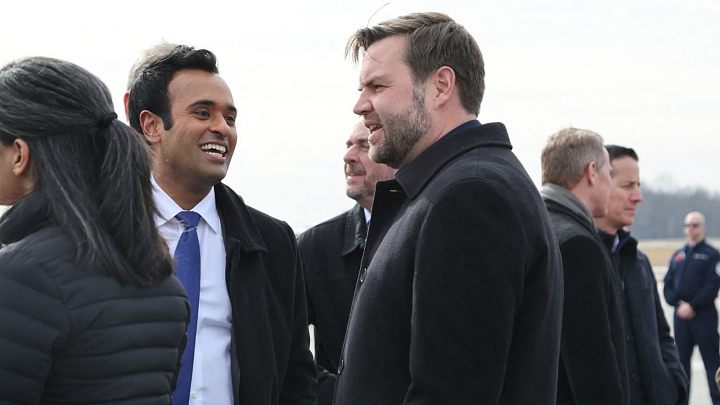
Midterm Fallout: Why Vivek Ramaswamy's Loss In Ohio May Be Bad News For JD Vance In 2028
Vivek Ramaswamy entered the Ohio governor’s race with several advantages: President Donald Trump’s endorsement, the backing of a powerful Republican network and millions of dollars of his own money to spend on the campai
লেখক Apoorva Misra··32K বার পড়া
Midterm Fallout: Why Vivek Ramaswamy's Loss In Ohio May Be Bad News For JD Vance In 2028
Vivek Ramaswamy entered the Ohio governor’s race with several advantages: President Donald Trump’s endorsement, the backing of a powerful Republican network and millions of dollars of his own money to spend on the campaign. Yet, none of it was enough on Wednesday to prevent Democrat Amy Acton from pulling off a victory in a state Trump won comfortably in 2024.
The defeat is a setback for Republicans in a state that has become an important part of their electoral map. But its implications could extend beyond Ramaswamy and the party’s immediate midterm losses. Among those with a stake in the outcome is Vice-President JD Vance, who had campaigned for his close friend, defended his controversial campaign tactics and effectively put his own political influence on display in his home state.
With Vance widely viewed as a potential Republican presidential contender in 2028, Ramaswamy’s defeat raises an uncomfortable question: if the political formula they share could not deliver Ohio, what does that say about Vance’s own path to the White House?
Vance Tied His Political Fortunes To Ramaswamy
Ohio was an important political test for Vance. The state is his political home, and he represented it in the US Senate before resigning after being elected vice-president. He returned repeatedly during the campaign to rally support for Ramaswamy and Republican Senator Jon Husted.
ALSO READ | Vivek Ramaswamy, An Ad, Sexual Assault & Mental Health: The $4-Million Campaign Explained
Vance’s support was not limited to campaign appearances. When Ramaswamy’s advertisement featuring Acton’s estranged mother drew criticism from Republicans as well as Democrats, Vance publicly defended the candidate. He praised Ramaswamy for having the “audacity” to run the advertisement and said he was “disgusted” with Republicans who were criticising it rather than focusing on defeating Democrats.
The advertisement became a major controversy in the campaign. It featured Acton’s mother calling her daughter a liar and questioning her account of her childhood. Acton and her brother had spoken about abuse by their stepfather, who was charged with raping her when she was a child. The advertisement drew condemnation from several Republicans, including Ohio Governor Mike DeWine and Husted, who said he would not have run it.
By standing firmly behind Ramaswamy, Vance made the controversy a test of his own political judgement. Acton’s victory does not establish that the advertisement alone cost Ramaswamy the election, but the episode exposed divisions within the Republican camp and gave Democrats an opportunity to question the party’s campaign strategy.
Ohio’s Double Setback For Vance
The gubernatorial result was not the only blow to Republicans in Vance’s home state. Democrat Sherrod Brown also defeated Republican Jon Husted in the Senate race, reclaiming the seat that Vance had vacated after becoming vice-president.
ALSO READ | Inside Trump’s Succession Battle: Why JD Vance Vs Marco Rubio Divide Is Not About Personalities
Husted had been appointed to replace Vance in 2025. His defeat means that both the Republican candidates who were central to the Ohio contest, Ramaswamy and Husted, failed to win their races.
That is politically significant for Vance. He had campaigned for both men, and the state was a crucial test of whether the Republican coalition that helped Trump win Ohio in 2024 could be mobilised again in a midterm election.
Trump carried Ohio by more than 11 percentage points in 2024. Acton’s victory, alongside Brown’s Senate comeback, suggests that Democrats were able to make gains in a state that has increasingly leaned Republican.
The 2028 Question: Can Vance Replicate Trump’s Politics?
Vance is widely seen as a potential Republican presidential contender in 2028, although he has not formally declared his intentions. His political identity is closely linked to Trump’s movement, and his role as one of the administration’s most prominent defenders has helped raise his national profile.
But the Ohio results highlight a potential challenge: the political approach that works for Trump may not necessarily work as effectively for other Republican figures.
Trump has built a distinctive political following over several election cycles. Vance, despite his national profile, will have to establish that he can attract voters beyond the core MAGA base and build a coalition of his own.
The Ohio campaign also raises questions about whether aggressive, highly personalised political attacks can help Republican candidates win over voters who are more concerned about affordability, healthcare and everyday economic pressures. Acton campaigned heavily on these issues, while Ramaswamy’s wealth and the scale of spending by his campaign and allies became part of the Democratic attack.
Setback, Not The End Of Vance’s 2028 Ambitions
There is, however, a limit to what can be read into one state’s midterm results. A gubernatorial contest is not a presidential election, and Vance was not himself on the ballot. Ohio’s political dynamics, candidate profiles and local issues also shaped the outcome.
Moreover, Vance remains vice-president and has considerable time to build his national standing before the next presidential election.
But the results leave him with uncomfortable questions. His preferred candidate lost despite Trump’s endorsement, substantial campaign spending and high-profile Republican support. His defence of Ramaswamy’s controversial advertisement also ties him to a campaign strategy that drew criticism from within his own party.
For a politician who could seek to inherit Trump’s political coalition in 2028, the Ohio results are therefore more than a setback for a friend. They are an early warning that loyalty to Trump’s style of politics may not, by itself, be enough to deliver victories.