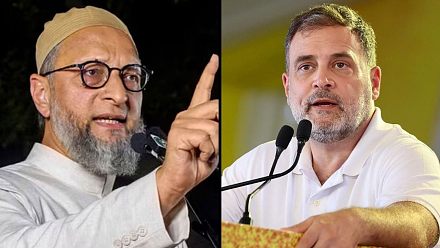
'Owaisi May Win 4-5 Seats But...' Why Congress Is Wary Of AIMIM's Alliance Offer For UP Elections
AIMIM chief Asaduddin Owaisi’s offer to join hands with “like-minded” parties in Uttar Pradesh ahead of the 2027 assembly elections has put the Congress in a familiar political dilemma—whether bringing AIMIM into an oppo
লেখক Apoorva Misra··175K বার পড়া
'Owaisi May Win 4-5 Seats But...' Why Congress Is Wary Of AIMIM's Alliance Offer For UP Elections
AIMIM chief Asaduddin Owaisi’s offer to join hands with “like-minded” parties in Uttar Pradesh ahead of the 2027 assembly elections has put the Congress in a familiar political dilemma—whether bringing AIMIM into an opposition arrangement would help consolidate anti-BJP votes or create a new set of electoral and political complications.
Congress MP Imran Masood has now made the party’s concern more explicit, arguing that the primary objective should be defeating the Bharatiya Janata Party (BJP) and warning that AIMIM could win a handful of seats while potentially affecting the larger contest.
“Defeating the BJP is the primary objective and Muslims alone cannot defeat the BJP,” Masood said. He added that Owaisi might win “4-5 seats”, but questioned what that would achieve if his presence ultimately facilitated the formation of a BJP government.
“The political atmosphere in Hyderabad is different from that in Uttar Pradesh,” Masood said, arguing that electoral calculations in Owaisi’s home turf cannot simply be applied to UP.
Owaisi, meanwhile, has opened the door to joining hands with the Opposition in UP and said AIMIM would decide on possible alliances by October 2. He has called on parties seeking to stop the BJP from forming another government in the state to join hands with AIMIM.
That puts Congress and the Samajwadi Party in a complicated position.
The Muslim Vote Is Central To The Equation
For the Congress, one of the biggest issues is that AIMIM is not simply another small regional party. Owaisi has built his politics around representing Muslim interests, making the party a potential competitor in a constituency that both Congress and SP are seeking to consolidate.
The SP has traditionally relied heavily on its Muslim-Yadav social coalition in UP, while Congress has been attempting to rebuild its independent support base in the state. The two parties fought the 2024 Lok Sabha election together and remain opposition partners, but they are also competing to expand their individual organisational and social bases ahead of the assembly election.
The situation now seems to be a “Catch-22” for the Opposition—accepting AIMIM could allow Owaisi to strengthen his independent political base, while rejecting an alliance could leave the opposition vote fragmented in constituencies where AIMIM contests.
For Congress, therefore, the question is not simply whether AIMIM can win seats. It is also about who controls the political space among Muslim voters and whether an alliance would strengthen or dilute the party’s own outreach.
Why The BJP Factor Complicates An Alliance
Congress leaders are also conscious of the possibility that an AIMIM alliance could become a political weapon for the BJP.
If AIMIM contests independently in closely fought constituencies, opposition leaders worry about fragmentation of votes. But if Congress or SP formally allies with Owaisi, the BJP could attack the arrangement as evidence of minority-oriented politics and use Owaisi’s presence to sharpen its campaign against the opposition.
Opposition parties face two competing concerns: AIMIM’s presence could divide anti-BJP votes, while an alliance with Owaisi could give the BJP an opportunity to push a counter-polarisation narrative.
This is particularly relevant for Congress because the party is trying to position itself as a broad-based opposition force rather than ceding minority politics entirely to AIMIM.
AIMIM’s UP Record Adds Another Layer
Owaisi’s offer comes despite AIMIM’s limited electoral success in Uttar Pradesh so far. The party failed to win a single seat in the 2022 assembly election, although it has since been reorganising its state unit and attempting a more expansive campaign for 2027.
AIMIM has also signalled that it intends to contest beyond a handful of constituencies. Its UP leadership has spoken about a substantially larger electoral footprint, while the party has kept the possibility of an understanding with other parties open.
That is significant for Congress and SP because even a party without a large state-wide vote share can affect individual constituencies if its support is concentrated.
The recent defection of AIMIM’s prominent UP face and national spokesperson Syed Asim Waqar to Congress has further underlined the contest between the two parties for political space in the state. Waqar, after joining Congress, said opposition parties should focus on defeating the BJP rather than fighting each other and accused AIMIM of weakening opposition unity.
The Telangana Example
Owaisi’s relationship with Congress also varies sharply depending on the state.
In Telangana, AIMIM and Congress remain political rivals, but their relationship has recently acquired a tactical dimension. Telangana Chief Minister Revanth Reddy and Owaisi have appeared together publicly, with Owaisi saying AIMIM was supporting Reddy rather than the Congress as a party. Reddy, in turn, publicly praised Owaisi.
The Telangana equation demonstrates that political interactions between Congress and AIMIM can be shaped by local electoral calculations rather than a fixed national template.
But UP is a different political battlefield. Here, the SP is already a major opposition force, Congress is trying to strengthen its own organisation and AIMIM is attempting to establish itself as another pole of Muslim representation.
What Owaisi Wants From An Alliance
Owaisi has not presented the alliance offer simply as an electoral arrangement. His pitch is that opposition parties need to work together if they want to prevent another BJP government in UP.
He has simultaneously criticised both the BJP and SP, arguing that successive governments have failed to adequately address issues affecting Muslims. He has also demanded greater political representation for the community.
For AIMIM, an alliance could therefore provide access to constituencies and an established electoral network while giving Owaisi a larger role in UP’s opposition politics.
For Congress, however, there is a strategic question: Would bringing AIMIM into the opposition fold consolidate anti-BJP votes, or would it allow Owaisi to build a stronger independent political base at Congress’s expense?
Masood’s remarks suggest where at least some Congress voices see the immediate risk. “Since the BJP would form the government, people need to act sensibly. People must make decisions wisely and astutely,” he said, arguing that the larger objective should remain defeating the BJP.
With Owaisi’s October 2 deadline approaching, the question for Congress and its opposition partners is likely to be less about whether AIMIM can win a large number of seats and more about how its presence could reshape contests across the constituencies where the anti-BJP vote is already being contested by multiple parties.