From Persian Carpets To Trade, Pezeshkian’s Daughter Zahra Explores India-Iran Handicraft Ties At BRICS Bazaar
When Zahra Pezeshkian, daughter of Iranian President Masoud Pezeshkian, visited the BRICS Bazaar in New Delhi with her husband Hassan Majidi, the stop offered a quieter window into the India-Iran relationship — one built
লেখক News Desk··81K বার পড়া
From Persian Carpets To Trade, Pezeshkian’s Daughter Zahra Explores India-Iran Handicraft Ties At BRICS Bazaar
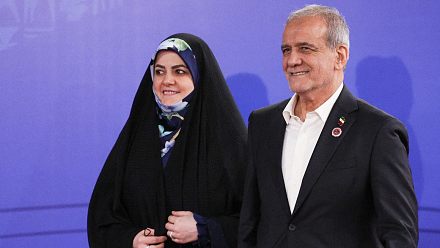
When Zahra Pezeshkian, daughter of Iranian President Masoud Pezeshkian, visited the BRICS Bazaar in New Delhi with her husband Hassan Majidi, the stop offered a quieter window into the India-Iran relationship — one built not only around diplomacy, energy and strategic connectivity, but also around centuries-old craft traditions.
BRICS Summit 2026 LIVE
Pezeshkian and Majidi toured the bazaar at the National Crafts Museum and Hastkala Academy, where artisans from BRICS countries are showcasing traditional art, handicrafts and cultural heritage. They were accompanied by Union Minister for Women and Child Development Annapurna Devi.
Daughter of Iranian President Masoud Pezeshkian, Zahra Pezeshkian, along with her husband Hassan Majidi, visited the BRICS Bazaar at the National Crafts Museum in New Delhi, exploring the rich art, crafts and cultural heritage showcased by BRICS member and partner countries. pic.twitter.com/qDcLZg4XCN— Iran in India (@Iran_in_India) September 12, 2026
The bazaar, being held from September 10 to 15, brings together artisans and craft traditions from across the expanded BRICS grouping. Among the exhibits are South African beadwork and Russia’s Fedoskino (lacquer) miniature painting tradition, highlighting how handicrafts are being used as a form of cultural exchange alongside the formal diplomacy of the summit.
From Persian Carpets To Metalwork, Iran’s Craft Heritage
Iran’s presence at the bazaar also brings attention to a craft tradition that stretches across centuries. Persian carpets are perhaps the country’s best-known handicraft abroad, but Iran’s craft landscape extends to intricate metal engraving, woven products, woodwork, embroidery and other forms of decorative art.
Iran exports handicrafts worth about $400 million a year, according to figures cited by TV BRICS. Woven handicrafts, engraved metalwork, wooden products and leather embroidery are among the products finding markets, particularly in neighbouring countries. Iran’s handicraft sector has also received greater government support, with budget allocations for the sector increasing sharply in 2025. The country’s licensing system has registered about 570,000 craftsmen across 300 fields of art.
The BRICS Bazaar therefore becomes more than a display of traditional objects. For countries such as India and Iran, crafts also represent a potential bridge between cultural diplomacy, tourism, small businesses and international trade.
India-Iran Handicrafts And Trade
There is already a commercial link between Indian handicrafts and the Iranian market. India has traditionally exported handicrafts and cottage-industry products to Iran, alongside commodities such as textiles and other goods. Official Indian trade documentation lists handicrafts among products available for export to Iran.
The potential is significant because both countries have large artisan communities and consumers with a strong cultural affinity for handmade products. Indian handicraft exports, excluding hand-knotted carpets, reached Rs 33,122.79 crore ($3.72 billion) in FY2024-25, according to data cited by the India Brand Equity Foundation. Woodware, embroidered and crocheted goods, art metalware and hand-printed textiles were among the major export categories.
India’s handicraft economy is also moving beyond traditional physical marketplaces. Digital platforms, e-commerce and improved logistics are allowing artisans and small businesses to reach buyers outside their immediate markets. India had an estimated 64.66 lakh handloom and handicraft artisans as of August 2025, with women accounting for a significant share of the workforce.
For India and Iran, that digital shift could create new avenues for craft exports, particularly as both countries look for ways to expand trade despite geopolitical and financial constraints.
Beyond Trade, A Form Of Soft Diplomacy
The timing of the bazaar is significant. India and Iran are seeking to deepen their economic relationship even as the wider region faces conflict and disruptions to trade routes. Prime Minister Narendra Modi and Pezeshkian met in New Delhi on Friday, with discussions covering bilateral ties, regional developments, navigation, commerce and the safety of seafarers.
Pezeshkian’s visit to the crafts bazaar offered a different setting from those high-level discussions. Instead of trade corridors and geopolitical calculations, the focus was on textiles, artwork, artisans and cultural memory.
That is also where handicrafts can acquire a larger diplomatic role. A carpet, a piece of engraved metalwork or a handwoven textile can travel across borders as a commercial product, but it also carries the history and identity of the community that produced it.