‘Babar Vs Bajrangbali’ To Be Uttar Pradesh's Key Political Theme Ahead Of 2027 Assembly Elections?
Chief Minister Yogi Adityanath’s latest remark in Meerut, where he said “Babar’s followers” would be answered by “devotees of Bajrangbali”, has brought the Bharatiya Janata Party’s (BJP) ideological narrative back to the
লেখক Oliver Fredrick··180K বার পড়া
‘Babar Vs Bajrangbali’ To Be Uttar Pradesh's Key Political Theme Ahead Of 2027 Assembly Elections?
Chief Minister Yogi Adityanath’s latest remark in Meerut, where he said “Babar’s followers” would be answered by “devotees of Bajrangbali”, has brought the Bharatiya Janata Party’s (BJP) ideological narrative back to the centre of the state’s emerging election discourse.
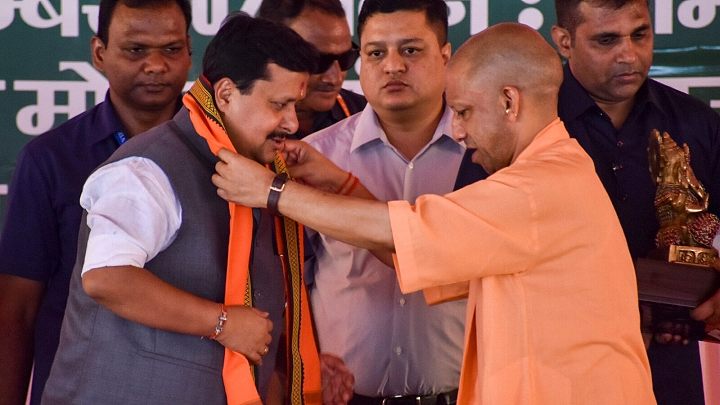
The remark came at a BJP programme attended by party president Nitin Nabin, who simultaneously projected the Yogi government’s development record and said Uttar Pradesh had moved towards becoming an “Uttam Pradesh”.
The juxtaposition of the two speeches is significant: while the BJP leadership is highlighting governance and development, Yogi’s political messaging continues to place cultural identity and Hindutva at the heart of the party’s narrative.
Yogi, in his address at the BJP’s Shakti Kendra Sanyojak Sammelan (West Region) in Meerut on Monday, while referring to historical invaders including Mahmud of Ghazni, Muhammad Ghori, Ibrahim Lodi, Babar and Aurangzeb, said attempts had been made to equate India’s cultural traditions with those figures. He said that “Babar’s followers” could be answered by the devotees of Bajrangbali.
2027 UP ELECTIONS
For the BJP, the timing is important. The 2027 Uttar Pradesh Assembly election is approaching, and the party has already begun strengthening its organisational machinery and outreach across the state. The Meerut programme therefore combined political messaging with organisational mobilisation.
Political analyst Dr Shashikant Pandey, Head of the Department of Political Science at Dr Bhimrao Ambedkar University, Lucknow, said Yogi’s political appeal has become an important component of the BJP’s strategy in Uttar Pradesh.
“Yogi Adityanath has developed a distinct political identity in Uttar Pradesh, and his appeal is an important part of the BJP’s electoral communication in the state. His speeches often combine governance with cultural and ideological themes,” Pandey said.
According to Pandey, however, the 2027 election will not be determined by ideological messaging alone. The BJP will also have to work on social coalition-building, organisation, candidate selection and local-level issues.
“The political contest in Uttar Pradesh will involve multiple factors. Identity politics is one component, but caste representation, welfare delivery, local leadership, employment and the performance of the government will also influence the political debate,” Pandey said.
BJP’S CHALLENGE
The BJP’s challenge is particularly relevant after the 2024 Lok Sabha election in Uttar Pradesh, when the party won 33 of the state’s 80 seats. The Samajwadi Party won 37 seats and the Congress six. The result forced the BJP to reassess aspects of its electoral strategy in the state.
The opposition’s success was accompanied by the expansion of the Samajwadi Party’s PDA — PDA referring to the party’s political formulation involving backward classes, Dalits and minorities. The BJP has subsequently focused on strengthening its outreach among different social groups while retaining its core support base.
The 2027 contest is therefore likely to involve competing narratives. The BJP can point to the Yogi government’s governance and development record, while the opposition is expected to focus on social representation, welfare, employment and questions concerning different sections of the electorate.
NABIN AND YOGI
Nabin’s role in the latest programme is also significant. As the BJP’s national president, his presence highlights the importance the party is attaching to Uttar Pradesh. His praise of Yogi and the “Uttam Pradesh” formulation places the government’s performance within the BJP’s larger organisational campaign.
The party’s emphasis on grassroots mobilisation has also increased. Booth-level workers, Shakti Kendras, mandals and district organisations are expected to become increasingly important as the election approaches.
For Yogi, meanwhile, the Meerut speech indicates that ideological mobilisation remains an important element of his political communication. The invocation of Babar and Bajrangbali brings the BJP’s cultural-nationalist narrative directly into the early 2027 discourse.
Pandey said the significance of such statements would ultimately have to be assessed alongside the BJP’s broader campaign.
“The important question will be how different elements of the BJP’s campaign are integrated. The party will have to communicate its governance record while also maintaining its ideological identity and expanding its social reach,” he said.
Meerut is particularly significant because western Uttar Pradesh has historically witnessed competitive electoral battles and complex social alignments. The region will again be closely watched as political parties begin consolidating their respective voter coalitions.
The emerging picture, therefore, is not of a single-issue election but of a contest in which multiple narratives are likely to overlap. The BJP is projecting development, governance and Yogi’s leadership while simultaneously reinforcing its ideological vocabulary. The opposition parties are likely to counter this with their own emphasis on social coalitions, representation, welfare and governance.
With the 2027 Assembly election still ahead, the Meerut speeches offer an early indication of how the BJP may frame the political debate. ‘Uttam Pradesh’ represents the governance narrative; ‘Babar versus Bajrangbali’ represents the ideological one. The eventual political contest will unfold around how these narratives, along with caste, welfare, employment, leadership and local issues, resonate with voters across Uttar Pradesh.