A New Diplomatic Bridge? Inside India's Quiet West Asia Peace Push At BRICS As Iran, UAE Meet
For a grouping that has struggled to find common ground on the West Asia conflict, an unexpected diplomatic moment unfolded in New Delhi on Saturday.
লেখক Apoorva Misra··147K বার পড়া
A New Diplomatic Bridge? Inside India's Quiet West Asia Peace Push At BRICS As Iran, UAE Meet
For a grouping that has struggled to find common ground on the West Asia conflict, an unexpected diplomatic moment unfolded in New Delhi on Saturday.
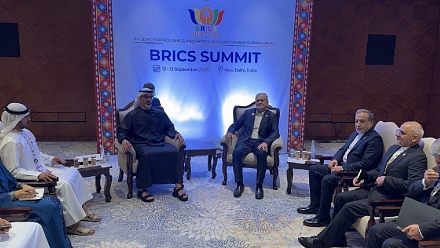
UAE Crown Prince Sheikh Khaled bin Mohamed bin Zayed Al Nahyan met Iranian President Masoud Pezeshkian on the sidelines of the BRICS Summit, with the two sides discussing regional and international issues, de-escalation, stability and efforts towards regional peace and development.
The meeting is significant because it brings together senior leadership from Iran and the UAE at a particularly sensitive moment in West Asia. Iran and the UAE have been on opposing sides of the ongoing conflict, with the war having also strained relations within BRICS itself. The UAE is represented at the New Delhi summit by Sheikh Khaled, while Iran is represented by Pezeshkian.
ALSO READ | New Delhi Declaration Unveiled: BRICS Unites On Pahalgam Terror Attack, UNSC Expansion & India-Led Digital Infra
And this is where India’s role becomes important.
Why The Iran-UAE Meeting Matters
Iran and the UAE are not just two countries caught up in a regional conflict. They are both members of BRICS, making their tensions an internal challenge for the grouping.
In fact, disagreements between Tehran and Abu Dhabi had already complicated attempts to arrive at a common BRICS position on West Asia. The bloc’s foreign ministers had failed to issue a joint statement earlier this year amid differences, with the Iran-UAE divide emerging as one of the sticking points.
The New Delhi summit therefore faced a basic diplomatic test: Could BRICS speak with one voice on a conflict that directly affects two of its own members?
India’s answer has been to push dialogue rather than allow the differences to paralyse the grouping.
The agreement on a joint declaration ahead of the leaders’ discussions was itself significant. India led consultations to bridge competing positions, with the eventual document expected to condemn unilateral aggression without directly naming countries.
The Iran-UAE meeting now adds another layer to that diplomatic effort.
PM Modi’s Message: Talk, Don’t Escalate
Prime Minister Narendra Modi has repeatedly used his meetings with leaders involved in the conflict to push the same basic message: disputes must be resolved through dialogue and diplomacy.
His meeting with Pezeshkian in New Delhi on Friday was particularly important. It was their second meeting in less than two weeks, following talks on the sidelines of the Shanghai Cooperation Organisation summit in Bishkek on August 31.
PM Modi told the Iranian president that India supports efforts towards lasting peace and stability in West Asia, while stressing the need to protect freedom of navigation, commerce and the safety of seafarers.
The maritime element is not incidental. The conflict has disrupted shipping and energy flows, with the Strait of Hormuz and other regional sea lanes becoming critical pressure points. For India, which depends heavily on the region for energy and has millions of citizens and major commercial interests connected to West Asia, instability has direct consequences.
That gives New Delhi a strong reason to push for de-escalation.
Why India Can Play This Role
India’s diplomatic advantage is that it maintains working relationships with countries that are often on opposite sides of global conflicts.
New Delhi has deep strategic and economic ties with the UAE and other Gulf states, while also maintaining longstanding relations with Iran. At the same time, India has close partnerships with the US, Russia and Israel. That gives India a degree of diplomatic access that many countries do not possess.
The challenge is to use that access without being seen as taking sides.
This is also why India’s language has been carefully calibrated. New Delhi has not positioned itself as a formal mediator between Iran and the US or between Iran and Arab countries. Instead, it has consistently advocated dialogue, diplomacy, de-escalation, protection of civilians and uninterrupted trade and navigation.
In other words, India’s pitch is less about brokering a grand peace deal and more about keeping diplomatic channels open.
BRICS Becomes India’s Diplomatic Stage
The timing is important because India is not merely hosting another summit. It is trying to demonstrate what an expanded BRICS can do when its members have sharply different geopolitical interests.
The grouping now includes Iran and the UAE alongside major powers such as China and Russia. That makes it a difficult diplomatic ecosystem, but also potentially a useful one.
India’s challenge has been to prevent BRICS from becoming paralysed by the very conflicts it is expected to discuss.
The fact that Tehran and Abu Dhabi could meet on the margins of the New Delhi summit is therefore symbolically important. It does not mean their differences have disappeared, nor does it signal an immediate breakthrough in the wider West Asia conflict. But it shows that BRICS can still provide a room where countries with competing interests can sit across the table.
And that is precisely the role India appears keen to cultivate for itself.
A Balancing Act
There is another important reason for New Delhi to push this diplomacy: India has too much at stake in West Asia to remain a passive observer.
The region is crucial for India’s energy security, trade routes, diaspora and remittances. Any prolonged disruption to shipping, oil supplies or regional commerce can quickly translate into higher costs for countries far beyond West Asia, including India.
That is why PM Modi’s message on freedom of navigation and maritime commerce sits alongside his broader call for peace.
India’s BRICS diplomacy, then, is less about claiming the mantle of a traditional mediator and more about establishing itself as a country capable of talking to all sides. For a summit taking place amid one of the world’s most dangerous conflicts, that may itself be an important diplomatic achievement.